
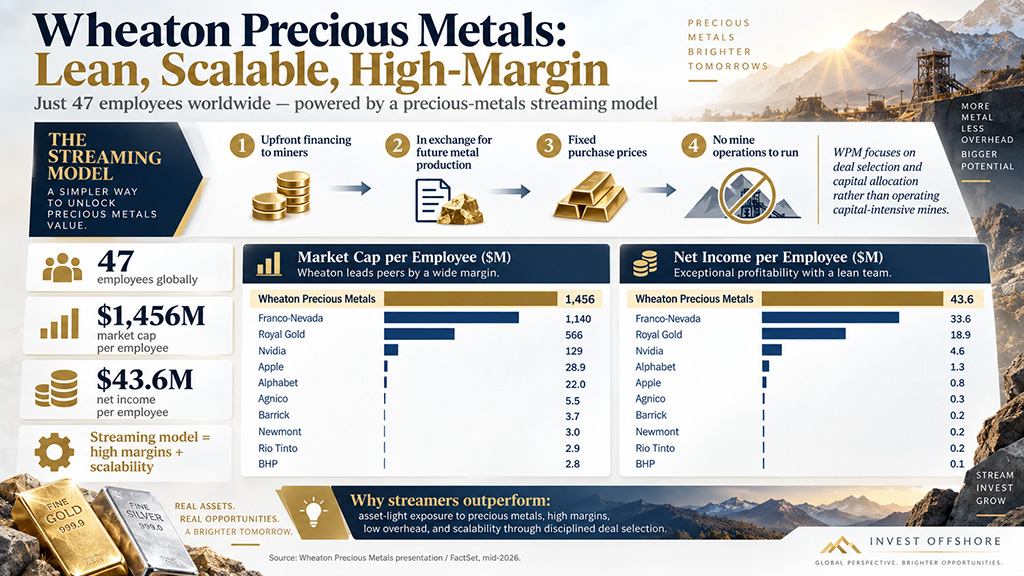
Wheaton Precious Metals has built one of the leanest large-cap business models in the global resources sector. With just 47 employees worldwide, the company demonstrates how precious-metals streaming can generate extraordinary scale without the enormous workforces, equipment fleets and operating infrastructure normally associated with mining.
The numbers in Wheaton Precious Metals’ latest presentation are striking.
As of mid-2026, Wheaton reported approximately $1.456 billion in market capitalization per employee and $43.6 million in net income per employee. Those figures put the company ahead not only of traditional miners, but also some of the most celebrated technology companies in the world.
The reason is not simply higher gold and silver prices.
It is the structure of the business itself.
Mining Without Operating the Mine
Wheaton Precious Metals is not a conventional mining company.
Rather than owning and operating mines, employing thousands of miners, purchasing fleets of haul trucks or constructing processing plants, Wheaton operates primarily through precious-metals streaming agreements.
The model is relatively straightforward.
Wheaton provides mining companies with a significant amount of capital upfront. In exchange, it receives the contractual right to purchase a percentage of future gold, silver or other metal production from those mines at predetermined prices.
The mining company remains responsible for developing and operating the project.
Wheaton provides the capital and participates in the future production.
That distinction radically changes the economics.
A traditional miner must contend directly with labor, fuel, explosives, equipment maintenance, construction overruns, sustaining capital, permitting and day-to-day mine management.
A streamer can concentrate instead on capital allocation, geology, due diligence, deal structuring and portfolio management.
That is why a company controlling exposure to billions of dollars of mineral production can operate with fewer employees than many small businesses.
$1.456 Billion of Market Value Per Employee
The attached Wheaton chart illustrates just how unusual this model has become.
On a market-capitalization-per-employee basis:
- Wheaton Precious Metals: $1,456 million
- Franco-Nevada: $1,140 million
- Royal Gold: $566 million
- Nvidia: $129 million
- Apple: $28.9 million
- Alphabet: $22.0 million
- Agnico Eagle: $5.5 million
- Barrick: $3.7 million
- Newmont: $3.0 million
- Rio Tinto: $2.9 million
- BHP: $2.8 million
The comparison is remarkable.
Even Nvidia — one of the defining companies of the artificial-intelligence era — sits far below Wheaton on this particular measure.
And compared with conventional mining companies, the gap becomes enormous.
Wheaton’s business model simply requires far fewer people to administer each dollar of underlying economic exposure.
$43.6 Million in Net Income Per Employee

The second half of the chart may be even more revealing.
Wheaton generated approximately $43.6 million of net income per employee, compared with:
Franco-Nevada at $33.6 million, Royal Gold at $18.9 million, Nvidia at $4.6 million, Alphabet at $1.3 million and Apple at $0.8 million.
Among major mining companies, the difference becomes greater still.
Agnico Eagle registered approximately $0.3 million in net income per employee, while Barrick, Newmont and Rio Tinto were around $0.2 million.
BHP stood at approximately $0.1 million.
This does not mean one company is automatically a better investment than another. Market capitalization per employee and income per employee measure operating structure, not valuation, future returns or investment risk.
But they vividly illustrate the economic leverage inherent in the streaming model.
The Asset-Light Side of the Mining Boom
Mining is fundamentally capital intensive.
Producing another million ounces of gold generally means discovering deposits, drilling them, completing engineering studies, permitting projects, building infrastructure and then operating mines for decades.
Streaming companies approach the same industry from another direction.
Their principal asset is capital.
When a producer needs several hundred million dollars to construct or expand a mine, a streaming company can supply part of that financing in exchange for decades of future metal production.
Once the agreement has been completed, the streamer’s incremental corporate overhead associated with receiving additional production can be comparatively small.
That creates tremendous scalability.
A 47-person organization can potentially add exposure to another major mine without adding thousands of employees.
It may require additional technical evaluation, legal work, financial analysis and portfolio oversight — but it does not require Wheaton itself to recruit an underground mining workforce.
Why Streamers Can Produce High Margins
The fundamental advantage is that many streaming contracts establish the streamer’s future purchase price for metal well in advance.
Suppose gold and silver prices rise substantially over the life of a mine.
The mining operator may benefit, but it can also face higher wages, fuel costs, equipment prices and sustaining-capital requirements.
The streamer can have a different economic profile because its contractual purchase terms may already have been established.
The difference between the contractual purchase price and the prevailing metal price can therefore create substantial operating margins.
This makes precious-metals streaming an unusual hybrid.
It combines elements of mining finance, commodity exposure and long-duration contractual cash flow.
And because multiple streams can be assembled into one portfolio, a streaming company can diversify its exposure across mines, operators, commodities and jurisdictions without physically operating those assets.
The Real Business Is Deal Selection
A streaming company’s greatest competitive advantage may therefore not be operational efficiency alone.
It is the ability to identify the right mines.
Every streaming deal requires judgments about geology, mine life, reserve quality, management, jurisdiction, expansion potential and future commodity prices.
A poorly structured stream on a troubled mine can still disappoint.
The model eliminates much of the operational burden, but it does not eliminate mining risk.
For Wheaton, the crucial work happens before the capital is deployed.
That makes the company’s small workforce more understandable.
Rather than operating mines, Wheaton’s team is effectively allocating capital across a global portfolio of mineral assets.
In that sense, the business resembles a specialized natural-resources investment platform more than a traditional mining corporation.
A Powerful Model for the New Precious-Metals Cycle
If the world is entering a prolonged period of greater demand for gold, silver and strategic minerals, the streaming model deserves particular attention.
Building new mines is becoming more expensive and more complex. Producers require enormous quantities of capital to develop resources, expand existing operations and bring dormant projects back into production.
That creates potential opportunities for companies capable of supplying financing.
And once a successful stream has been secured, the resulting production can continue for years — sometimes decades.
Wheaton’s 47-person global workforce therefore tells a much larger story.
This is a company that has separated ownership of commodity economics from ownership of mining operations.
The miners move the rock.
The streamers finance the opportunity.
And as Wheaton’s extraordinary market capitalization and net-income-per-employee figures demonstrate, that distinction can produce one of the most scalable business models anywhere in the natural-resources sector.
For offshore investors seeking exposure to precious metals, streaming companies offer a fascinating middle ground: participation in rising metal prices and mine development, without assuming the full operating footprint of a traditional mining company.
Chart source: Wheaton Precious Metals / FactSet. Net income based on the last twelve months through June 30, 2026; market capitalization and employee headcount as of September 2, 2026, according to the presentation.
Leave a Reply