
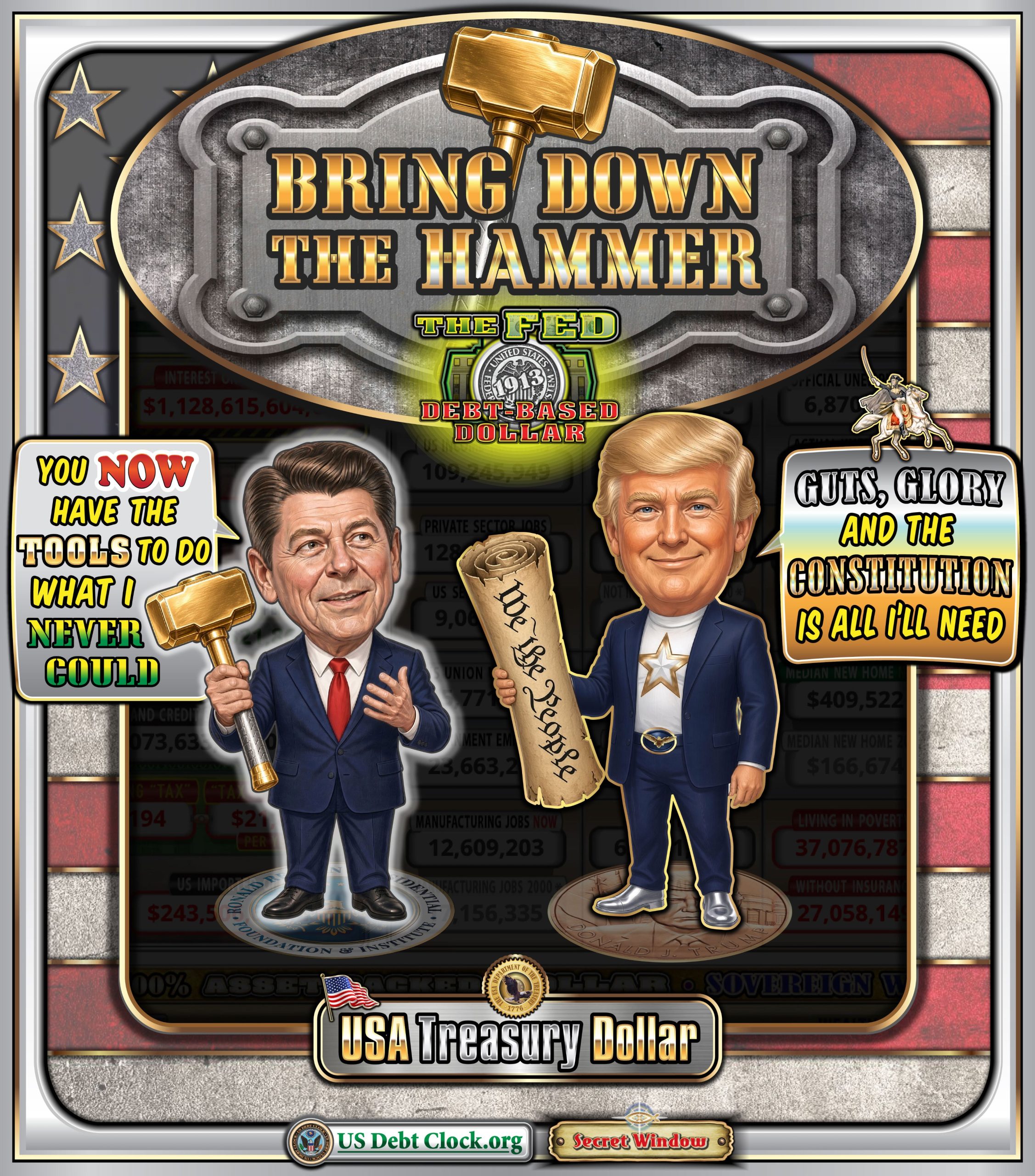
The US Debt Clock has released another “DJT” poster, and this one carries the force of a courtroom verdict.
The headline reads:
Bring Down the Hammer
Underneath it sits the familiar target:
The Fed Debt-Based Dollar — 1913
The image places DJT beside Ronald Reagan. Reagan holds a golden hammer. DJT holds a scroll of the Constitution. Below them appears the proposed replacement:
USA Treasury Dollar
The dialogue is direct. Reagan says:
“You now have the tools to do what I never could.”
DJT replies:
“Guts, glory and the Constitution is all I’ll need.”
That is the decode: the US Debt Clock is now framing the New Money Revolution as a constitutional action against the debt-dollar system born in 1913.
Why Reagan Appears
Reagan is not included here as decoration. He represents the modern American language of limited government, tax relief, free enterprise, and economic liberty.
The Reagan Foundation summarizes his economic policy as an effort to reduce regulation, lower taxes, promote free-market capitalism, and stimulate growth through individual wealth creation. Reagan Foundation
That fits perfectly with the Debt Clock’s recent themes: lower interest, lower taxes, state credit unions, household savings, asset-backed money, and a shift from debt dependency to ownership.
In this poster, Reagan is effectively handing off the hammer.
His message: the philosophy was there, but the tools were not.
The 1913 Target
The poster once again points to 1913, the year the Federal Reserve Act became law. Federal Reserve History states that President Woodrow Wilson signed the Federal Reserve Act on December 23, 1913, creating the modern Federal Reserve System. Federal Reserve History
For the US Debt Clock, 1913 has become the origin point of the debt-based dollar system it is attacking.
The current Federal Reserve note remains lawful money and legal tender. The Federal Reserve explains that Federal Reserve notes are obligations of the United States and are receivable for taxes, customs, and public dues. Federal Reserve
But the poster is not arguing about whether the current dollar is legally accepted. It is asking whether the current monetary architecture still serves the American people.
The Hammer Symbol
A hammer means judgment.
It can be a judge’s gavel.
It can be a builder’s tool.
It can be a weapon against corruption.
That triple meaning is important.
The Debt Clock is not merely saying “criticize the Fed.” It is saying: bring down legal, constitutional, and structural force on the old debt-money system.
The hammer is not chaos.
The hammer is authority.
That is why DJT holds the Constitution.
The poster is making the case that any monetary transformation must be grounded in American law, not just anger at the banking system.
From “GO Time” to “Bring Down the Hammer”
This poster follows the recent It’s GO Time message, which translated the New Money Revolution into household savings through lower-rate loans and state credit union models.
Now the message escalates again.
If It’s GO Time was the retail launch button, Bring Down the Hammer is the constitutional enforcement phase.
The sequence is clear:
Expose the old system.
Introduce the Treasury Dollar.
Show household savings.
Then bring down the hammer on the structure that blocks the transition.
The US Debt Clock is telling readers that the monetary battle is no longer only financial. It is legal, constitutional, and historical.
The Treasury Dollar as the Replacement
At the bottom of the poster sits the proposed solution:
USA Treasury Dollar
This has become the centerpiece of the Debt Clock’s New Money Revolution narrative.
The idea is a Treasury-centered monetary system tied to assets rather than endless debt expansion. Earlier posters have connected that concept to gold, silver, sovereign wealth, state credit unions, lower interest, tax relief, and a 100% reserve model.
In this poster, the Treasury Dollar is not just a policy idea.
It is the destination after the hammer falls.
The old system: Fed debt-based dollar.
The new system: USA Treasury Dollar.
That is the poster’s architecture.
“Guts, Glory and the Constitution”
The phrase is theatrical, but the meaning is serious.
Guts means political will.
Glory means national restoration.
The Constitution means lawful authority.
Together, the line suggests that the Debt Clock sees monetary reform as a test of courage and legitimacy.
A new money system cannot be built only on technology.
It cannot be built only on gold.
It cannot be built only on slogans.
It must be built on lawful sovereign authority.
That is why this poster matters.
The Invest Offshore Decode
For Invest Offshore readers, the significance is not that an official Treasury Dollar has been launched. It has not.
The significance is that the Debt Clock storyline has moved into constitutional monetary reform.
That matters for offshore investors because capital depends on legal certainty. If the U.S. dollar system begins to shift from debt-backed issuance toward Treasury-centered asset backing, the transition will require law, regulation, enforcement, custody, payment rails, and market confidence.
The offshore world should watch:
Treasury policy
Federal Reserve reform
Gold and silver signals
State credit-union models
Digital settlement rails
Tax policy changes
Legal treatment of Federal Reserve notes
Asset-backed Treasury instruments
This is not just a currency debate. It is an asset protection debate.
Conclusion: The Hammer Is the Signal
The US Debt Clock’s Bring Down the Hammer poster is another escalation in the New Money Revolution.
Reagan brings the philosophy.
DJT brings the Constitution.
The hammer brings enforcement.
The Treasury Dollar brings the replacement.
The poster’s message is simple:
The old debt-based dollar was born in 1913.
The new Treasury Dollar must be born through lawful, decisive action.
The transition requires courage, authority, and constitutional force.
Whether readers view the image as prophecy, satire, or symbolic monetary education, one thing is clear:
The US Debt Clock is no longer only counting debt.
It is calling for the hammer.
Leave a Reply