
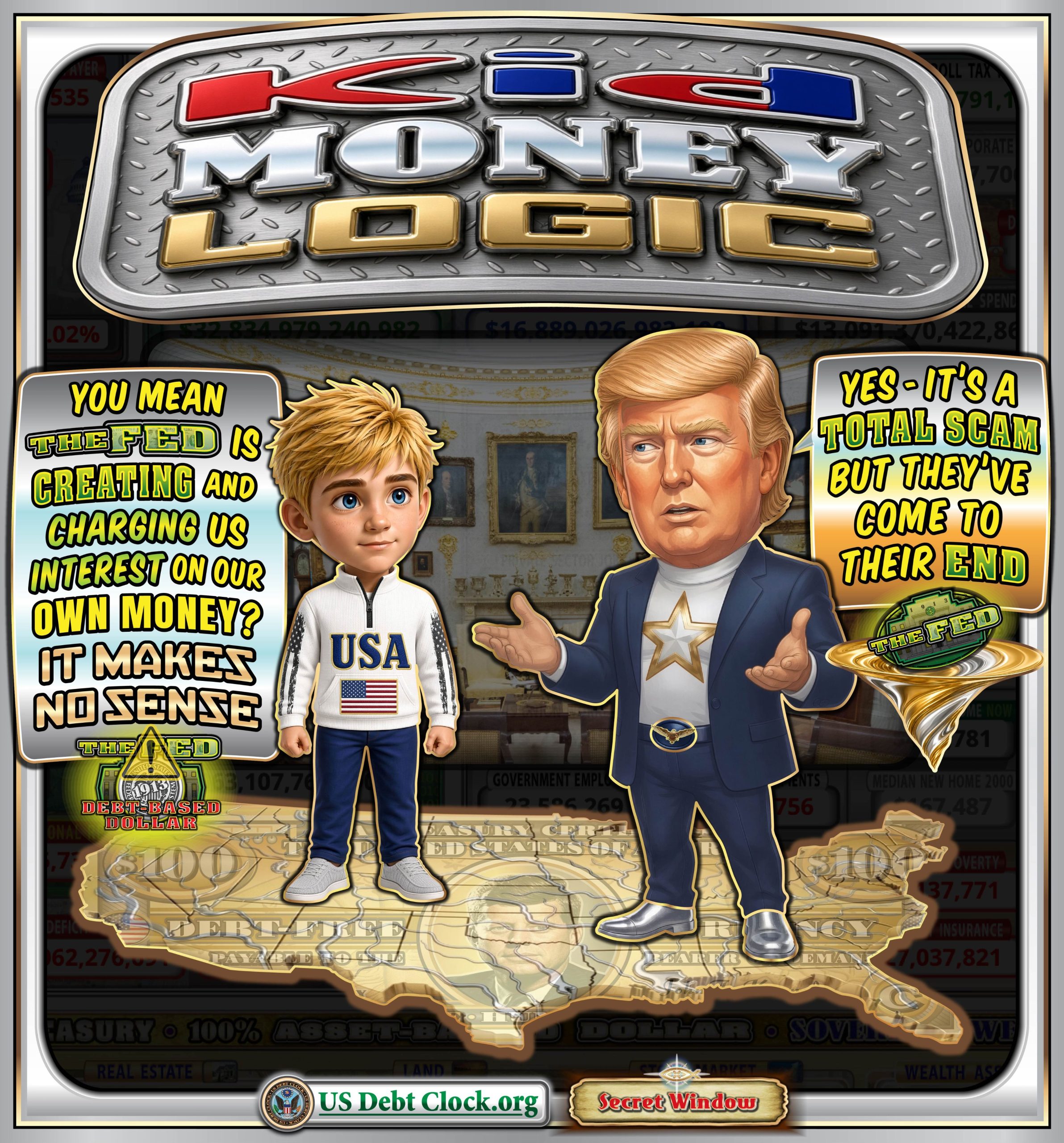
The US Debt Clock has released another provocative Secret Window poster, and this time the New Money Revolution delivers its message through the simplest financial question imaginable.
The headline reads:
KID MONEY LOGIC
Standing on a map of America, a young boy wearing a USA sweatshirt turns toward DJT and asks:
“You mean the Fed is creating and charging us interest on our own money? It makes no sense!”
DJT responds:
“Yes — it’s a total scam, but they’ve come to their end.”
To the right, the Federal Reserve’s debt-based dollar symbol disappears into a golden whirlpool.
The message could hardly be more direct.
After months of posters about Treasury Dollars, asset revaluation, sovereign wealth, tax elimination, and financial restitution, the US Debt Clock has returned to the fundamental question beneath its entire New Money Revolution.
Why should a sovereign nation depend so heavily on interest-bearing debt to finance its future?
And perhaps more importantly:
Is there a better way?
The Kid Asks the Question Adults Forgot
The most revealing character in the poster is not DJT.
It is the kid.
That is an important creative choice.
Earlier Debt Clock images featured presidents, Treasury officials, generals, philosophers, and banking adversaries. They used complex symbols to explain proposed changes to monetary policy.
This poster strips away the complexity.
A kid asks why Americans must pay interest within a monetary system supposedly designed to serve them.
The question is deliberately provocative.
In reality, the Federal Reserve does not simply create every dollar and collect interest on all of it. Commercial banks create deposits through lending, Treasury securities are held by numerous investors, and the Fed has historically returned its excess earnings to Treasury.
But the poster raises a legitimate underlying issue: the growing cost of financing government debt, and the question of whether America’s monetary arrangements are producing the best outcomes for its citizens.
That is where the serious economic discussion begins.
The Fed Debt-Based Dollar Goes Down the Drain
Look carefully at the right side of the image.
The familiar Federal Reserve dollar symbol is being drawn into a swirling golden funnel.
This is no ordinary decoration.
Throughout the Debt Clock’s recent series, the Fed debt-based dollar has represented the financial architecture established after the Federal Reserve Act of 1913.
The disappearing symbol suggests the conclusion of that chapter.
The poster does not illustrate a complicated financial conversion.
It illustrates an exit.
The symbolism is unmistakable:
The old debt-money system is being shown the door.
That does not mean the Federal Reserve has actually been abolished or that Federal Reserve notes have lost their legal-tender status. Neither development is established by the poster.
Instead, the image dramatizes the Debt Clock’s preference for an alternative monetary architecture built around Treasury authority and national assets.
From Mega Restitution to Money Logic
The timing of this poster matters.
Invest Offshore has followed a remarkable progression in the US Debt Clock’s October messages.
The American Jubilee asked whether national asset revaluation could provide a pathway toward reducing America’s debt burden.
Mega Restitution introduced an extraordinary, unverified claim of potential financial recovery for American taxpayers.
The Grand Infusion imagined a sovereign wealth reserve supporting a proposed USA Treasury Dollar.
Economic Reinvention presented the intended benefits: zero taxes on income, property, and capital gains, a 3% lending-rate ceiling, and an illustrative taxpayer restitution figure.
Now comes Money Logic.
Instead of presenting another complex financial proposal, the poster asks readers to reconsider the foundational assumptions of the monetary system.
Why does government debt keep expanding?
Who receives the interest?
How does credit creation affect purchasing power?
And could sovereign money be structured differently?
The earlier posters proposed a new system. Money Logic asks why the old one should continue unchanged.
Who Actually Creates Money and Collects Interest?
Understanding the distinction between currency creation, bank lending, and government borrowing is essential.
The Federal Reserve issues central-bank money, including bank reserves, and serves as the issuing authority for Federal Reserve notes.
Commercial banks also create money in the form of deposits when they extend loans.
Separately, the U.S. Treasury borrows by issuing securities purchased by individuals, pension funds, banks, foreign institutions, the Federal Reserve, and other investors.
Interest on Treasury debt therefore does not simply flow into one central-bank account.
The Federal Reserve’s own financial arrangements also include operating costs, interest expenses, and a statutory framework for remitting excess earnings to Treasury.
These distinctions matter.
They do not eliminate legitimate concerns over the national debt, monetary policy, inflation, financial concentration, or the burden of interest expenses.
But they show why meaningful monetary reform requires careful accounting rather than slogans alone.
For Invest Offshore readers, the essential question is not whether a cartoon’s accusation is literally correct.
It is whether the current system can be made more transparent, efficient, accountable, and supportive of long-term productive wealth.
The New Treasury Dollar Alternative
The proposed solution has appeared repeatedly throughout the Debt Clock series.
The USA Treasury Dollar.
The concept imagines a new form of sovereign money backed by a diversified reserve of tangible and productive assets.
Gold and silver.
Land and agriculture.
Energy and strategic minerals.
Infrastructure and national wealth.
Earlier posters went further, suggesting a 100% sovereign wealth reserve and a currency linked to public ownership.
In that imagined system, the government’s financial foundation would place greater emphasis on existing assets and productive capacity rather than continuing debt expansion.
But substantial questions remain.
Who owns the reserves?
How are they valued?
Would holders have redemption rights?
How would the currency maintain stability?
And how would such a transition affect existing Treasury securities, banking deposits, and international dollar obligations?
Those questions must be answered before any proposed replacement can be treated as a credible monetary system.
The Next Generation Deserves Better Money
The presence of a child gives the poster its deeper meaning.
America’s national debt is not merely a number on a screen.
It is part of the financial environment inherited by future generations.
Children born today will grow up facing decisions about wages, housing, savings, investment, taxation, inflation, and the purchasing power of their money.
That connects directly to another important Invest Offshore theme: introducing children to investment ownership early in life.
Financial independence begins with understanding money.
How it is created.
How borrowing works.
Why interest matters.
How inflation affects savings.
And why owning productive assets can be central to building long-term family wealth.
The Debt Clock’s latest image uses a child to suggest that the next generation should not inherit monetary arrangements nobody is permitted to question.
That is a message worth taking seriously, regardless of one’s position on the Federal Reserve.
The Invest Offshore Decode
For offshore investors, Money Logic reinforces a principle that has guided international wealth management for generations.
Understand the monetary system before deciding where to preserve capital.
Currency risk, sovereign debt, purchasing power, banking relationships, legal jurisdiction, and asset custody are inseparable.
Gold and silver can provide diversification, although their prices remain volatile.
Productive land, energy, mining, infrastructure, and businesses offer exposure to real economic activity.
Private banking and international structures can help manage certain jurisdictional risks when properly established and legally compliant.
But no asset or structure is immune from market risk.
The important lesson is that wealth protection starts with understanding the financial obligations and institutions behind the money itself.
Conclusion: The Simplest Question May Be the Most Powerful
The US Debt Clock’s Money Logic poster is one of the most direct images in its New Money Revolution series.
No elaborate asset allocation formula.
No spectacular gold revaluation.
No trillion-dollar balance-sheet calculation.
Just a child asking a question.
DJT supplies the cartoon’s dramatic answer, declaring that the old system has reached its end.
The image portrays the Fed debt-based dollar disappearing into a golden vortex.
Whether that vision ever becomes policy remains uncertain.
But the question is real.
Can America reduce its dependence on expanding debt, strengthen its productive asset base, and create a monetary framework that better serves future generations?
That is the challenge beneath the artwork.
The American Jubilee questioned the debt.
Mega Restitution questioned the interest.
The Grand Infusion proposed a new monetary foundation.
Economic Reinvention illustrated the potential household benefits.
Money Logic questions the entire arrangement.
And perhaps that is why the Debt Clock chose a child to deliver its latest message.
Sometimes the most important financial questions are the ones adults have stopped asking.
The future of money deserves answers that make sense to the next generation.
Invest Offshore continues tracking the New Money Revolution, Federal Reserve policy, Treasury reform, asset-backed finance, sovereign wealth, precious metals, and the evolving architecture of global capital.
Invest Offshore — Global Capital. Clear Intelligence.
Leave a Reply