
Meta description: An evidence-based estimate of euro cash pallets in global circulation, how they compare with U.S. dollar pallets, and how bulk currency logistics works.
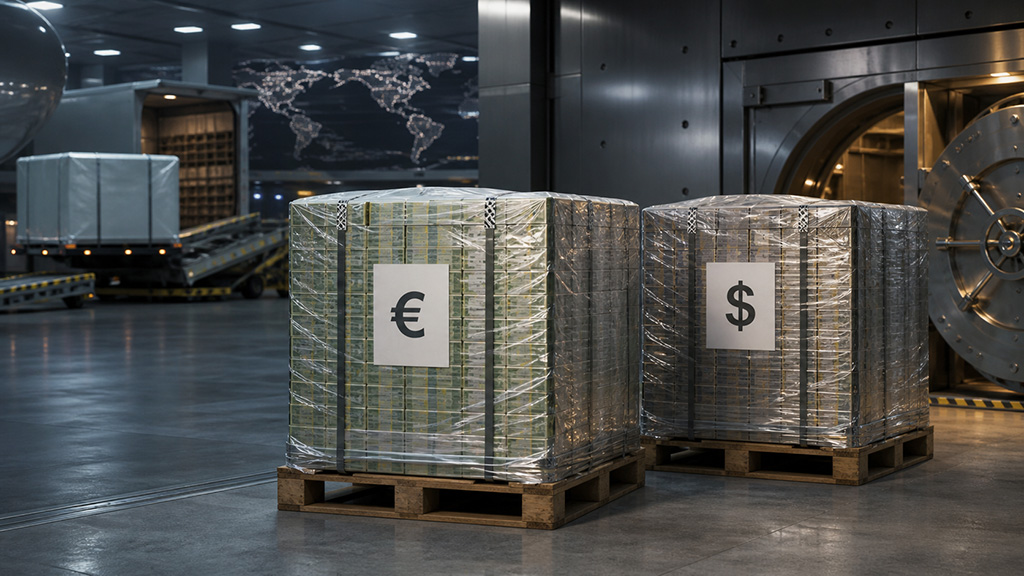
The image of banknotes stacked on pallets is familiar from central-bank vaults, armored vehicles and airport cargo facilities. But how many euro cash pallets are actually in circulation—and how does that compare with the U.S. dollar?
The short answer is approximately 49,000 euro cash pallet-equivalents versus 88,000 U.S. dollar pallet-equivalents, based on year-end 2025 banknote volumes and an assumed capacity of 640,000 notes per pallet.
That makes the euro banknote supply approximately 55% as large as the U.S. dollar supply by physical pallet count. Put differently, the outstanding U.S. banknote supply would require about 1.8 times as many pallets as the euro supply.
These figures are estimates, not an official inventory. Central banks publish the number and value of banknotes in circulation, but they do not publish a global count of loaded cash pallets. Most circulating notes are dispersed among households, retailers, banks, ATMs and vaults rather than sitting on pallets.
The pallet-equivalent estimate
At the end of 2025, the European Central Bank reported 31.3 billion euro banknotes in circulation, with a combined face value of €1.6195 trillion. The number of notes had increased 2.5% during the year, while their value rose 2%. ECB Annual Report 2025
The Federal Reserve reported 56.6 billion U.S. banknotes in circulation at the same date. These included 15.2 billion $1 notes, 11 billion $20 notes and 19.9 billion $100 notes. Their combined face value was approximately $2.395 trillion. Federal Reserve volume data and Federal Reserve value data
There is no universal capacity for a cash pallet. Packaging, note dimensions, denomination, carrier requirements and weight limits all affect the load. However, a New York Federal Reserve staff study of international wholesale dollar shipments reported that a typical pallet contained 640,000 banknotes. That provides a defensible common benchmark for comparing the two currencies. New York Fed staff report
| Currency | Notes in circulation | Assumed notes per pallet | Estimated pallet-equivalents |
|---|---|---|---|
| Euro | 31.3 billion | 640,000 | Approximately 48,900 |
| U.S. dollar | 56.6 billion | 640,000 | Approximately 88,400 |
The calculation is straightforward:
- Euro: 31.3 billion ÷ 640,000 = approximately 48,900 pallets
- U.S. dollar: 56.6 billion ÷ 640,000 = approximately 88,400 pallets
Using a broader capacity range of 500,000 to one million notes per pallet produces an estimated 31,300 to 62,600 euro pallet-equivalents and 56,600 to 113,200 dollar pallet-equivalents. The euro-to-dollar ratio remains roughly the same when an identical packing assumption is used.
Pallet count is not the same as cash value
The euro represents only about 55% of the dollar’s estimated pallet count, but the difference by face value is considerably smaller.
The average euro banknote outstanding at the end of 2025 had a face value of approximately €51.74. The average U.S. note was worth approximately $42.31. Using the ECB’s year-end 2025 exchange rate of $1.175 per euro, the euro banknote supply was worth approximately $1.90 trillion, or about 79% of the dollar banknote supply’s value.
Under the 640,000-note assumption, a pallet reflecting the overall euro denomination mix would have an average face value of approximately €33.1 million, while a comparable pallet reflecting the overall U.S. mix would average approximately $27.1 million.
Actual shipments do not normally use an average mix. Bulk pallets and boxes are generally separated by denomination. A pallet of €100 notes, for example, would carry a very different face value from a pallet of €10 notes even if both contained the same number of banknotes.
How euro cash pallet logistics works
Euro cash logistics begins well before banknotes reach commercial banks. Production is pooled across the Eurosystem. National central banks commission notes from high-security printing facilities, maintain logistical inventories and redistribute banknotes when individual countries or regions experience shortages or surpluses.
The Eurosystem also maintains a Strategic Stock for exceptional demand or supply interruptions. This is separate from the logistical stock used to replace unfit notes, accommodate seasonal demand and optimize transportation between central-bank branches. ECB banknote production and stocks
For cross-border Eurosystem operations, euro banknotes move through a controlled hierarchy:
Banknotes → packets or bundles → boxes → sealed pallets → secure transport
European rules specify bundles of 1,000 notes and bulk-transfer boxes containing 10,000 notes. Pallets and boxes generally contain a single denomination, although different banknote series may be included. Shipments are identified using standardized barcodes and electronic messages recording the supplying central bank, receiving bank, carrier, denomination, quantity, value and weight. EUR-Lex cash-transfer requirements
Large-scale transport may involve armored road vehicles or secured air freight, depending on distance and urgency. National central banks, regulated cash-in-transit companies, commercial banks and international banknote wholesalers all participate in the broader cash cycle.
The United States uses a comparable controlled process. Federal Reserve deposit standards organize currency into straps of 100 notes and bundles of 1,000 notes, with sealed containers, identifying information and tamper-evident packaging. Federal Reserve cash packaging guide
Why both currencies circulate internationally
Cash demand is not confined to the jurisdiction that issues a currency.
Federal Reserve staff estimated that foreigners held more than $1 trillion in U.S. banknotes in early 2025—roughly half of the total value outstanding. The dollar is used internationally for savings, emergency liquidity and transactions in economies where confidence in the domestic currency or banking system is limited. Federal Reserve analysis
Euro banknotes also circulate beyond the euro area, especially in neighboring European countries. The ECB reported that international purchases and sales of euro banknotes increased by almost 10% in 2025. ECB international role of the euro report
This international demand helps explain why physical currency continues growing despite cards, mobile payments, stablecoins and other digital alternatives.
Moving a pallet of cash is not an ordinary freight transaction
A genuine international currency shipment requires much more than an airway bill and a warehouse receipt. Depending on the jurisdictions involved, the participants may need:
- Proof of ownership and the economic source of funds
- Central-bank or regulated-bank documentation
- Customs and currency declarations
- Anti-money-laundering and sanctions screening
- Verified shipper, carrier and consignee records
- Banknote authentication and fitness processing
- Insurance, sealed packaging and an auditable chain of custody
Entering or leaving the European Union with €10,000 or more generally triggers cash-declaration requirements. Authorities may also require disclosure when unaccompanied cash is transported by freight, post or courier. European Commission cash controls
The United States requires reporting for the international transportation, mailing or shipment of more than $10,000 in currency or monetary instruments. These requirements also apply to commercial currency carriers. FinCEN guidance
A declaration does not by itself prove that the funds are legitimate. Banks and authorities can still require evidence concerning ownership, origin, intended use and the parties to the transaction.
An important investor warning
Investors should be extremely cautious when approached about “discounted cash pallets,” “blocked funds,” diplomatic consignments or currency supposedly waiting in an airport or private vault.
Physical feasibility is not proof of ownership or bankability. Fraudulent schemes frequently use photographs of boxes, warehouse certificates, seals, purported central-bank letters or offers to release cash after payment of an insurance, customs or cryptocurrency fee.
A legitimate transaction should be independently verifiable through the named bank, carrier and relevant authorities using contact information obtained separately—not telephone numbers or email addresses supplied by an intermediary. No investor should advance money against a cash shipment without regulated legal, banking and compliance professionals confirming the provenance and transferability of the funds.
The bottom line
Using the latest complete comparable figures and a common 640,000-note pallet benchmark, the world’s euro banknote supply equals approximately 48,900 cash pallet-equivalents, compared with approximately 88,400 for the U.S. dollar.
The United States therefore has about 39,500 more pallet-equivalents, or 1.8 times the physical banknote volume of the euro.
These are hypothetical pallet-equivalents representing all outstanding notes—not the number of pallets presently stored or transported. Nevertheless, the comparison illustrates the extraordinary physical infrastructure still required to support the world’s two leading international currencies.
Leave a Reply