
Most investors know the names of the world’s largest banks. Far fewer know the institution quietly sitting behind an enormous share of the international securities market.
That institution is Euroclear Bank.
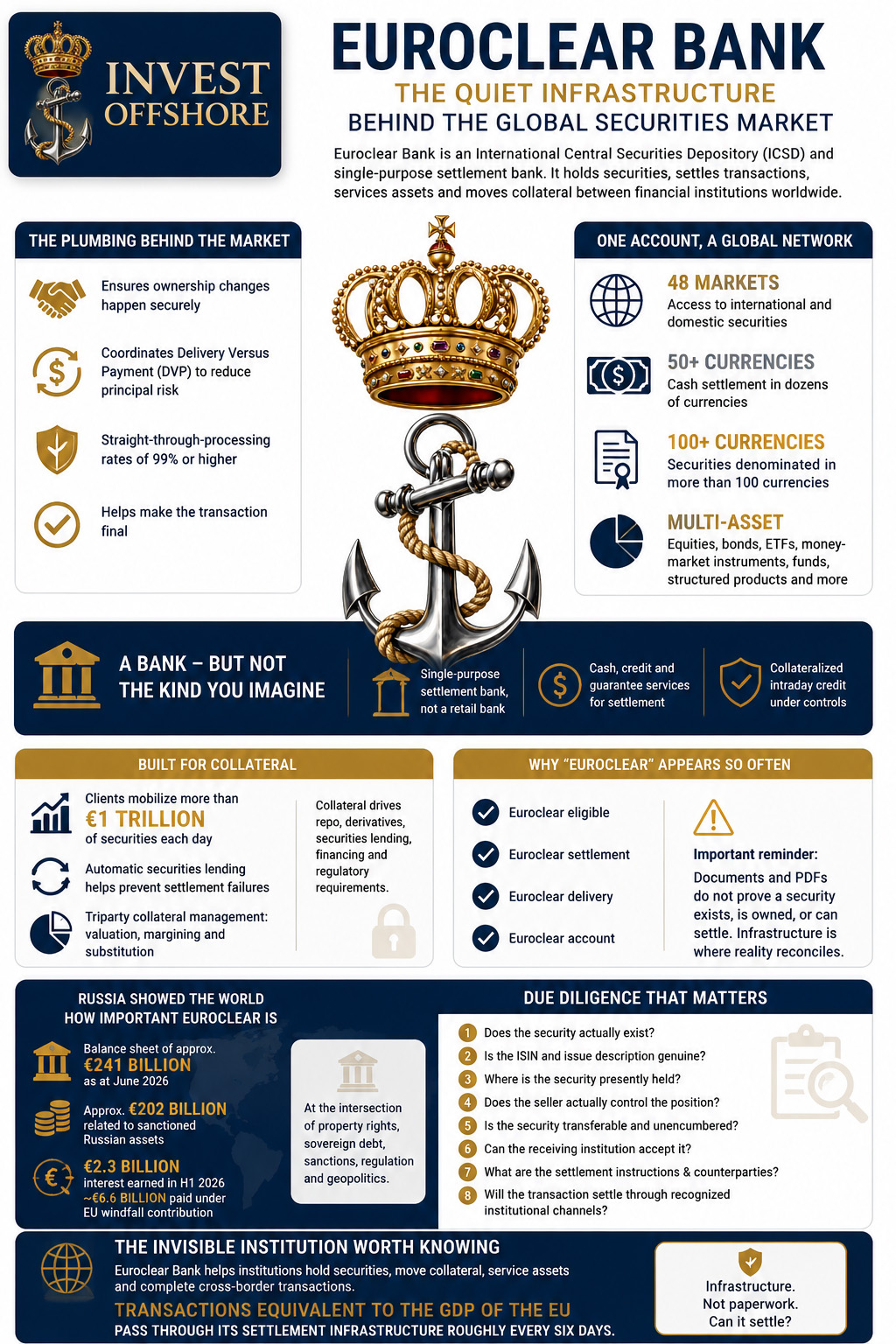
Based in Brussels, Euroclear Bank is not primarily a conventional commercial bank taking retail deposits and making mortgages. It is an International Central Securities Depository (ICSD) and a single-purpose settlement bank: financial infrastructure designed to hold securities, settle transactions, service assets and move collateral between sophisticated financial institutions around the world.
For offshore investors trying to understand how institutional bonds and other securities actually move from seller to buyer, understanding Euroclear is essential.
The Plumbing Behind the Market
Buying a security is conceptually simple. One party sells. Another buys.
But somebody must make certain that ownership of the security actually changes, the money moves in the opposite direction, the correct accounts are credited and debited, corporate actions are subsequently processed, and the transaction becomes final.
That is the world of post-trade financial infrastructure.
Euroclear Bank provides settlement services for international securities, including Eurobonds and international ETFs, as well as domestic securities across dozens of markets. Its infrastructure connects issuers, banks, custodians, brokers, investment managers, central banks and institutional investors.
Euroclear describes its settlement model as Delivery Versus Payment (DVP): the transfer of securities and corresponding payment are coordinated so that the exchange substantially reduces principal risk. Across the wider Euroclear group, straight-through-processing rates can reach 99% or higher.
This is one reason Euroclear is so important.
It isn’t merely recording a transaction.
It is helping make the transaction final.
One Account, A Global Securities Network
The international reach is considerable.
Euroclear Bank provides access to international securities and domestic securities across 48 markets, while settlement can occur against payment in dozens of currencies. Its securities accounts can accommodate equities, bonds, money-market instruments, structured products, investment funds and ETFs. Securities denominated in more than 100 currencies can be accepted.
For an institutional investor operating internationally, that creates something enormously valuable: centralization.
Rather than treating every national securities market as an entirely isolated infrastructure problem, an eligible Euroclear participant can use the network as an international access point.
This is one of the largely invisible mechanisms that makes today’s global capital market possible.
Euroclear Bank Is a Bank — But Not the Kind Most People Imagine
The word Bank creates understandable confusion.
Euroclear Bank does hold a banking licence, but Euroclear describes it as a single-purpose settlement bank. Its banking activities exist primarily to support securities settlement rather than conventional consumer or corporate banking.
Its cash, credit and guarantee services are consequently focused on facilitating cross-border settlement. These include cash management and money transfers in more than 50 currencies and collateralized intraday credit under controlled conditions.
That distinction becomes extremely important when evaluating transactions described as being “through Euroclear.”
Euroclear is infrastructure.
It should not be confused with an investment program, private trading platform or magical source of liquidity.
The Other Giant Function: Collateral
Modern finance doesn’t run solely on money.
It runs on collateral.
Government bonds and other high-quality securities are constantly mobilized to support repo transactions, derivatives exposures, securities lending, financing and regulatory requirements.
Euroclear has built substantial infrastructure around precisely this function.
Its securities lending and borrowing operation says clients mobilize more than €1 trillion of securities each day, while its systems can automatically lend securities to help prevent settlement failures. Euroclear also provides triparty collateral-management capabilities, including valuation, margin management and collateral substitution.
This is where Euroclear becomes particularly interesting from an offshore-finance perspective.
A security isn’t valuable merely because somebody possesses a document saying it exists.
Institutionally, what matters is whether the security can be authenticated, held through recognized custody infrastructure, transferred, settled, valued and mobilized.
That is an entirely different standard.
Why “Euroclear” Appears So Often in International Bond Transactions
Anyone working around international fixed income eventually encounters phrases such as:
Euroclear eligible.
Euroclear settlement.
Euroclear delivery.
Euroclear account.
The reason is straightforward: Euroclear Bank is one of the principal pieces of infrastructure connecting international bond-market participants.
But those words should never substitute for transaction-level verification.
A PDF bearing a security description, ISIN, Euroclear terminology or bank references does not by itself establish that a security exists within Euroclear, that the person presenting it owns it, that it is freely transferable, or that a proposed transaction can settle.
This distinction becomes especially important in private transactions involving supposed MTNs, historical bonds, blocked securities or unusually large institutional positions.
The document is not the asset. The settlement infrastructure is where the institutional reality ultimately has to reconcile.
Russia Revealed Just How Important Euroclear Really Is
The sanctions imposed following Russia’s invasion of Ukraine unexpectedly pushed Euroclear from the financial plumbing into international headlines.
By the end of June 2026, Euroclear Bank reported a balance sheet of approximately €241 billion, of which approximately €202 billion related to sanctioned Russian assets. Interest generated by those immobilized assets has itself become economically and politically significant.
Euroclear reported €2.3 billion of interest earnings from sanctioned Russian assets during the first half of 2026 and said approximately €6.6 billion had already been paid through the EU windfall-contribution mechanism at that point.
The resulting disputes demonstrate something bigger than the sanctions story.
Euroclear sits at an extraordinary intersection of property rights, sovereign debt, international sanctions, banking regulation and geopolitics.
When securities become immobilized inside critical financial-market infrastructure, governments, central banks and investors quickly discover just how important the custodian and settlement layer really is.
A Powerful Due-Diligence Lesson
There is also a lesson here for offshore investors.
The larger and more sophisticated a purported financial transaction becomes, the less meaningful impressive paperwork becomes on its own.
For securities represented as settling through Euroclear, serious due diligence should distinguish among several separate questions:
- Does the security actually exist?
- Is the ISIN and issue description genuine?
- Where is the security presently held?
- Does the purported seller actually control the position?
- Is the security transferable and unencumbered?
- Can the receiving institution accept it?
- What precisely are the settlement instructions and counterparties?
- Will the transaction settle through recognized institutional channels?
Those questions are far more valuable than the visual appearance of a certificate, term sheet, screenshot or purported bank statement.
The Difference Between Securities and Stories
Euroclear provides a useful dividing line between the institutional financial world and the enormous grey market of financial stories circulating internationally.
Real institutional assets live within systems.
They have custodians. They have account relationships. They have settlement mechanics. They have counterparties. They have compliance requirements. They have ownership records. They have transfer restrictions or the absence thereof. They generate corporate actions. And when ownership changes, there is an auditable operational process behind that change.
That doesn’t mean every legitimate security must be held at Euroclear.
It means sophisticated securities ultimately need credible financial infrastructure somewhere.
That is the larger lesson.
The Invisible Institution Worth Knowing
Euroclear will probably never have the consumer recognition of JPMorgan, UBS or HSBC.
It doesn’t need it.
Its importance comes from occupying a much deeper layer of the financial system.
Euroclear Bank helps institutions hold securities, move collateral, service assets and complete cross-border transactions. The Euroclear group says transactions equivalent to the GDP of the European Union pass through its settlement infrastructure roughly every six days.
For investors accustomed to thinking about offshore finance in terms of banks, jurisdictions, currencies and tax structures, Euroclear introduces another dimension:
infrastructure.
Because at the institutional level, possessing an asset and possessing a document describing an asset are two very different things.
The real financial system eventually asks a much simpler question:
Can it settle?
Invest Offshore editorial note: Euroclear infrastructure and terminology should never be treated as independent proof that a privately offered security or transaction is authentic. Securities, ownership, custody and settlement instructions should be independently verified through regulated institutions and appropriate professional advisers.
Official resource: Euroclear
Leave a Reply