
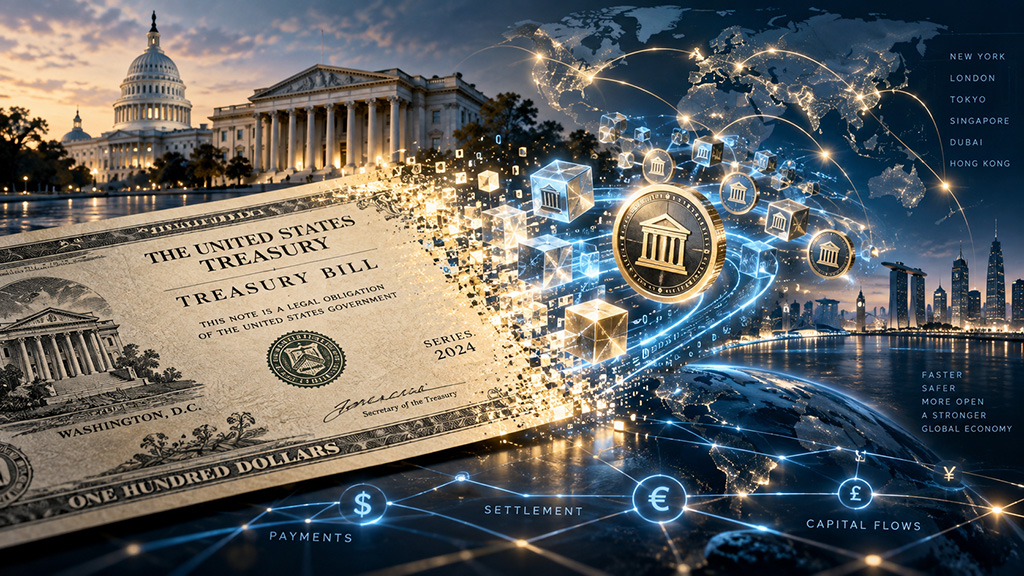
The most important development in digital finance may not be Bitcoin, meme coins or even central bank digital currencies.
It may be something far more conventional:
U.S. Treasury securities moving onto digital rails.
A new financial architecture is emerging in which Treasury bills, Treasury-backed money market funds and stablecoin reserves are becoming the collateral foundation for programmable dollars, tokenized investment products and 24-hour global settlement.
The significance is difficult to overstate.
For more than a century, U.S. government debt has sat at the foundation of the global financial system. Now that same collateral is being repackaged into instruments that can potentially move across blockchain networks in seconds rather than through layers of banks, brokers, custodians and clearing systems.
The Treasury market is going digital.
What Is a Treasury-Backed Digital Instrument?
The term can describe several related structures.
A tokenized Treasury fund can represent ownership in a regulated investment fund holding Treasury bills, cash or repurchase agreements.
A Treasury-backed stablecoin represents a digital dollar liability whose reserves may include short-term Treasury securities.
A tokenized security can represent traditional securities ownership through blockchain infrastructure rather than exclusively through conventional databases.
The distinction matters.
The U.S. Treasury itself is generally not issuing these blockchain tokens. Private asset managers, financial institutions and digital-asset companies are creating instruments backed by, invested in or economically linked to Treasury securities.
The Securities and Exchange Commission made that distinction increasingly explicit in 2026. The SEC defines a tokenized security as a security represented by a crypto asset where ownership records are maintained partly or entirely through crypto networks. Crucially, moving a security onto a blockchain does not remove it from securities regulation.
In other words:
The blockchain changes the plumbing. It does not magically change the underlying asset.
Wall Street Is Already Moving
This transformation is no longer theoretical.
Franklin Templeton’s Franklin OnChain U.S. Government Money Fund was launched in 2021 and uses blockchain technology as its official system for recording share ownership. Its BENJI token represents shares of the fund.
By April 2026, Franklin Templeton said its BENJI suite had reached approximately $1.98 billion in assets under management, while offering capabilities including peer-to-peer transfers, on-chain dividend distribution and intraday yield calculations.
BlackRock has moved aggressively in the same direction.
Its BUIDL fund provides qualified investors exposure to U.S. dollar yield through a tokenized fund investing in assets including cash, Treasury bills and repurchase agreements. In April 2026, BlackRock, Standard Chartered and OKX announced a framework allowing BUIDL to function as yield-bearing collateral for institutional trading.
That is an important evolution.
A tokenized Treasury product is no longer simply something an investor buys and holds.
It can become working collateral.
Capital can potentially remain invested in a yield-producing Treasury instrument while simultaneously supporting trading, settlement, margin or other financial activity.
That is programmable finance beginning to emerge in the real world.
BlackRock Pushes Tokenized Cash Further
The market took another step in August 2026 when BlackRock announced two additional tokenized money-market products: OnChain Shares of the BlackRock Select Treasury Based Liquidity Fund and the BlackRock Daily Reinvestment Stablecoin Reserve Vehicle.
BlackRock described the products as combining regulated money-market structures with blockchain-based infrastructure.
This matters because money-market funds already represent one of the world’s largest pools of liquid capital.
Putting these assets onto digital infrastructure creates the possibility of combining three attributes that historically existed in different financial systems:
safety, yield and programmability.
That combination could become exceptionally powerful.
Stablecoins Create Another Treasury Pipeline
The second side of this revolution is stablecoins.
Under the GENIUS Act signed into law in July 2025, permitted stablecoin reserves can include highly liquid assets such as cash, deposits, repurchase agreements and Treasury securities with remaining maturities of 93 days or less, subject to the legislation’s requirements.
Treasury officials have openly discussed stablecoin growth as a potential new source of demand for short-term U.S. government debt.
The Treasury Borrowing Advisory Committee has been studying exactly this relationship.
Treasury materials noted that major stablecoin issuers’ Treasury holdings have increased dramatically and concluded that further stablecoin growth could generate substantial additional demand for Treasury bills and Treasury repo instruments.
This creates a remarkable circular relationship:
Investors demand digital dollars.
Digital-dollar issuers acquire Treasury securities as reserves.
Treasury securities support the digital dollars.
Those digital dollars circulate globally.
Greater circulation can create additional Treasury demand.
The Internet may therefore become an entirely new distribution mechanism for U.S. government debt.
The Digital Dollar Without a CBDC
There is an even bigger geopolitical implication.
Washington may not need a retail central bank digital currency to create a global digital-dollar ecosystem.
Private-sector stablecoins and tokenized Treasury products can potentially accomplish much of the international distribution.
Treasury Secretary Scott Bessent explicitly argued when the GENIUS Act became law that stablecoins could strengthen the dollar’s global reserve-currency position while generating additional demand for U.S. Treasuries.
That provides an entirely different way of viewing digital assets.
Rather than cryptocurrency replacing the dollar, certain digital assets may become distribution networks for the dollar and the Treasury market itself.
A wallet in Dubai, Singapore, Buenos Aires or Nairobi could ultimately hold digital instruments economically backed by the same Treasury securities that sit inside traditional institutional portfolios in New York.
The wrapper changes.
The collateral remains American sovereign debt.
From Static Asset to Programmable Collateral
This is where tokenization becomes especially interesting for Invest Offshore readers.
Traditional Treasury securities are extraordinarily liquid, but they still operate inside financial infrastructure built around business hours, custodians, settlement cycles and jurisdictional intermediaries.
Tokenization potentially introduces another layer of utility.
A Treasury-backed digital instrument could theoretically be:
transferred around the clock;
used as trading collateral;
integrated into automated escrow arrangements;
redeemed into stablecoins;
used in cross-border settlement;
incorporated into smart-contract workflows;
or moved between financial applications without repeatedly liquidating the underlying investment.
BlackRock’s BUIDL is already moving in this direction. Its use as collateral through institutional trading arrangements demonstrates how tokenized Treasury exposure can evolve beyond simply providing yield.
The future competition may therefore not be between crypto and Treasuries.
It could be between traditional Treasury infrastructure and programmable Treasury infrastructure.
Regulation Is Catching Up
There are still substantial obstacles.
Token ownership must correspond to legally enforceable rights. Custody must survive insolvency. Redemption mechanisms must work during periods of stress. Blockchains and smart contracts introduce technological risks. Securities laws, transfer-agent rules, broker-dealer requirements and market infrastructure must accommodate systems that can operate continuously.
The SEC emphasized in January 2026 that tokenized securities can take different forms with materially different ownership rights. Commissioner Mark Uyeda subsequently described tokenization as potentially reducing intermediaries, improving settlement and modernizing capital markets while stressing that securities regulation continues to apply.
Regulators are therefore moving beyond the question of whether tokenization will exist.
The debate is increasingly about how it will operate.
The Real-World Asset Revolution Begins With the Safest Collateral
For years, the cryptocurrency industry promised that almost everything would eventually be tokenized.
Real estate.
Stocks.
Bonds.
Commodities.
Private equity.
Intellectual property.
Those markets may come.
But Wall Street appears to have discovered that the easiest place to begin is with one of the oldest and most liquid financial instruments on Earth:
the U.S. Treasury bill.
That makes sense.
Before trillions of dollars of real-world assets can operate on digital networks, those networks need trusted collateral, reliable liquidity and a digital equivalent of cash.
Treasuries already provide the collateral.
Stablecoins provide the transactional dollar.
Blockchain provides the settlement rail.
Tokenized funds connect the three.
Invest Offshore View
The financial revolution now taking place is not simply about replacing old money with cryptocurrency.
It is about rebuilding the machinery underneath money.
The winners may ultimately be instruments that combine the strongest characteristics of both worlds: the legal certainty and collateral quality of traditional finance with the speed, transparency and programmability of digital networks.
Treasury-backed digital instruments sit directly at that intersection.
The Treasury bill is not disappearing.
It is becoming programmable.
And if that transformation continues, the world’s largest sovereign debt market could become the collateral engine powering the next generation of global digital finance.
Leave a Reply