
The next monetary revolution may not be about replacing the dollar. It may be about rebuilding the infrastructure that moves it.
For years, the debate over digital money has been framed as a contest between banks and cryptocurrency, the Federal Reserve and stablecoins, or the dollar and some future central bank digital currency.
Cornell Law professor Dan Awrey offers a more useful way of looking at the problem.
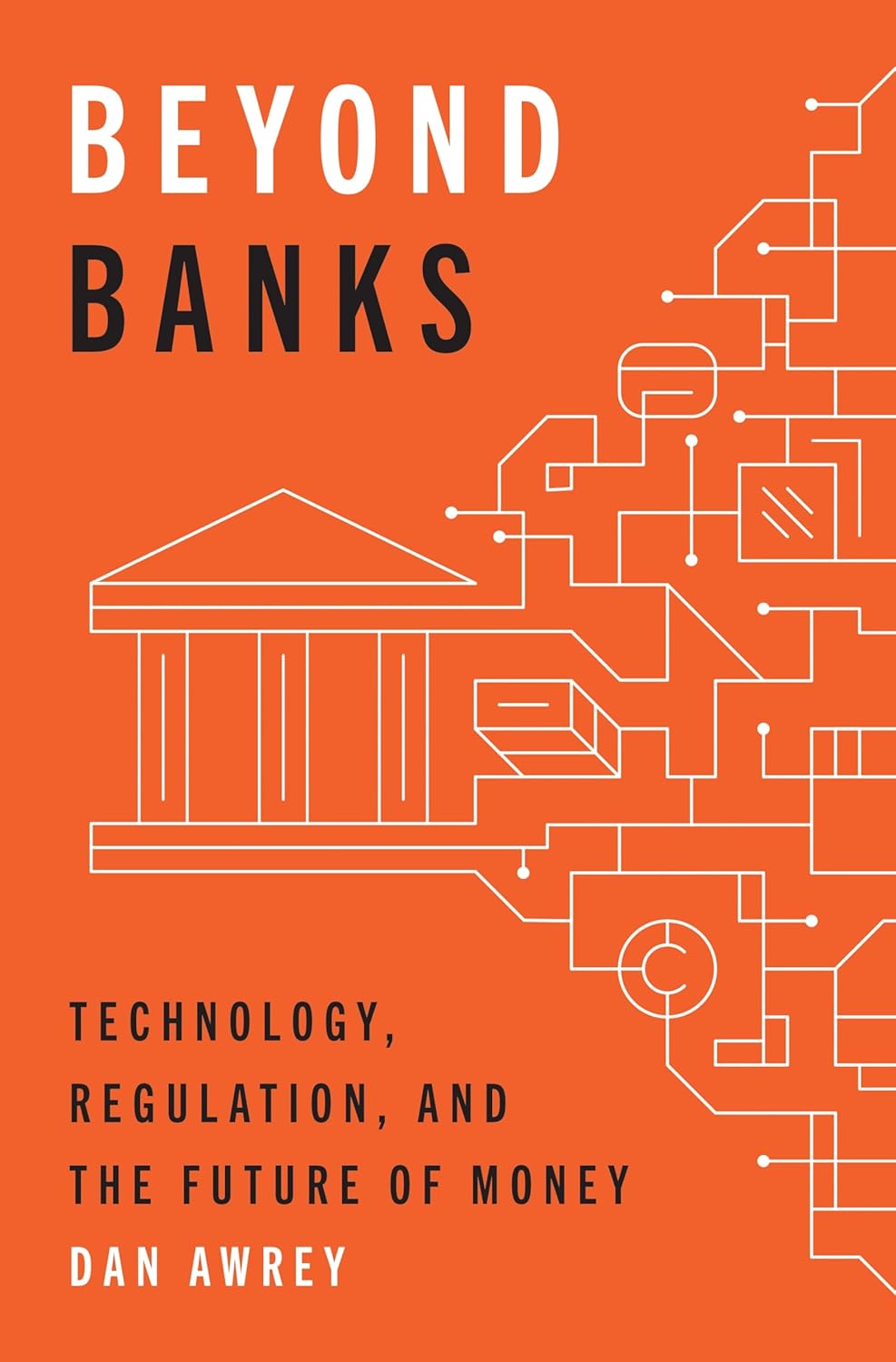
The central argument running through his recent book Beyond Banks: Technology, Regulation, and the Future of Money and his discussion with David Beckworth on Macro Musings is surprisingly simple: money and payments are not the same thing.
That distinction may turn out to be one of the most important ideas in the transformation of the global financial system.
America has spent generations building institutions capable of producing relatively safe money. Deposit insurance, prudential regulation, lender-of-last-resort facilities and bank-resolution regimes have helped create a banking system in which a dollar deposited at a regulated institution is generally expected to remain worth a dollar.
But building good money did not necessarily produce good payments.
Awrey argues that the United States inherited a payment architecture built around banks—and that architecture increasingly looks cumbersome in a world of APIs, instant settlement, programmable assets, stablecoins and 24-hour financial markets. Mercatus Center
Good Money Is Not the Same as Good Payments
This is Awrey’s foundational distinction.
Good money depends primarily on law and institutions. People must believe that the monetary claim they hold will maintain a stable nominal value and remain redeemable when financial stress arrives.
Good payments, by contrast, are largely a technological and governance problem. They depend on speed, cost, interoperability, convenience, network design and access.
Traditional banks generally produce good money.
Fintech platforms can produce extremely good payments.
The challenge is combining the two.
After the internet and commercial APIs opened financial services to technology companies, firms outside the traditional banking system were suddenly able to build payment experiences that were faster and more convenient than many conventional bank products. Yet these companies did not automatically inherit the safety net that supports bank deposits. Federal Reserve Bank of Atlanta
That tension explains much of what is happening today with PayPal, Venmo, stablecoins, crypto exchanges, fintech wallets and other forms of privately issued digital monetary claims.
Consumers increasingly select where they keep money based on how easily they can move it.
And that changes everything.
The Rise of the “Shadow Monetary System”
Awrey describes an emerging shadow monetary system: institutions operating outside conventional deposit-taking banks that nevertheless issue claims functioning economically like money.
Stablecoins are perhaps the clearest example.
A dollar stablecoin promises something that looks simple: put one dollar in and receive one digital token designed to remain worth one dollar.
But the quality of that promise depends upon far more than software.
What assets back the stablecoin?
Where are those assets held?
Who owns them legally?
What happens if the issuer becomes insolvent?
Can customers redeem directly?
Who takes control during a bankruptcy?
How quickly can users receive their dollars?
These questions become particularly important because consumers generally do not evaluate payment instruments the same way institutional credit analysts evaluate balance sheets.
When something says “$1,” users naturally assume it is a dollar.
Awrey’s concern is that increasingly sophisticated payment technology could cause consumers to migrate toward monetary claims whose underlying legal protections are considerably weaker than the user experience suggests. Mercatus Center
Gresham’s New Law
This leads to one of Awrey’s most interesting concepts: Gresham’s New Law.
Traditional Gresham’s Law is usually summarized as:
Bad money drives out good.
Historically, people tended to hoard coins containing more valuable metal while spending inferior coins.
Awrey flips the idea for the digital economy.
Consumers today may choose their money according to the quality of its payment experience rather than the strength of the institution standing behind it.
A payment platform that allows someone to instantly split dinner, pay rent, send money internationally or settle a digital transaction may be far more attractive than a conventional bank account—even if the underlying monetary claim carries greater risk.
Thus, in periods of financial stability, good payments can cause people to hold potentially weaker forms of money.
The danger only becomes visible during a crisis.
Then suddenly the characteristics investors ignored—bankruptcy law, liquidity, asset segregation, redemption rights and access to central-bank money—become the only characteristics that matter. Awrey describes this as an inversion of traditional Gresham dynamics: payment quality increasingly influences what people choose to treat as money. Mercatus Center
Stablecoins Are Becoming Part of the Dollar System
For Invest Offshore readers, this is where Awrey’s argument becomes especially important.
Stablecoins should not necessarily be viewed as competitors to the U.S. dollar.
Many of them are becoming distribution networks for the dollar.
They enable dollar-denominated value to travel through blockchain infrastructure across borders, outside banking hours and potentially between machines, applications and financial markets.
That gives the United States an extraordinary opportunity.
Instead of requiring every digital payment innovation to originate within a conventional commercial bank, America could potentially allow new payment companies to compete on technology while imposing rules ensuring that the money they issue remains extremely safe.
Awrey therefore does not argue that innovation should simply be pushed back inside banks.
Quite the opposite.
His policy framework attempts to separate the two functions.
Let banks perform banking.
Let payment companies compete on payments.
But do not allow payment companies that issue money-like liabilities to quietly become highly leveraged banks.
The “No Intermediation” Principle
Awrey’s proposed solution begins with what he calls the no intermediation principle.
If a company is issuing digital monetary claims designed to function like dollars, it should not simultaneously engage in substantial credit, liquidity or maturity transformation.
In plain English:
Don’t let a payments company become a bank without being regulated like one.
Customer money should be protected rather than transformed into a complicated portfolio of risky assets.
Awrey has proposed that customer funds could ultimately be held in ring-fenced Federal Reserve master accounts, giving these monetary claims exposure to what he regards as the ultimate risk-free dollar settlement asset.
Additional financing and activity restrictions could prevent payment issuers from turning supposedly safe customer balances into funding for unrelated corporate activities. Mercatus Center
The objective is elegant:
engineer safe money while allowing technology companies to engineer better payments.
Open the Federal Reserve’s Infrastructure
Another major element of Awrey’s framework is open access to core financial infrastructure.
Today, many fintech and stablecoin companies still need commercial banks to connect with important parts of the U.S. payment system.
That produces an unusual dependency.
A technology company may build the superior customer-facing payment experience, but ultimately its dollars must sit somewhere in the traditional banking system.
Awrey argues that carefully regulated nonbank payment providers should potentially receive direct access to Federal Reserve master accounts and clearing infrastructure.
He has also argued that Congress would need to reconsider the statutory framework governing eligibility for these accounts rather than merely rebranding existing access arrangements. Mercatus Center
The implications could be enormous.
Imagine payment companies competing directly over:
speed,
international reach,
programmability,
merchant fees,
user experience,
financial inclusion,
machine-to-machine payments,
and settlement technology—
while the underlying customer funds remain extremely conservative dollar assets.
That would represent something closer to payment utilities competing on technology rather than financial institutions competing on leverage.
Payments Are Networks—and Networks Need Governance
Awrey’s work with Joshua Macey and Jeffery Zhang adds another important dimension: payment systems are networks.
And networks create difficult trade-offs.
Their research identifies three critical objectives: stability, access and investment. Payment-system designers frequently cannot maximize all three simultaneously.
Restrict access and a network may become safer—but less competitive.
Open access aggressively and innovation may accelerate—but new stability risks can appear.
Demand extremely high infrastructure investment and the largest incumbents may acquire even greater advantages.
The governance structure therefore matters almost as much as the technology itself. SSRN
Who gets access?
Who determines technical standards?
Who pays for upgrades?
Who decides whether a new technology becomes interoperable with existing systems?
These sound like technical questions.
They are actually questions about economic power.
The GENIUS Act May Be Only the Beginning
Awrey has been critical of whether America’s emerging stablecoin framework fully resolves these issues.
His concern is not principally that stablecoins exist.
It is that policymakers may regulate the assets backing stablecoins without adequately redesigning the payment architecture surrounding them, including resolution procedures and direct infrastructure access. Mercatus Center
This distinction deserves attention.
Requiring safe reserves is important.
But a stablecoin backed by Treasury securities can still experience operational, legal or insolvency complications if customers depend on banks, custodians and conventional bankruptcy proceedings to ultimately recover their money.
The future regulatory debate may therefore shift from:
“What assets back the coin?”
to:
“What exactly happens during the 48 hours after something goes wrong?”
That is a much harder question.
The Invest Offshore Perspective: The Dollar Is Becoming an Operating System
Awrey’s ideas point toward a future in which the fundamental monetary unit may remain surprisingly familiar.
The dollar does not necessarily disappear.
Instead, the architecture surrounding the dollar changes.
Bank deposits.
Tokenized deposits.
Stablecoins.
Payment wallets.
Instant-payment networks.
Blockchain settlement.
Treasury-backed digital instruments.
They may eventually become different interfaces connected to the same underlying monetary ecosystem.
Awrey told an Atlanta Fed conference in 2026 that if this innovation succeeds, consumers may eventually stop saying that they “paid with a stablecoin.” The technology could simply disappear beneath the transaction, much as internet users rarely think about the protocols transmitting an email. Federal Reserve Bank of Atlanta
That may be the destination.
The winning digital currency may not be some entirely new currency.
It may simply be the U.S. dollar rebuilt for the internet.
And if America can combine the institutional protections that made bank money reliable with the technological advantages that made fintech and stablecoins attractive, the result could be far more consequential than a central bank digital currency alone.
It could turn the dollar from the world’s dominant reserve currency into the world’s dominant digital settlement infrastructure.
That is the deeper message in Dan Awrey’s work.
The future of money is not merely about deciding what money is.
It is about deciding who may build the rails that move it—and what protections must exist underneath those rails when the next financial storm arrives.
Source note: This article draws primarily on Dan Awrey’s 2026 Macro Musings discussion of Beyond Banks, his remarks at the Federal Reserve Bank of Atlanta’s 2026 Financial Markets Conference, and his payment-network governance research with Joshua Macey and Jeffery Y. Zhang. Mercatus Center
Leave a Reply