
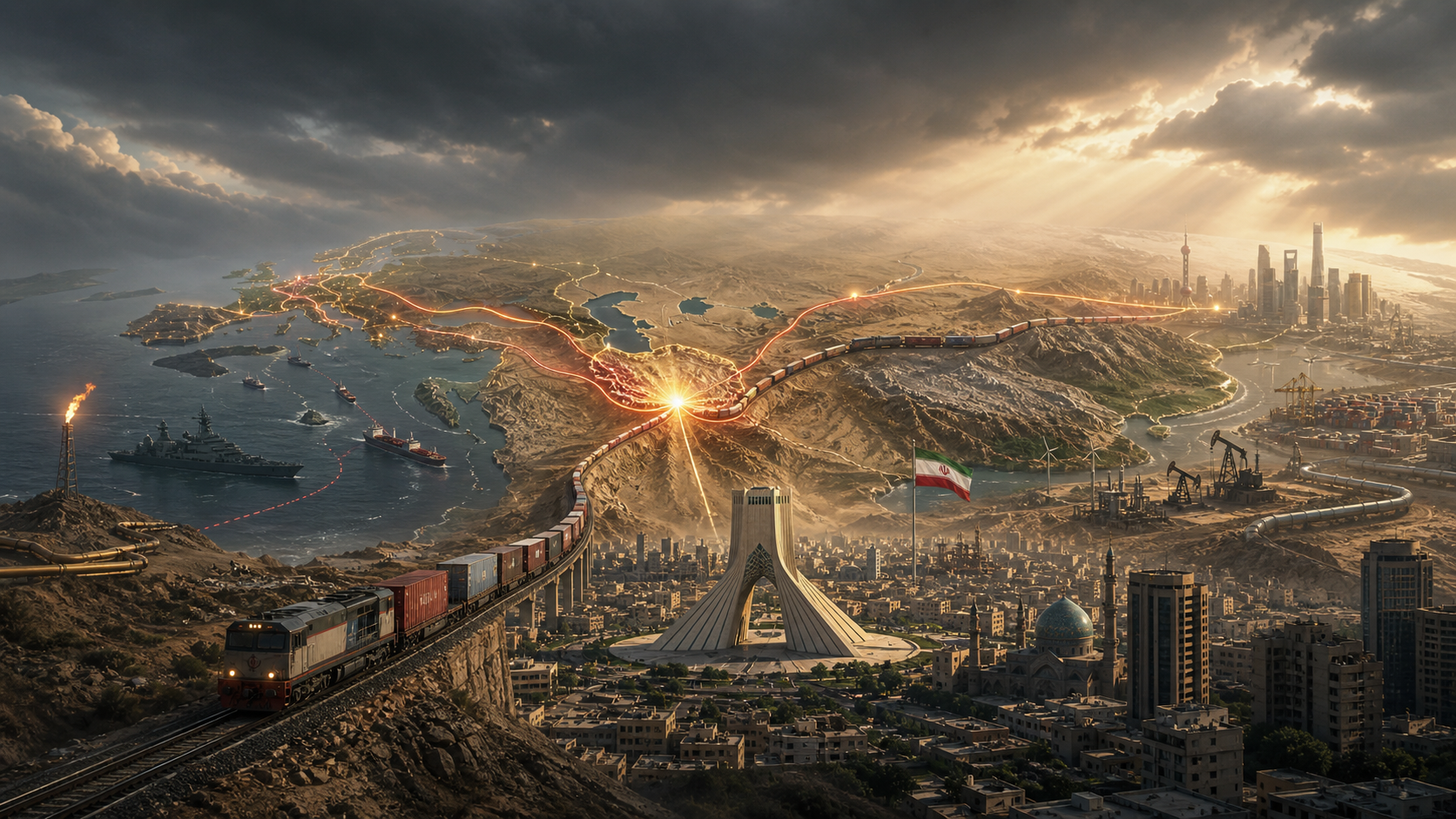
China’s Belt and Road Initiative is usually described in the language of ports, railways, trade corridors, and development finance. But beneath the concrete and steel sits something far more strategic: a parallel world system designed to reduce China’s exposure to U.S. naval power, U.S. sanctions, and the U.S. dollar.
At the center of that system is Iran.
This is the overlooked pressure point in the China-U.S. rivalry. The contest may not be decided only in Silicon Valley, Taiwan, the South China Sea, or Shanghai. It may be decided in Tehran.
Iran Is Not Just Another Chinese Partner
In 2021, China and Iran signed a 25-year cooperation agreement, bringing Iran further into China’s Belt and Road framework. Reuters reported at the time that the accord was expected to include Chinese investment in energy and infrastructure, and that it connected Iran to a multi-trillion-dollar Belt and Road architecture intended to stretch from East Asia to Europe. (Reuters)
That agreement should not be viewed as a normal diplomatic handshake. It is more like a geopolitical insurance policy.
For Iran, China is a buyer of last resort, a sanctions shield, and a source of financial oxygen. For China, Iran is a laboratory for de-dollarized energy settlement, a discounted oil supplier, and a land bridge into the Middle East and Europe.
The relationship is not equal. But it is deeply strategic.
The Petroyuan Laboratory
The dollar remains the king of global energy trade. That has been one of the pillars of American power since the rise of the petrodollar system.
China’s long-term challenge is obvious: how does Beijing buy the world’s oil without relying on the currency and banking system controlled by its main rival?
Iran gives China a real-world testing ground.
Chinese purchases of Iranian oil have become one of the most important examples of energy trade moving around the U.S.-dominated system. Reuters reported that China bought more than 80% of Iran’s shipped oil in 2025, averaging 1.38 million barrels per day, equal to 13.4% of China’s seaborne crude imports. (Reuters)
This is why Iran matters beyond the barrels. The trade provides Beijing with a practical model for settling sanctioned energy flows, using alternative channels, disguised origin points, intermediaries, and yuan-linked settlement structures.
But there is a limit. The yuan is still not a true dollar replacement. China’s capital controls remain a major barrier to full renminbi internationalization, and analysts continue to point out that complete convertibility remains uncertain. (Stiftung Wissenschaft und Politik (SWP))
That is why Iran is so important. It allows China to test a partial alternative before the yuan is ready to become a full reserve currency.
The Land Corridor Around American Sea Power
The Belt and Road Initiative is often drawn as a map of inevitability. But maps can lie.
China’s sea lanes still run through vulnerable chokepoints. The Strait of Malacca remains the classic example: a narrow maritime artery exposed to U.S. naval dominance and allied pressure.
Iran offers something different: a southern overland corridor.
In July 2024, the Iran-China container block train resumed operations between Iran and China. The International Union of Railways reported that the route resumed from Qom City, Iran, to Yiwu City, China, after an agreement involving the railways of China, Iran, Kazakhstan, and Turkmenistan. Iranian railway leadership described the southern Silk Road route as a way to consolidate rapid and safe trade from China to Europe. (UIC – International union of railways)
That is the strategic point. Iran is not merely an oil supplier. It is geography.
Through Iran, China can pursue routes connecting Central Asia, the Persian Gulf, Turkey, and Europe. Eurasianet reported that China is building up a Southern Corridor through Iran, including work on the Sarakhs railway terminal at the Turkmenistan-Iran border and agreements tied to rail electrification from Sarakhs toward the Turkish frontier. (Eurasianet)
In plain English: Iran gives China a way to move goods, energy, and influence across land without depending entirely on sea lanes patrolled by the U.S. Navy.
The Shadow Fleet Subsidy
China also receives something more immediate from Iran: cheap oil.
Reuters reported that Iranian Light crude has traded at roughly $8 to $10 per barrel below ICE Brent on a delivered basis to China, with Chinese independent refiners drawn to those discounted barrels. (Reuters)
At scale, that discount becomes a hidden industrial subsidy.
If China imports roughly 1.38 million barrels per day of Iranian oil and saves around $8 to $10 per barrel, the implied annual savings can run into the billions of dollars. At higher discount assumptions, the number rises further. That cheap feedstock helps China’s refining system, export machine, and industrial base remain competitive in a world where energy costs are a major input.
This is the dark side of globalization: the price tag on a consumer good may include a hidden geopolitical discount.
America sees the same architecture. On April 24, 2026, the U.S. Treasury sanctioned China-based Hengli Petrochemical Dalian Refinery and approximately 40 shipping firms and vessels, saying China-based independent refineries play a vital role in sustaining Iran’s oil economy and that Iran’s shadow fleet transports petroleum and petrochemicals as a financial lifeline to the regime. (U.S. Department of the Treasury)
That is not just sanctions enforcement. It is Washington targeting the plumbing of China’s Iran hedge.
China’s Strategic Vulnerability
The popular image of China is that of a patient master strategist. But Iran reveals a weakness.
China has built physical exposure into a political regime it does not control.
Rail terminals, energy flows, port access, pipeline concepts, settlement systems, refinery relationships, and shadow maritime networks are not liquid assets. They cannot be sold overnight. They cannot be moved like a stock portfolio.
That makes China vulnerable to regime risk in Tehran.
If Iran remains aligned with Beijing, China retains a crucial hedge against American maritime dominance and dollar power. But if Iran were to collapse internally, fragment politically, or pivot toward the West, China would face a strategic write-down across energy, logistics, finance, and diplomacy.
The U.S.-China Economic and Security Review Commission notes that China is Iran’s largest trading partner and primary oil buyer, while also observing that Beijing remains cautious because it must balance Iran against larger Middle East relationships with Saudi Arabia and the UAE. (USCC)
That is the paradox. Iran is vital to China’s anti-dollar, anti-chokepoint strategy — but Iran is also volatile, sanctioned, politically brittle, and expensive to defend.
The Hormuz Lesson
History rewards those who understand chokepoints.
The Portuguese Empire understood this in the 16th century. Control of Hormuz, Aden, and Malacca was not about owning every road or every market. It was about controlling the narrow gates through which commerce had to pass.
Modern empires are no different. They do not always fall where they look weakest. They often crack at the overlooked hinge that holds the system together.
For China, Iran may be that hinge.
The Invest Offshore View
Iran is not merely a Middle East story. It is a global capital story.
It touches oil pricing, yuan settlement, sanctions evasion, shipping insurance, refinery margins, Eurasian rail, U.S. naval power, and the future of the dollar system.
For investors, the lesson is clear: geopolitical risk is no longer background noise. It is balance-sheet risk. It is currency risk. It is supply-chain risk. It is settlement risk.
China’s grand strategy depends on building a world where trade can move without the dollar and without U.S.-controlled seas. Iran is one of the few countries that gives Beijing all three things at once: oil, geography, and defiance.
That makes Tehran one of the most important capitals in the world.
If the regime holds, China keeps its parallel financial and logistics system alive.
If it falls or pivots West, China loses one of its most important hedges against American monetary and maritime power.
The next chapter of the China-U.S. rivalry may not begin with a chip ban, a naval exercise, or a trade tariff.
It may begin at the gates of Tehran.
Leave a Reply