
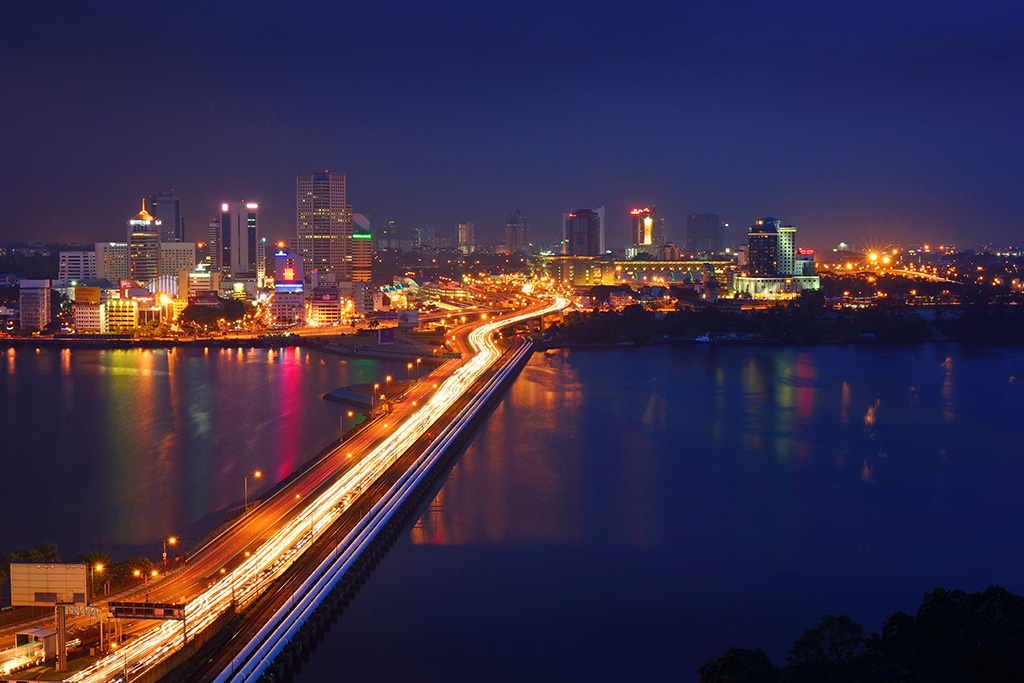
A five-minute cross-border rail journey, a 3,500-square-kilometre economic zone and Singapore’s search for more affordable space are reshaping the investment case for Malaysia’s southern gateway.
For years, Johor Bahru occupied an unusual position in Asian real estate.
It was geographically close to one of the world’s most important financial centres, yet psychologically separated from it by traffic congestion, immigration queues and an unpredictable daily border crossing.
Singapore and Johor Bahru could be seen from opposite sides of the strait, but they did not always function like one connected urban economy.
That may be about to change.
The Johor Bahru–Singapore Rapid Transit System Link is targeted to begin passenger service at the end of 2026. At the same time, Malaysia and Singapore are developing the Johor-Singapore Special Economic Zone, or JS-SEZ, to make it easier for companies, workers, goods and investment to operate across both jurisdictions. (Land Transport Authority)
Together, these initiatives could turn Johor Bahru into something more significant than a lower-cost neighbour to Singapore.
They could create a genuine cross-border property market.
The Five-Minute Journey That Could Change Johor Bahru
The RTS Link will connect Bukit Chagar in central Johor Bahru with Woodlands North in Singapore.
The rail journey between the two stations is expected to take approximately five minutes. The system is designed to carry as many as 10,000 passengers per hour in each direction during peak periods. Passengers will clear both Malaysian and Singaporean immigration at their departure point through co-located customs, immigration and quarantine facilities. (Land Transport Authority)
That immigration arrangement may be just as important as the train itself.
The existing Causeway is frequently congested, making cross-border commuting difficult to predict. A five-minute train ride is valuable, but the greater investment benefit may come from making the complete journey more consistent.
Property markets respond strongly to reliable travel time.
A home that is theoretically close to an employment centre can remain unattractive when the daily commute is uncertain. Once that journey becomes dependable, the area around the transit connection can begin to function as part of a much larger employment market.
Bukit Chagar is therefore not merely another railway station. It could become the central gateway between Malaysian housing and Singaporean employment.
Singapore’s Affordability Pressure Moves North
Singapore offers security, infrastructure, employment and international connectivity, but its limited land supply has created one of Asia’s most expensive residential markets.
Johor Bahru presents the opposite proposition: more space, a lower property-price base and extensive land available for new residential, commercial and industrial development.
That contrast creates an obvious cross-border opportunity.
Malaysians employed in Singapore may be able to earn income in Singapore while maintaining a home in Johor. Singapore residents may consider Johor for second homes, retirement, weekend living or investment property. Companies operating in Singapore may also place selected employees, warehouses, production facilities or support functions across the border.
The RTS Link does not eliminate the border, but it may reduce the practical importance of that border for certain households and businesses.
In property terms, Singapore’s economic influence could begin moving farther into Johor Bahru.
The Johor-Singapore Special Economic Zone
The railway is only one part of the transformation.
Malaysia and Singapore formally exchanged their agreement establishing the JS-SEZ in January 2025. The initiative is intended to improve cross-border movement, strengthen the business ecosystem and allow companies to combine Singapore’s financial, corporate and technological strengths with Johor’s land, labour and industrial capacity. (Economic Development Board)
The economic zone covers more than 3,500 square kilometres—over four times the size of Singapore—and contains nine investment zones serving 11 sectors. These include the digital economy, financial services, logistics, manufacturing, tourism, healthcare, education, energy and business services. (Economic Development Board)
The two countries initially targeted 50 investment projects and 20,000 skilled jobs during the zone’s first five years. (Reuters)
That matters to real estate because sustainable property demand ultimately comes from economic activity.
Railways can increase land values, but employment creates tenants. Businesses create office demand. Factories create logistics requirements. Skilled workers create demand for housing, schools, healthcare, retail and entertainment.
The strongest investment case for Johor Bahru is therefore not based solely on Singaporeans buying inexpensive condominiums.
It is based on the possibility that the JS-SEZ creates a larger integrated economy on both sides of the border.
Property Prices Are Already Responding
Evidence of renewed investor interest began appearing before the RTS Link opened.
JLL reported that Johor Bahru’s average serviced-apartment transaction prices increased by 20.4% in the second quarter of 2025 compared with the 2024 annual average. Double-storey terrace houses rose by approximately 8.6% over the same period. (JLL)
For the full year, JLL Malaysia reported serviced-apartment price growth of 25.4%, although that figure was influenced by transactions in selected developments, including R&F Princess Cove. Apartment and condominium prices rose by 7.5%, while two-storey terrace houses recorded 11% growth. (StarProperty)
Those increases sound dramatic, but the broader picture is more complicated.
Johor’s residential transaction volume declined by 17% in 2025, while total transaction value fell by 6%. JLL consequently warned that a market correction remained possible even as it identified further growth potential in well-connected locations. (StarProperty)
This is a crucial distinction for offshore investors.
Higher reported prices do not always mean that every unit is becoming easier to sell. A market can record strong pricing in selected new developments while overall transaction activity weakens.
The result is a market that appears promising—but highly selective.
The Areas Most Likely to Benefit
The most obvious property story surrounds Bukit Chagar and central Johor Bahru.
Developments within practical walking or feeder-transit distance of the RTS station may appeal to cross-border professionals who value reliability above larger unit sizes or resort amenities. JLL expects transport hubs and RTS-adjacent locations to benefit from residential demand and rental markets serving professionals who commute between Johor and Singapore. (JLL)
Other areas may benefit for different reasons.
Central Johor Bahru
The city centre offers proximity to Bukit Chagar, customs facilities, shopping, healthcare and established commercial districts. Its investment proposition is based largely on cross-border access.
Iskandar Puteri
Iskandar Puteri has attracted major residential communities, schools, industrial projects and data-centre investment. Its appeal is broader than commuting, although it is farther from the RTS terminus.
Tebrau and Mount Austin
These districts have developed into established residential and lifestyle areas with restaurants, retail and local demand. They may offer a more conventional Johor housing story than projects marketed primarily to foreign investors.
Industrial and Logistics Corridors
The JS-SEZ may also create opportunities beyond residential property. Warehouses, worker accommodation, business parks, healthcare facilities and neighbourhood retail could benefit if manufacturing and logistics investment produces the employment growth envisioned by both governments. (Economic Development Board)
The important lesson is that “Johor Bahru property” is not one market.
A transit-oriented condominium, suburban family house and industrial warehouse depend on very different sources of demand.
Singapore’s Data-Centre Boom Has Already Crossed the Border
Johor’s growing relationship with Singapore is not theoretical.
The state became a major beneficiary of Singapore’s earlier restrictions on new data-centre development. Reuters reported that Johor attracted approximately US$35 billion in data-centre investment, including projects associated with major international technology companies. Planned capacity, including developments under construction and in the pipeline, could increase eightfold to approximately 7,000 megawatts. (Reuters)
This expansion demonstrates how quickly Singapore-linked business activity can move into Johor when land, power and scale become limiting factors south of the border.
It can also support property demand by creating construction employment, technical jobs, supplier activity and new commercial requirements.
But there is another side to the story.
Johor residents have raised concerns about electricity consumption, water availability, construction disruption and environmental pressure. The state has tightened scrutiny of proposed projects and prohibited certain extremely water-intensive data-centre designs. (Reuters)
The data-centre boom therefore illustrates both Johor’s opportunity and its central risk: investment can arrive faster than infrastructure and communities can comfortably absorb it.
The Oversupply Question Has Not Disappeared
Johor Bahru has experienced property excitement before.
Large numbers of high-rise units were developed during earlier periods of optimism surrounding Iskandar Malaysia and anticipated Singapore demand. Not every project achieved the occupancy, rental rates or resale liquidity originally promoted.
That history should make today’s investors more disciplined.
The RTS Link is real infrastructure, and the JS-SEZ is a formal bilateral initiative. But neither guarantees that every nearby development will perform well.
A project can be close to Singapore on a map and still be inconvenient in practice. A condominium can offer an impressive view yet struggle with poor maintenance, high service charges, weak management or hundreds of competing rental units.
Investors should pay particular attention to:
- The actual walking route to Bukit Chagar or other transport links
- The developer’s completion and management record
- Existing occupancy rather than projected occupancy
- The number of similar units under construction nearby
- Service charges and sinking-fund adequacy
- Tenant demand outside weekends and holidays
- Resale activity in the completed development
- Flooding, traffic and local infrastructure
- Whether the property serves local residents or depends almost entirely on foreign buyers
The strongest project may not be the one with the most dramatic Singapore-themed marketing.
It may be the development that works as a practical home for people who genuinely live and work in the region.
Foreign Buyers Need Local Legal Advice
Non-Malaysian citizens and foreign companies generally require consent from the relevant Malaysian state authority when acquiring land or eligible property. Johor also maintains its own rules for foreign interests, property categories and approval procedures. (JKPTG)
Purchase thresholds, eligible property types, consent fees and development-specific conditions may change. Buyers should therefore obtain independent advice from a Malaysian property lawyer before paying a reservation fee or signing a sale agreement.
Foreign investors should verify:
- Whether the unit is eligible for foreign ownership
- Whether state consent is required and likely to be granted
- The title type and remaining lease period
- Restrictions affecting resale or rental
- Stamp duty, legal fees and state charges
- Financing availability for non-residents
- Tax treatment when the property is sold
- Whether rental income may be lawfully repatriated
- The legal status of any guaranteed-rental arrangement
Currency also matters. A property priced in Malaysian ringgit may appear inexpensive to a buyer earning Singapore dollars, but exchange-rate movements can affect returns when rental income, financing and eventual sale proceeds are measured in another currency.
Is Johor Bahru Becoming a Suburb of Singapore?
Not exactly.
Johor Bahru remains a major Malaysian city with its own economy, population, government and property market. Singapore and Johor will also continue to have separate immigration systems, currencies, laws and regulatory structures.
But economically, the distinction may become less rigid.
Singapore can provide capital, corporate headquarters, technology, financial services and international connectivity. Johor can provide land, housing, industrial capacity, labour and space for expansion.
The RTS Link may allow people to move between those complementary systems with far greater reliability. The JS-SEZ is intended to help businesses do the same.
That is why Johor Bahru’s property story is larger than a railway station.
It is about whether two neighbouring markets can begin functioning as one connected economic corridor.
The Market Nobody Saw Coming—Twice
Johor Bahru has been promoted as Singapore’s next property frontier before, and some earlier investors learned that proximity alone was insufficient.
This time, however, several pieces are moving together: physical rail infrastructure, coordinated immigration, a bilateral economic zone, industrial investment and genuine demand for alternatives to Singapore’s high costs.
That does not remove the risk of oversupply. It makes selection more important.
The likely winners will be properties supported by real employment, dependable transportation, strong management and neighbourhoods where people want to live even when the investment narrative is removed.
The likely losers will be generic units sold entirely on the promise that Singapore is nearby.
The Causeway has always connected Singapore and Johor Bahru geographically.
The RTS Link and JS-SEZ may finally connect them economically.
For offshore real estate investors, the decisive question is no longer whether Singapore’s property influence will cross the border.
It is which parts of Johor Bahru will be ready when it arrives.
Leave a Reply