
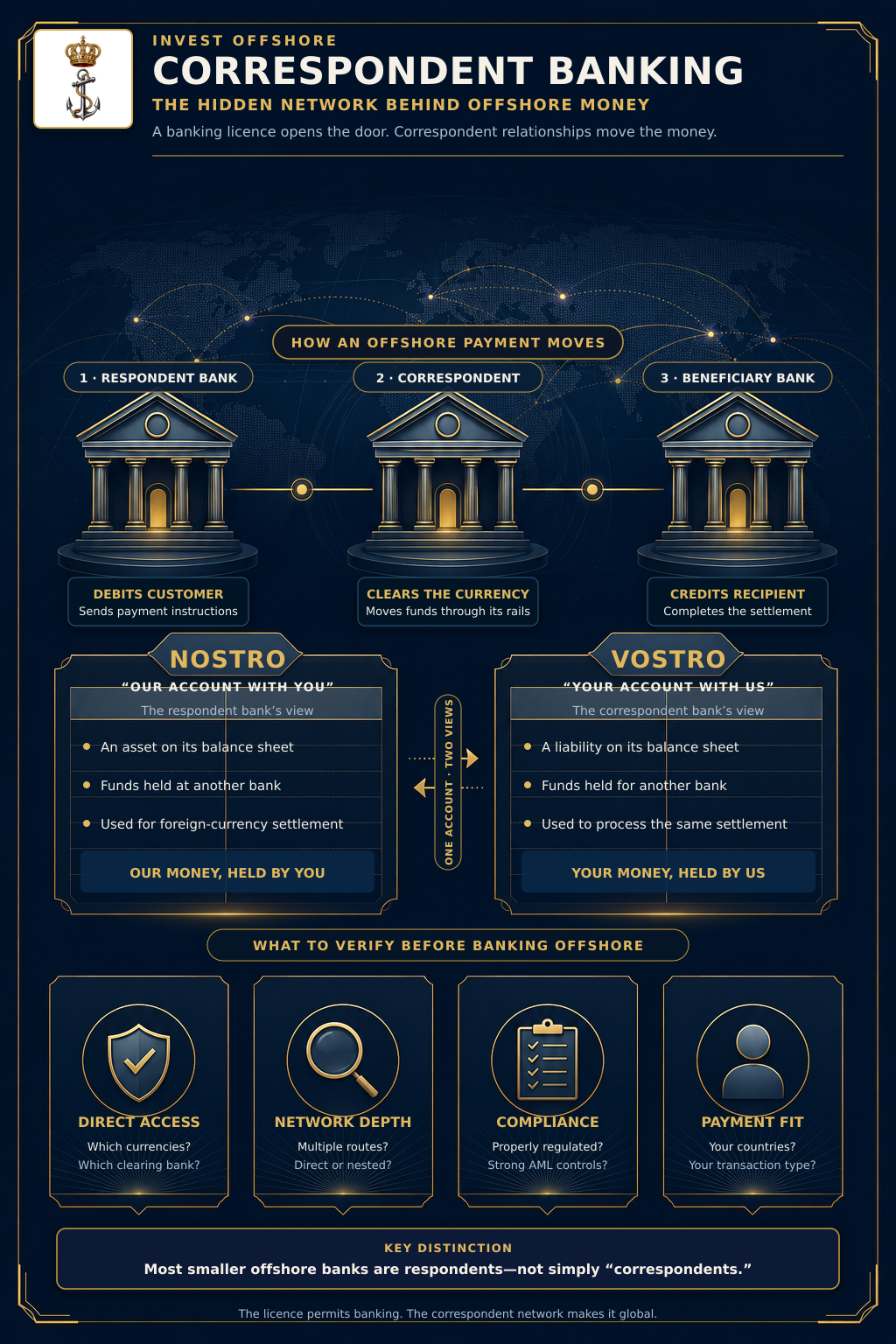
When money moves from an offshore bank in the Cayman Islands, Bermuda or the Bahamas to New York, London or Zurich, the transaction rarely travels directly between the customer’s bank and the final recipient.
Behind the payment is a network of correspondent banks, intermediary institutions and internal accounts known as Nostro and Vostro accounts. This largely invisible infrastructure is what gives a smaller offshore bank access to major currencies and financial centres where it has no branch of its own.
Understanding that network is essential when evaluating an offshore bank. A banking licence may establish the institution’s legal authority to accept deposits, but its correspondent relationships determine how effectively those deposits can move around the world.
What Is a Correspondent Bank Agreement?
A correspondent banking agreement allows one bank to provide services to another bank located in a different jurisdiction.
The bank providing the services is the correspondent bank. The institution using those services is commonly called the respondent bank.
Under the agreement, the correspondent may provide:
- International wire transfers
- Foreign-currency clearing
- Cheque clearing and settlement
- Cash-management services
- Foreign exchange
- Trade finance
- Access to national payment systems
- Custody of securities or deposits
The Bank for International Settlements defines correspondent banking as an arrangement in which one bank holds deposits owned by another bank and provides payment and related services to it. The arrangement allows banks to operate internationally without maintaining branches in every country or joining every domestic payment system directly. Bank for International Settlements
A Cayman bank, for example, may maintain an account with a major New York institution. The Cayman bank can then use that account to receive and send US dollars through the American payment system.
Nostro and Vostro: Two Views of the Same Account
Nostro and Vostro are not necessarily two separate accounts. They are frequently two descriptions of the same account from opposite sides of the banking relationship.
The terms come from Latin:
- Nostro means “ours.”
- Vostro means “yours.”
Suppose Cayman Bank A maintains a US-dollar account with New York Bank B.
From Cayman Bank A’s perspective, the account is:
Our money held by you.
It is therefore recorded as Cayman Bank A’s Nostro account.
From New York Bank B’s perspective, it is:
Your money held by us.
It is therefore recorded as Cayman Bank A’s Vostro account.
| Perspective | Account description |
|---|---|
| Cayman Bank A | Nostro: our account with New York Bank B |
| New York Bank B | Vostro: Cayman Bank A’s account with us |
The underlying funds are the same. The terminology changes according to which bank is viewing its accounting records.
“Loro,” meaning “theirs,” may also appear when one institution refers to an account held by a third bank.
A Practical Offshore Payment Example
Imagine that a customer of a Cayman bank must send US$500,000 to a supplier whose account is with a Canadian bank.
The transaction might follow this path:
- The Cayman bank debits its customer’s account.
- It sends payment instructions through SWIFT.
- Its US correspondent debits the Cayman bank’s US-dollar Nostro balance.
- The funds move through the relevant dollar-clearing network.
- A correspondent serving the Canadian bank receives the payment.
- The Canadian bank credits the supplier.
SWIFT normally carries the standardized payment instructions; it does not itself hold the customer’s money. Settlement occurs through accounts maintained by the participating banks.
If neither institution has a direct relationship with the other, one or more intermediary banks may be inserted into the payment chain. Each additional institution can add fees, compliance reviews and processing time.
Why Correspondent Banking Matters Offshore
Correspondent access is especially important in international financial centres with relatively small domestic economies.
An offshore bank may be fully licensed and well capitalized but still lack direct membership in the US Federal Reserve’s payment systems, the United Kingdom’s sterling infrastructure or the euro area’s settlement systems. Its correspondent banks become its gateways into those markets.
A dependable network can determine whether the bank can:
- Send and receive major currencies reliably
- Process larger commercial transactions
- Provide trade-finance services
- Serve internationally active companies
- Settle securities and foreign exchange
- Maintain predictable payment times
- Avoid excessive intermediary charges
The loss of even one important relationship can have serious consequences. A bank that loses its principal US correspondent may still hold customer deposits but temporarily struggle to clear US-dollar transfers.
This is why “de-risking”—the termination of relationships considered too expensive or risky to supervise—has been particularly disruptive to smaller financial centres. An IMF report found that 21 of 23 surveyed Caribbean banks had lost at least one correspondent relationship, while eight were operating with only one provider. International Monetary Fund
The World Bank has similarly reported that correspondent withdrawals have affected international wires, clearing, cash management and trade finance, with US-dollar services experiencing the greatest pressure. World Bank
Which Offshore Banks Have the Most Correspondents?
There is no reliable public league table ranking offshore banks by their number of correspondent relationships.
Banks do not report them using a common standard. Some disclose only their principal payment routes, some identify correspondent banks by currency, and others keep the relationships confidential for operational or security reasons. A bank may also have several accounts with one correspondent, indirect access through an intermediary, or relationships that are available only for certain customers and transactions.
As a result, claims that a particular offshore institution has “the most correspondent banks” should be treated cautiously unless supported by current wire instructions, audited disclosures or direct confirmation from the institutions involved.
Cayman National provides a useful public example of a diversified network. Its published wire instructions identify three alternative US-dollar correspondents—Citibank, Wells Fargo and BNY Mellon—along with multiple routes for other currencies. This demonstrates direct access through several major institutions, although it does not establish that Cayman National has the largest offshore network. Cayman National wire instructions
Large international groups operating in offshore centres—such as HSBC, Scotiabank and Butterfield—may also benefit from group infrastructure, branches, affiliates and established clearing relationships. However, an internal transfer between two offices of the same banking group is not necessarily a correspondent transaction.
The quality of a network can be more important than its raw size. Three stable, direct relationships covering dollars, euros and sterling may be more valuable than 20 indirect arrangements with limited capabilities.
Are Offshore Banks “Just Correspondents”?
This question contains an important distinction: a correspondent bank is not a separate legal class of bank.
“Offshore bank” describes where or under what licence an institution operates. “Correspondent” and “respondent” describe the role it performs in a particular relationship.
A bank can therefore be all of the following:
- An offshore or international bank under its local licence
- A respondent using a larger institution for dollar clearing
- A correspondent providing services to smaller banks
- A direct clearing member for one currency
- An indirect participant for another currency
There is no credible global statistic showing how many offshore banks are “just correspondents,” because the category does not exist in regulatory data.
In practice, most small offshore banks are better described as respondents rather than correspondents. They rely on larger institutions for access to major currencies. Some regional offshore banks may simultaneously provide correspondent services to smaller institutions.
A respondent bank is also not the same thing as a shell bank. A shell bank generally lacks a meaningful physical presence and is unaffiliated with a regulated financial group. International standards prohibit institutions from maintaining correspondent relationships with shell banks. A legitimate offshore bank should have identifiable management, regulated operations, appropriate records and a genuine physical presence.
The Real Due-Diligence Questions
When evaluating an offshore bank, the useful question is not simply, “Does it have SWIFT?”
A SWIFT code provides an address on the financial messaging network. It does not prove that the institution has durable access to dollar clearing or that every payment can be completed without intermediaries.
More revealing questions include:
- Which banks currently clear its US dollars, euros, sterling and Swiss francs?
- Are those relationships direct or nested through another respondent?
- How long have the principal relationships existed?
- Does the bank maintain more than one route for its most important currency?
- Can it process both incoming and outgoing commercial payments?
- Are any industries or countries restricted?
- How many intermediary institutions normally touch a payment?
- What fees may be deducted before the beneficiary receives the funds?
- Has a correspondent recently suspended or limited the relationship?
Customers should verify this information using current wire instructions and regulated-bank disclosures rather than promotional material alone.
The Banking System Behind the Banking System
Correspondent banking is the connective tissue of offshore finance.
The offshore bank holds the relationship with its customer. The correspondent bank gives that institution access to currencies, clearing systems and markets beyond its own jurisdiction. Nostro and Vostro accounts provide the accounting mechanism through which the two banks settle their obligations.
This also explains why correspondent access is one of an offshore bank’s most valuable—and most vulnerable—assets. A licence may allow the bank to operate, but dependable correspondent relationships allow it to operate internationally.
For depositors, companies and investors, the lesson is straightforward: do not evaluate an offshore bank solely by its jurisdiction, website, stated capital or SWIFT code. Examine the payment network behind it. In cross-border banking, the strength of that network often determines the real utility of the account.
This article is for general information and does not constitute legal, tax, investment or banking advice.
Leave a Reply