
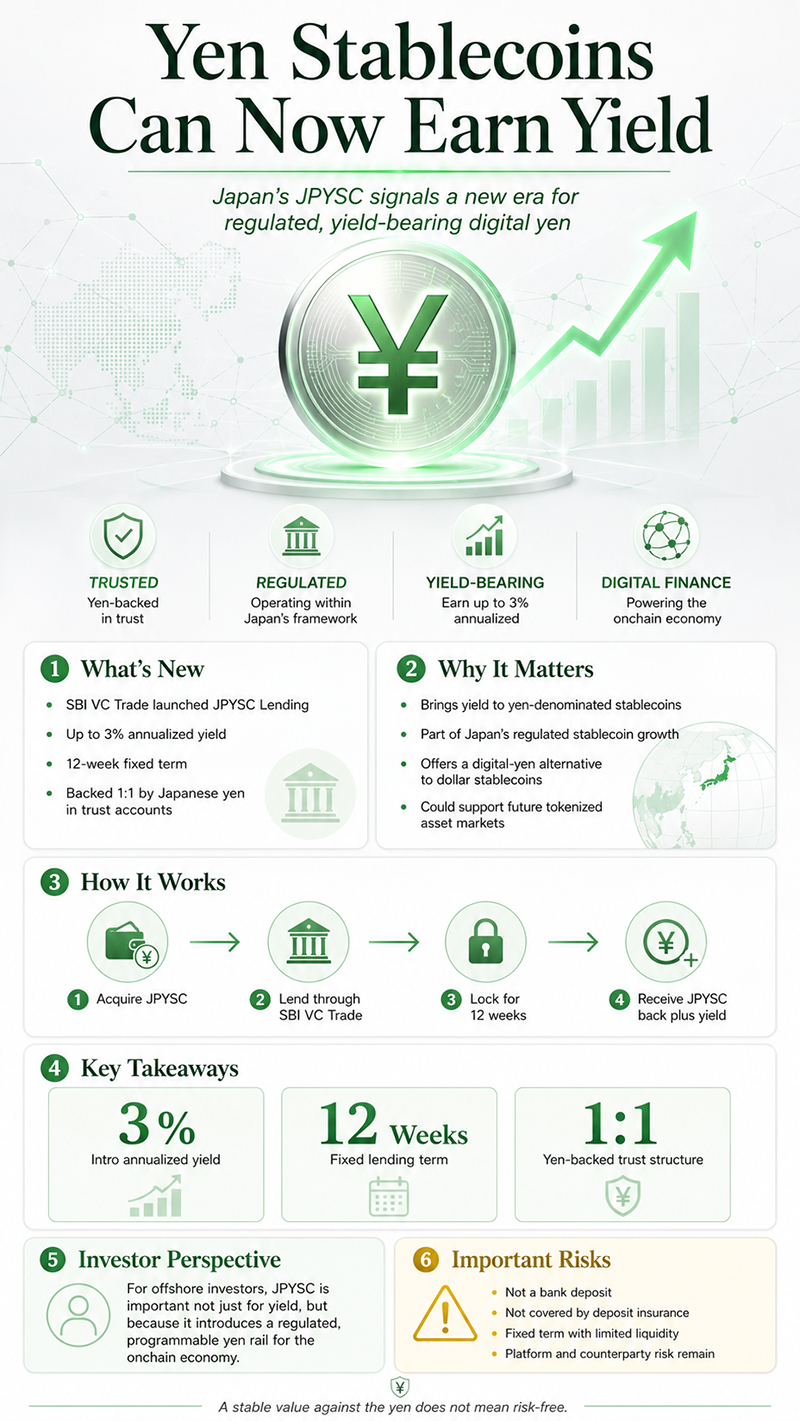
For most of the stablecoin era, earning yield on digital cash has meant accepting exposure to the U.S. dollar. Japan is now beginning to offer another choice: a regulated, yen-denominated stablecoin capable of generating income.
SBI VC Trade has announced JPYSC Lending, a fixed-term service that will initially pay a 3% annualized return on JPYSC deposited for 12 weeks. Applications are scheduled to open on July 16, 2026, with the first lending period beginning July 23. SBI expects future 12-week offerings to carry annualized rates of approximately 1% to 3%, depending on market conditions.
This may look like a modest new savings product. In reality, it represents something much more important: the transformation of the Japanese yen from conventional bank money into a programmable, potentially income-producing digital asset.
What Is JPYSC?
JPYSC is a Japanese yen stablecoin developed by SBI Holdings and Startale Group. It is issued by SBI Shinsei Trust & Banking and distributed through SBI VC Trade.
The token is structured as a trust-based Type III Electronic Payment Instrument under Japan’s financial regulatory system. It is designed to maintain a fixed value of one JPYSC to one Japanese yen, with holders able to redeem one token for one yen through the issuer. SBI says the token is supported by yen and equivalent assets held and managed within the trust structure.
JPYSC began its initial rollout on June 24, 2026. For now, its use is largely confined to the SBI VC Trade account environment, and users cannot yet freely transfer it to outside blockchain wallets. SBI and Startale ultimately intend to connect the digital yen with public blockchain networks, traditional financial infrastructure and tokenized-asset markets.
That restricted first phase makes JPYSC less decentralized than many familiar crypto assets. It also makes it distinctly Japanese: carefully regulated, institutionally controlled and introduced gradually rather than released into an unrestricted global market.
How the 3% Yield Works
Customers participating in JPYSC Lending are not placing yen into a bank savings account. They are lending their JPYSC to SBI VC Trade under a fixed-term loan agreement.
SBI then returns the same quantity of JPYSC at maturity, together with the agreed lending fee. The introductory term is 84 days, or 12 weeks, and early cancellation is generally unavailable. Returns are paid in JPYSC rather than in conventional bank deposits.
Because the advertised 3% rate is annualized, the actual gross return over 12 weeks is approximately 0.69%. A participant lending ¥1 million worth of JPYSC would therefore earn about ¥6,904 before tax, assuming the full introductory rate and term.
The figure is not spectacular by crypto-market standards. But that is precisely the point. JPYSC is not being promoted as a speculative token offering double-digit DeFi rewards. It is being presented as a regulated digital-yen instrument offering a return above many conventional Japanese term deposits.
Why This Matters for Japan
Japan’s stablecoin market is developing within one of the world’s most structured digital-asset regulatory environments.
The country established its core electronic-payment-instrument framework through earlier amendments to the Payment Services Act. A further amendment enacted in June 2025 strengthened protections surrounding service providers and created a regulated intermediary category for businesses connecting customers with stablecoin and crypto platforms.
This legal infrastructure has allowed Japan to proceed differently from jurisdictions where stablecoins first expanded and regulators attempted to catch up later. Japan is building the regulated distribution system before permitting widespread circulation.
The result could be especially significant in a country where households traditionally hold a large proportion of their wealth in cash and deposits. A digital yen that combines price stability, regulated custody and a competitive yield could introduce conservative savers to blockchain finance without requiring them to purchase Bitcoin, accept dollar exposure or navigate decentralized lending protocols.
The Yen Enters the Stablecoin Yield Market
Dollar stablecoins such as USDC have become widely used as digital collateral, settlement money and yield-producing assets. SBI VC Trade itself introduced a regulated USDC lending service in March 2026 before announcing the JPYSC product.
JPYSC adds an important missing component: native yen yield.
That creates several possible uses:
A Japanese company could hold working capital in digital yen while earning income between settlement dates. An international investor could maintain yen exposure without keeping all funds inside a traditional bank account. A tokenized securities platform could eventually settle Japanese bonds, funds or real-world assets using a regulated onchain yen instrument.
For offshore investors, the attraction is not simply the 3% rate. It is the emergence of another sovereign-currency rail outside the dollar stablecoin system.
A functioning yen stablecoin could eventually support:
- Asian cross-border trade and treasury management;
- settlement of tokenized Japanese securities;
- currency diversification for international digital portfolios;
- programmable corporate payments;
- regulated collateral for future onchain financial markets.
JPYSC may therefore become more valuable as financial infrastructure than as a standalone investment product.
Yield Does Not Eliminate Risk
The trust structure supporting JPYSC should not be confused with the lending arrangement offered by SBI VC Trade.
Once customers lend their JPYSC, the tokens are not treated as segregated customer assets under the same protections that apply while they are simply held through the platform. SBI’s disclosure states that customers could lose some or all of the lent JPYSC if SBI VC Trade became insolvent. The product is also not a bank deposit and is not protected by Japan’s deposit insurance system.
Participants must also consider:
- the inability to exit during the fixed lending period;
- platform and counterparty risk;
- changes to future lending rates;
- taxation of lending income;
- yen exchange-rate risk for investors whose base currency is dollars, euros or another currency;
- the present lack of unrestricted external-wallet transfers.
A stable value against the yen does not mean a risk-free investment. It only removes much of the price volatility normally associated with crypto assets.
A New Model for Digital Cash
JPYSC Lending signals an evolution in the stablecoin market.
The first generation of stablecoins concentrated on maintaining a currency peg. The second concentrated on payments and crypto trading. The next generation will combine regulated issuance, tokenized settlement, programmable ownership and carefully structured yield.
Japan appears determined to participate in that next phase without abandoning its traditional emphasis on trust institutions and financial supervision.
The introductory 3% rate may be temporary, and JPYSC remains in the early stages of deployment. Yet the underlying direction is unmistakable. The yen is moving onto blockchain infrastructure, and once digital yen can be held, transferred, invested and used to settle tokenized assets, it becomes more than an electronic copy of conventional money.
It becomes working capital for the onchain economy.
For Invest Offshore readers, JPYSC deserves attention not because 3% is an extraordinary return, but because it demonstrates that the future stablecoin market may not remain exclusively dollar-denominated. Japan is beginning to turn one of the world’s major currencies into regulated, programmable and yield-bearing digital money.
This article is for informational purposes and does not constitute investment, legal or tax advice.

Leave a Reply