
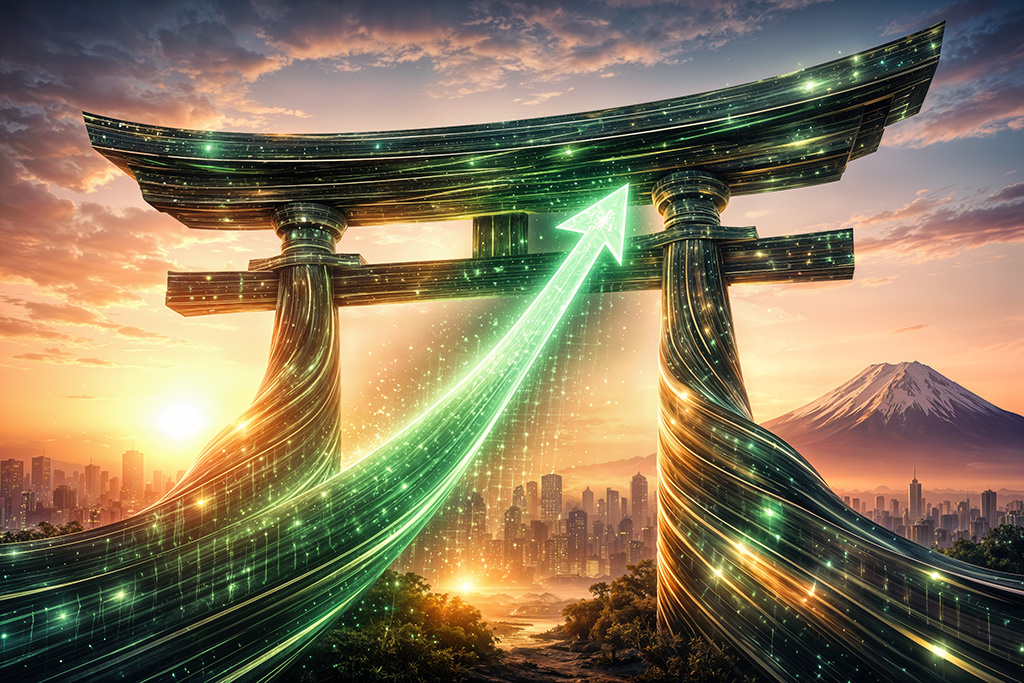
Japan just did something historic.
The Nikkei has crossed the 71,000 level for the first time, extending one of the most violent developed-market rallies in modern history. In only three months, the index has surged roughly 37%, adding an estimated ¥386 trillion — about $2.6 trillion — in market value.
That is not a normal rally. That is a global capital rotation.
For decades, Japan was the market investors loved to ignore. It was the land of deflation, aging demographics, zombie banks, sleepy boards, trapped cash, and false dawns. Now, almost overnight, Japan has become the market that nobody can afford to ignore.
Recent reports already showed the Nikkei breaking record after record — topping 67,000, then 68,000, then surging above 69,000 and 70,000 as AI, a weak yen, political momentum, and corporate reform collided into one powerful trade. (reuters.com)
Why Japan Is Exploding Higher
There are five major forces behind the move.
First, Japan is becoming an AI infrastructure market. The rally is no longer just about Toyota, banks, and exporters. It is about semiconductors, robotics, automation, data centers, power systems, and the companies that sit inside the global AI supply chain. SoftBank has become the symbol of this new Japan, with AI exposure helping it overtake Toyota as Japan’s most valuable company in recent market action. (reuters.com)
Second, the weak yen is acting like financial jet fuel. A soft yen inflates the foreign earnings of Japanese multinationals when translated back into yen. It also makes Japanese assets look cheaper to foreign buyers. But this is a dangerous blessing. Tokyo is already warning that it may intervene if yen volatility becomes disorderly. (reuters.com)
Third, corporate Japan is finally being forced to care about shareholders. The Tokyo Stock Exchange has pushed listed companies to focus on cost of capital, stock price, market capitalization, disclosure, buybacks, and capital efficiency. This is a structural change. Japan is no longer merely “cheap.” It is being repriced. (Japan Exchange Group)
Fourth, inflation has changed the psychology. Japan spent a generation trying to escape deflation. Now inflation, wages, and nominal growth are back in the conversation. The Bank of Japan has even raised rates to 1%, the highest level in decades, yet equities continue to climb because investors believe nominal earnings growth can absorb higher rates. (reuters.com)
Fifth, foreign capital is chasing performance. Once the Nikkei broke its old highs, global allocators had to look again. Japan moved from “under-owned value trap” to “must-own global reflation trade.” That kind of repositioning can feed on itself.
The Hidden Risk: This Is Becoming Concentrated
The most important warning is that the rally is not evenly distributed.
At several points, AI-linked stocks and a handful of mega-cap names have carried the index while the broader market lagged. That matters because the Nikkei is price-weighted, not market-cap weighted like many global benchmarks. A small number of high-priced stocks can move the index dramatically.
In plain English: Japan is booming, but not all of Japan is booming equally.
That creates opportunity, but it also creates fragility. If AI enthusiasm cools, if SoftBank stumbles, if semiconductor momentum breaks, or if the yen suddenly strengthens, the same forces that pushed the Nikkei upward could reverse quickly.
What Happens Next?
There are three likely paths.
The bullish path is continuation. If AI capex keeps rising, the yen remains weak but controlled, corporate reforms continue, and foreign investors keep buying, the Nikkei could push materially higher. In that scenario, Japan becomes the non-U.S. equity market of the decade.
The consolidation path is healthier. After a 37% move in three months, Japan may need to digest gains. A pullback or sideways period would not kill the bull market. It may actually strengthen it by allowing earnings to catch up with price.
The danger path is a policy shock. If the yen collapses too quickly, Tokyo may intervene. If the Bank of Japan tightens harder than expected, bond yields could pressure equities. If global AI stocks correct, Japan’s hottest names may be hit first.
The Invest Offshore View
Japan’s move through 71,000 is not just a stock market milestone. It is a message.
Capital is searching for the next great repricing. It found one in Japan.
The old Japan was deflation, cash hoarding, and corporate caution. The new Japan is AI infrastructure, shareholder reform, weak-currency leverage, and global capital inflows.
But investors should remember one rule: the faster the melt-up, the thinner the ice for black swans landing.
Japan may still have room to run. But after adding $2.6 trillion in market value in three months, the Nikkei is no longer a hidden opportunity. It is now a global momentum trade — and momentum trades demand respect.
Leave a Reply