
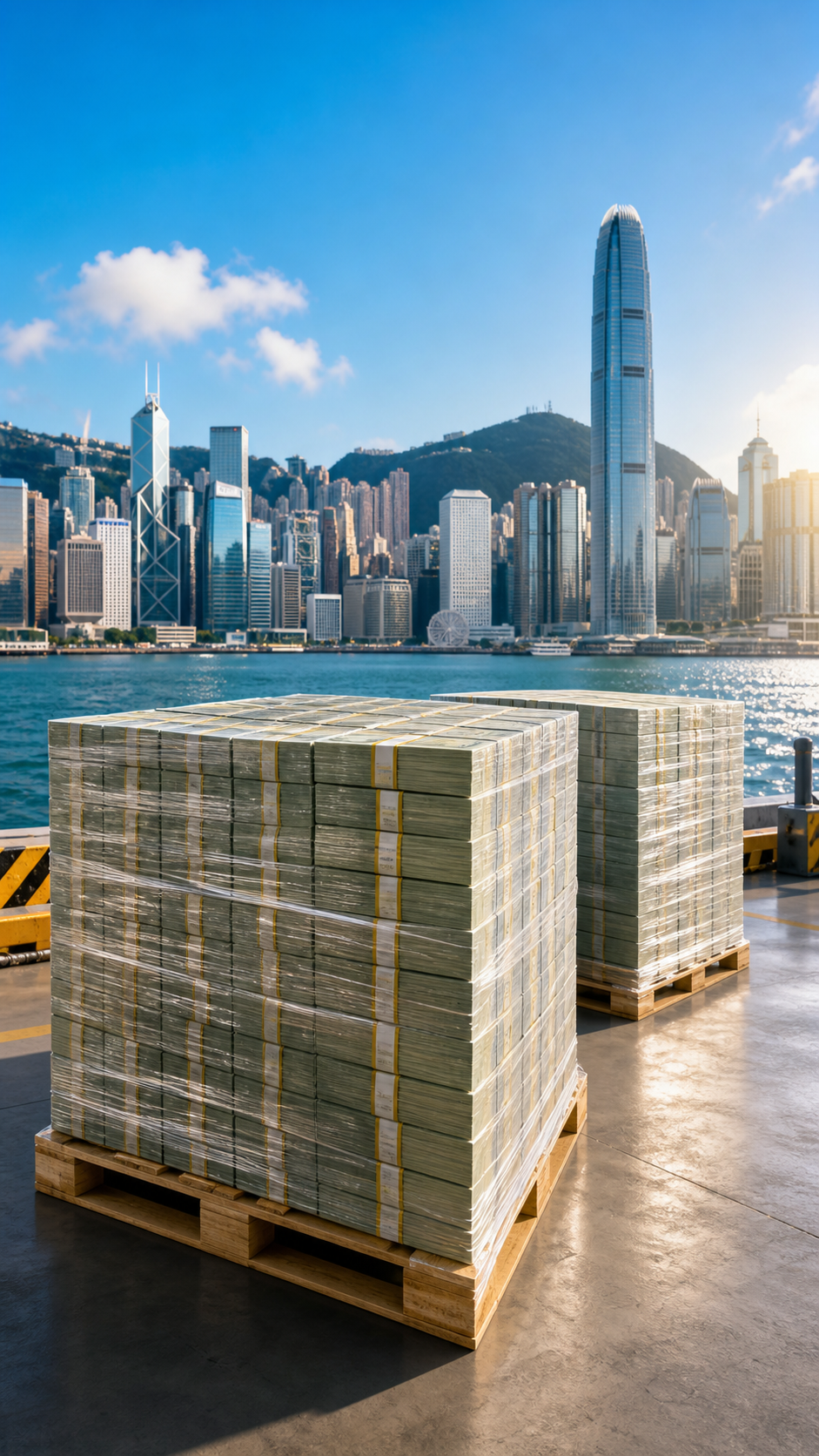
A trusted source has provided Invest Offshore with details of a proposed Hong Kong-based USD cash pallet redemption structure that, if confirmed and executed through proper institutional channels, may represent one of the more efficient redemption models currently being discussed in the market.
The essential point is simple: the pallets do not move.
Instead, title moves.
The Hong Kong Pallet Structure
According to the source, large volumes of USD cash pallets are currently located in Hong Kong and have already been verified by the Federal Reserve-side process. The transaction model being described is as follows:
A qualified bank or wealthy individual buyer purchases the pallets at:
100% face value less 15% buyer profit and 5% intermediary compensation.
In practical terms, this means the buyer participates in a short-duration transaction where the pallet title is transferred, the physical currency remains in Hong Kong, and the destruction process is handled locally under the relevant authority.
The Federal Reserve then delivers destruction certificates and pays 100% based on those certificates.
The stated result: the buyer may earn a 15% gross profit over a maximum period of a couple of weeks, assuming all documents, verification, title transfer, destruction, certification, and settlement occur as represented.
Why the Pallets Do Not Need to Move
This is the key feature.
Traditional cash pallet transactions often become complicated because sellers and intermediaries focus on logistics: movement, custody, armored transport, insurance, cross-border controls, customs, and security. Every movement of physical currency creates risk.
In this model, the pallets remain where they are.
The transaction is structured around:
- Verified inventory
- Buyer proof of funds
- Transfer of title
- Local destruction
- Issuance of certificates
- Final settlement against those certificates
This is cleaner than a physical movement model because the underlying value is not extracted by transporting the pallets. It is extracted by completing the verified destruction and redemption cycle.
Minimum Purchase: $10 Billion
The source indicates that the minimum purchase size is $10 billion.
That immediately removes casual buyers, small groups, and speculative intermediaries from the table. This is not a retail transaction. It is not a “try one pallet first” opportunity. It is a sovereign-scale or institutional-scale transaction.
The proper buyer profile would likely be:
- A private bank
- A major family office
- A sovereign-connected buyer
- A large institutional desk
- A wealthy individual with bankable proof of funds
- A buyer already familiar with blocked funds, settlement procedures, and high-value compliance
Proof of funds is required from the buyer.
The Economics
The economics are being presented as:
- Face value: 100%
- Buyer profit: 15%
- Intermediary compensation: 5%
- Fed-side redemption: 100%
- Expected duration: maximum of a couple of weeks
- Minimum transaction: $10 billion
On a $10 billion transaction, the numbers are enormous.
A 15% buyer profit would represent $1.5 billion in gross spread, while the 5% intermediary allocation would represent $500 million, subject of course to final contract terms, compliance approval, fee protection, tax treatment, and settlement mechanics.
That is why this opportunity, if real and properly documented, belongs only in the hands of serious institutions and highly qualified buyers.
The Critical Documents
No buyer should proceed on verbal representations alone. At this level, the transaction must be document-driven.
The buyer will need to see and verify:
- Proof of pallet existence
- Storage and custody records
- SKR or equivalent warehouse/custody confirmation
- Run-sheet or pallet identification details
- Verification status
- Title transfer procedure
- Destruction protocol
- Certificate issuance process
- Payment undertaking
- Intermediary fee protection
- AML and source-of-funds documentation
- Full legal authority of the seller or mandate
The buyer must also be prepared to provide acceptable proof of funds.
This is where most transactions fail. Sellers often demand CIS and POF before providing enough verifiable inventory detail. Buyers, especially institutional buyers, usually will not expose sensitive financial documentation without first confirming that the asset exists and that the seller controls it.
The solution is a disciplined sequence: proof of asset, proof of authority, proof of funds, contract, title transfer, destruction, certification, settlement.
Why Hong Kong Matters
Hong Kong has long served as a major financial, logistics, and custody hub between East and West. If thousands of verified pallets are indeed held there, the location is significant.
Hong Kong offers:
- Deep banking infrastructure
- Major vaulting and logistics capacity
- Proximity to Asian liquidity
- A mature legal and commercial environment
- Access to institutional intermediaries
- Existing relationships with global banks and custodians
The fact that the pallets reportedly do not need to be moved makes Hong Kong even more important. The jurisdiction becomes the execution venue rather than merely a storage point.
What Happens Next
The opportunity, as described, is straightforward but not simple.
The buyer must be able to show proof of funds for a minimum $10 billion purchase. The seller side must be able to show verified pallet control, title authority, and a clear pathway to destruction certificates and 100% settlement.
If both sides are real, the transaction could move quickly.
If either side is not real, the transaction will collapse immediately under due diligence.
That is the nature of the USD cash pallet market in 2026. The window is narrowing. The stories are many. The real pathways are few.
Invest Offshore View
Invest Offshore continues to monitor verified USD cash pallet redemption pathways involving Hong Kong, Europe, private banks, central banks, and institutional buyers.
The lesson remains the same: at this level, procedure is everything.
The pallets do not need drama. They need documents.
They do not need endless broker chains. They need authority.
They do not need movement. They need title, verification, destruction certificates, and settlement.
For qualified buyers with proof of funds of $10 billion or more, the Hong Kong structure may represent a rare short-duration redemption opportunity — but only if the documentation, authority, and payment pathway are confirmed beyond question.
Leave a Reply