
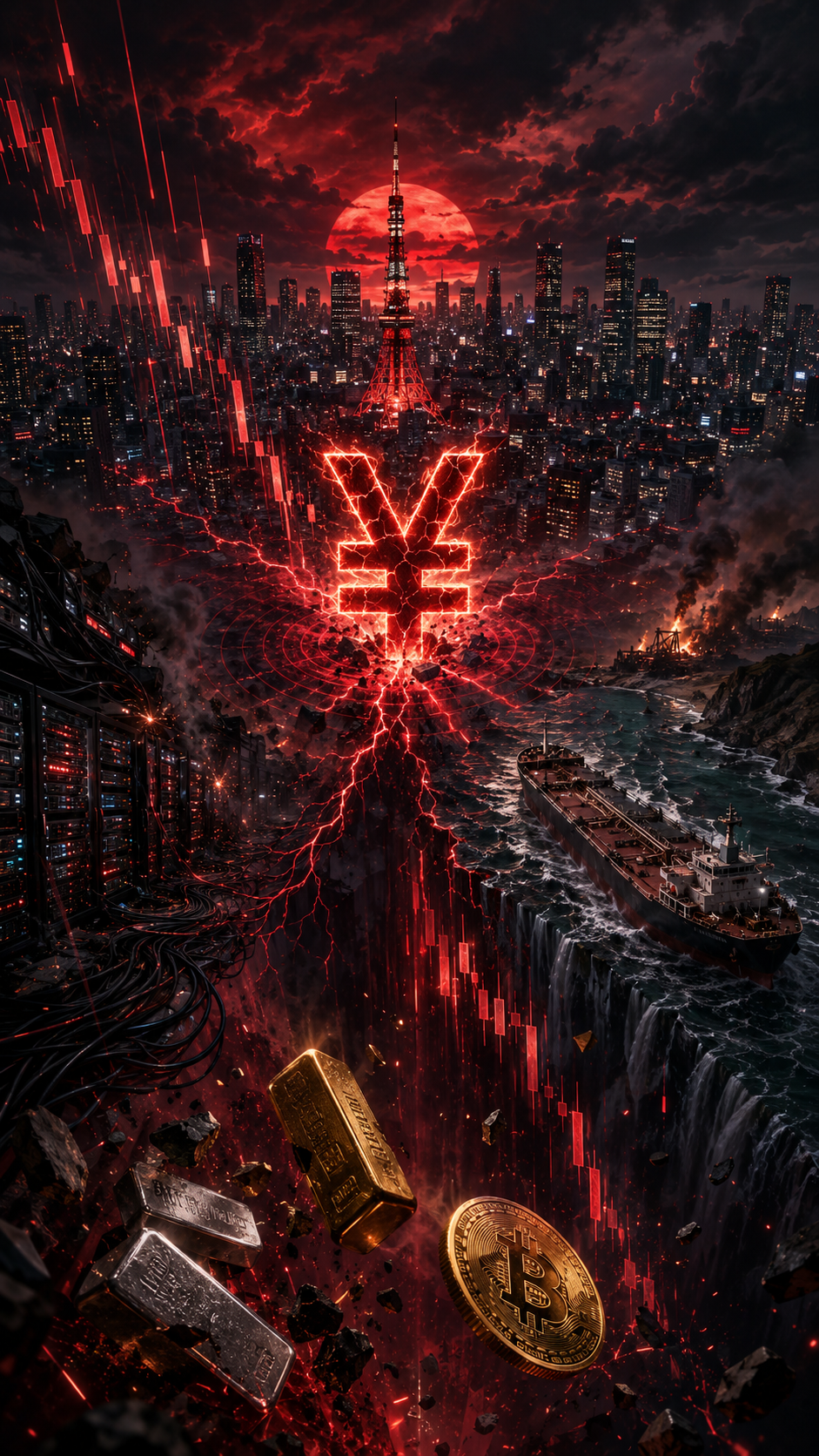
An extraordinary post circulating on X claims that a high-level Bank of Japan source has issued an apocalyptic warning to the West: measures now being prepared in Japan could affect billions of lives, with a solemn apology offered in advance. The post has not been authenticated as an official Bank of Japan communication, but that may almost be beside the point. Whether leak, signal, theater, or psychological warning, it points directly at the most dangerous pressure point in global finance: the yen carry trade. (X (@Yutokanzakireal))
For decades, the world quietly borrowed Japan.
The structure was simple. Borrow cheap yen. Convert into dollars. Buy higher-yielding assets. Treasuries. Equities. Emerging markets. Private credit. Crypto. Real estate. Anything with yield, momentum, or collateral value. Japan’s suppressed interest-rate regime became the hidden funding layer of the Western financial empire.
Now that layer is cracking.
The Bank of Japan raised its policy rate to 1% in June, the highest level in more than three decades, and said it would continue adjusting policy while watching inflation, foreign exchange, and Middle East-related energy risks. Meanwhile, the yen remains under severe pressure, recently trading weaker than 162 per dollar, with markets watching for possible Japanese intervention. (Reuters)
This is the nightmare combination: a weak yen, rising Japanese yields, imported inflation, and a central bank forced to defend credibility after decades of monetary repression.
Japan’s largest banking group is already sounding the alarm. MUFG CEO Junichi Hanzawa warned that a weakened yen could create sustained inflation, crush real wages, damage consumption, and threaten Japan’s recovery. (Reuters) That is not conspiracy. That is the head of Japan’s largest bank warning that the old model has reached its pain threshold.
The real bomb is not only inside Japan. It is inside the global bond market.
Japan remains the largest foreign holder of U.S. Treasuries, with $1.2099 trillion in holdings as of April 2026, far ahead of mainland China’s $651.1 billion. (U.S. Department of the Treasury) If Japan must defend the yen, fund domestic stability, or repatriate capital, the Treasury market feels it. Not because Tokyo needs to “dump everything,” but because the marginal buyer can become the marginal seller.
That is how empires break: not all at once, but at the margin.
The Western system depends on permanent demand for sovereign debt. It depends on low volatility. It depends on foreign savings recycling into U.S. paper. It depends on the illusion that every auction will clear, every deficit will be financed, and every carry trade can be rolled forever.
But if Japanese yields rise, capital has a reason to come home. If the yen snaps higher, carry trades are forced to unwind. If JGB yields keep climbing, global yields may be pushed higher too, with analysts already warning that Japan could become a source of volatility for Treasuries, gilts, and bunds. (The Wall Street Journal)
That is the “final countdown” hidden inside the viral warning.
Not a mushroom cloud. Not a press conference. Not a single dramatic collapse.
A repricing.
The old fiat order was built on synchronized suppression: low rates, central bank balance sheets, offshore dollar recycling, and cheap Japanese funding. The new order is being born through scarcity: higher real yields, stronger collateral demands, currency defense, gold accumulation, and the return of settlement discipline.
The phrase “ancient financial covenants” sounds theatrical, but the covenant itself is real: debt must be serviced, collateral must be honored, and capital eventually returns to where it is treated best.
If Japan calls its capital home, the West loses more than a lender. It loses a silent stabilizer.
For investors, this means the yen is no longer just a currency pair. It is a stress gauge for the entire offshore dollar system. Japanese Government Bonds are no longer sleepy domestic paper. They are the pressure valve for global duration. U.S. Treasuries are no longer risk-free collateral by default. They are political instruments inside a world where the largest foreign creditor has its own inflation problem.
Gold understands this.
Bitcoin understands this.
Hard assets understand this.
The fiat priesthood, however, still pretends the temple stands because the columns have not yet fallen.
The X post may never be confirmed. The alleged insider may be real, fake, or symbolic. But the warning has gone viral because the market already knows the truth: Japan is trapped, the carry trade is crowded, the Treasury market is fragile, and the West has financed comfort with borrowed time.
The Bank of Japan does not need to declare war on the Western empire.
It only needs to normalize.
That alone may be enough to shatter the illusion.
For Invest Offshore readers, the message is simple: watch the yen, watch JGB yields, watch Treasury auctions, watch gold, and watch capital controls. The next phase of the global monetary reset may not begin in Washington, London, or Brussels.
It may begin in Tokyo.
Leave a Reply