
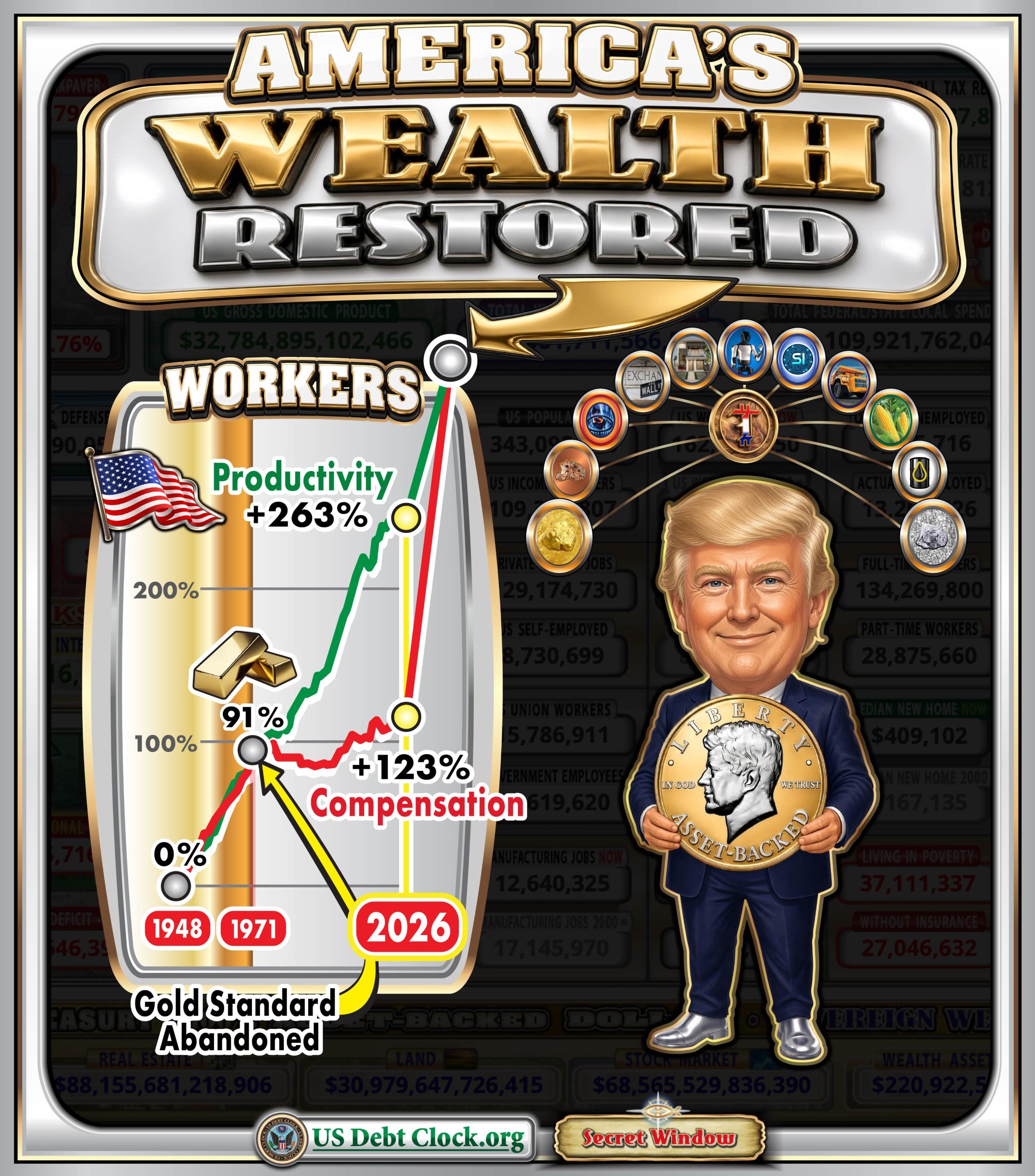
The US Debt Clock has released another “DJT” poster, and this one may be one of the clearest economic arguments in the entire New Money Revolution series.
The headline reads:
America’s Wealth Restored
On the left side is a chart labeled Workers, showing two lines moving apart after the gold standard was abandoned:
Productivity: +263%
Compensation: +123%
On the right stands DJT holding a large silver coin marked:
Liberty
Asset-Backed
Above him is a ring of real-world asset icons: gold, silver, energy, commodities, infrastructure, agriculture, industry, and exchange systems.
The message is simple but powerful:
American workers became more productive, but the monetary system failed to reward them fairly. The Debt Clock is saying that the missing wealth must be restored through asset-backed money.
NOTE: Click on “Secret Window” from US Debt Clock to see the following:

The Core Decode: Productivity Rose, Workers Fell Behind
The most important visual in the poster is the chart.
The green line represents productivity. It rises sharply.
The red line represents compensation. It rises too, but much more slowly.
That gap is the entire story.
The poster is saying that American workers did their part. They worked, produced, built, innovated, delivered, and increased output. But their compensation did not keep up with the value they created.
That is not framed as an accident.
In the US Debt Clock’s narrative, the gap appears after the monetary system moved away from hard-money discipline and deeper into debt-based fiat finance.
The worker created more value.
The system captured the difference.
The 1971 Break
The poster specifically marks 1971 with the phrase:
Gold Standard Abandoned
That date is the hinge.
Before 1971, the poster suggests, productivity and compensation moved more closely together. After 1971, the split became obvious.
This is the Debt Clock’s argument:
When money was tied to gold discipline, labor and value were more connected.
When money became debt-based fiat, productivity gains flowed increasingly toward asset owners, financial insiders, corporations, and those closest to credit creation.
In plain English:
Workers produced more, but money changed.
And when money changed, the distribution of wealth changed.
Why DJT Holds an Asset-Backed Coin
On the right, DJT holds a silver-colored coin marked Asset-Backed.
That is the proposed solution.
The Debt Clock is not merely complaining that wages failed to keep up with productivity. It is pointing to a monetary reset as the remedy.
The coin represents a new kind of dollar — not a debt-based instrument that loses purchasing power over time, but a Treasury-centered, asset-backed unit connected to real national wealth.
That is why the asset icons form an arc around DJT.
The future money system, according to the poster, should be backed by America’s real wealth:
Gold.
Silver.
Oil.
Energy.
Land.
Agriculture.
Infrastructure.
Industry.
Exchange systems.
Strategic resources.
The message is that America is not poor. America is mismeasured.
America’s Wealth Was Not Destroyed — It Was Diverted
The phrase America’s Wealth Restored matters.
The poster does not say America’s wealth must be created from nothing. It says restored.
Restoration means something already existed. Something was displaced, mispriced, captured, or hidden.
That fits the Debt Clock’s larger storyline:
The old system created debt.
Debt created interest.
Interest required taxation.
Inflation reduced purchasing power.
Workers lost ground.
Assets rose.
The productive class carried the load.
The financial system captured the spread.
This poster reduces that entire argument to one chart.
Productivity went one way.
Compensation went another.
That gap is the missing wealth.
From Wage Earner to Asset Owner
70 MILLION Trump Accounts and counting. The next generation is getting a head start on the American Dream. 💰 Catch up on every event through today on Trump TV! 📲 https://t.co/TwtoWCZa4V https://t.co/fAxM0zs8fh
— The White House (@WhiteHouse) October 7, 2026
The deeper message is not only about higher pay.
It is about ownership.
If wages alone cannot protect workers from monetary dilution, then workers must become owners of assets.
That is where the New Money Revolution connects directly to Invest Offshore’s asset protection theme.
A worker paid in depreciating money falls behind.
A citizen holding asset-backed money preserves value.
A family owning property, metals, businesses, and productive assets participates in national wealth.
A nation using asset-backed money restores the link between labor, ownership, and purchasing power.
That is the shift:
From wage dependency to ownership participation.
The New Money Revolution Connection
This poster follows naturally from the recent Debt Clock sequence.
The Big New Deal argued that the Treasury Dollar could be both a currency and an ownership instrument.
Incentives Work called for 0% income tax, 0% property tax, and 0% gains tax.
The Great Revaluation placed gold and silver at the center of the reset.
It’s GO Time showed household savings through lower-interest credit.
Now America’s Wealth Restored explains why the reset is necessary:
The worker gap must be closed.
The New Money Revolution is not only about banks, gold, Treasury notes, or tax policy. It is about restoring the relationship between productive work and real wealth.
Why Offshore Investors Should Care
For Invest Offshore readers, this poster is highly relevant because it frames monetary reform as a capital allocation event.
If the world begins to question the debt-based fiat system, investors will look for assets that preserve purchasing power and participate in real value creation.
That means renewed attention on:
Precious metals.
Energy.
Agriculture.
Land.
Infrastructure.
Mining.
Royalties.
Private credit.
Productive businesses.
Asset-backed instruments.
Offshore custody and diversification.
The poster’s message is that the next era may reward those who understand the difference between paper wealth and real wealth.
The Worker Chart Is the Warning
The chart is not just historical decoration. It is the warning label for the entire fiat era.
Productivity without compensation creates frustration.
Compensation without purchasing power creates insecurity.
Rising asset prices without broad ownership creates inequality.
Debt-based money without discipline creates silent wealth transfer.
The Debt Clock is saying that the American worker did not fail.
The money failed.
That is why restoration requires a monetary answer.
Reality Check
This poster should not be treated as official policy. No public Treasury Dollar replacement has been launched, and the current dollar system remains in place.
But as symbolic monetary commentary, the message is important.
It says the New Money Revolution is not only about replacing the Fed debt-based dollar. It is about repairing the social contract that broke when productivity and compensation separated.
That is the real significance.
Conclusion: Restore the Link Between Work and Wealth
The US Debt Clock’s America’s Wealth Restored poster delivers one of the most important messages of the series:
America’s workers became more productive, but the monetary system failed to return the full value of that productivity to them.
The proposed solution is not simply higher wages.
It is asset-backed money.
It is ownership.
It is real collateral.
It is Treasury-centered value.
It is a system where productivity, compensation, and national wealth reconnect.
That is the decode.
The chart shows the wound.
The asset-backed coin shows the remedy.
The headline gives the promise:
America’s Wealth Restored.
If the US Debt Clock is right, the next monetary battle is not only about the dollar.
It is about whether the American worker finally gets paid in money that holds its value.
Leave a Reply