
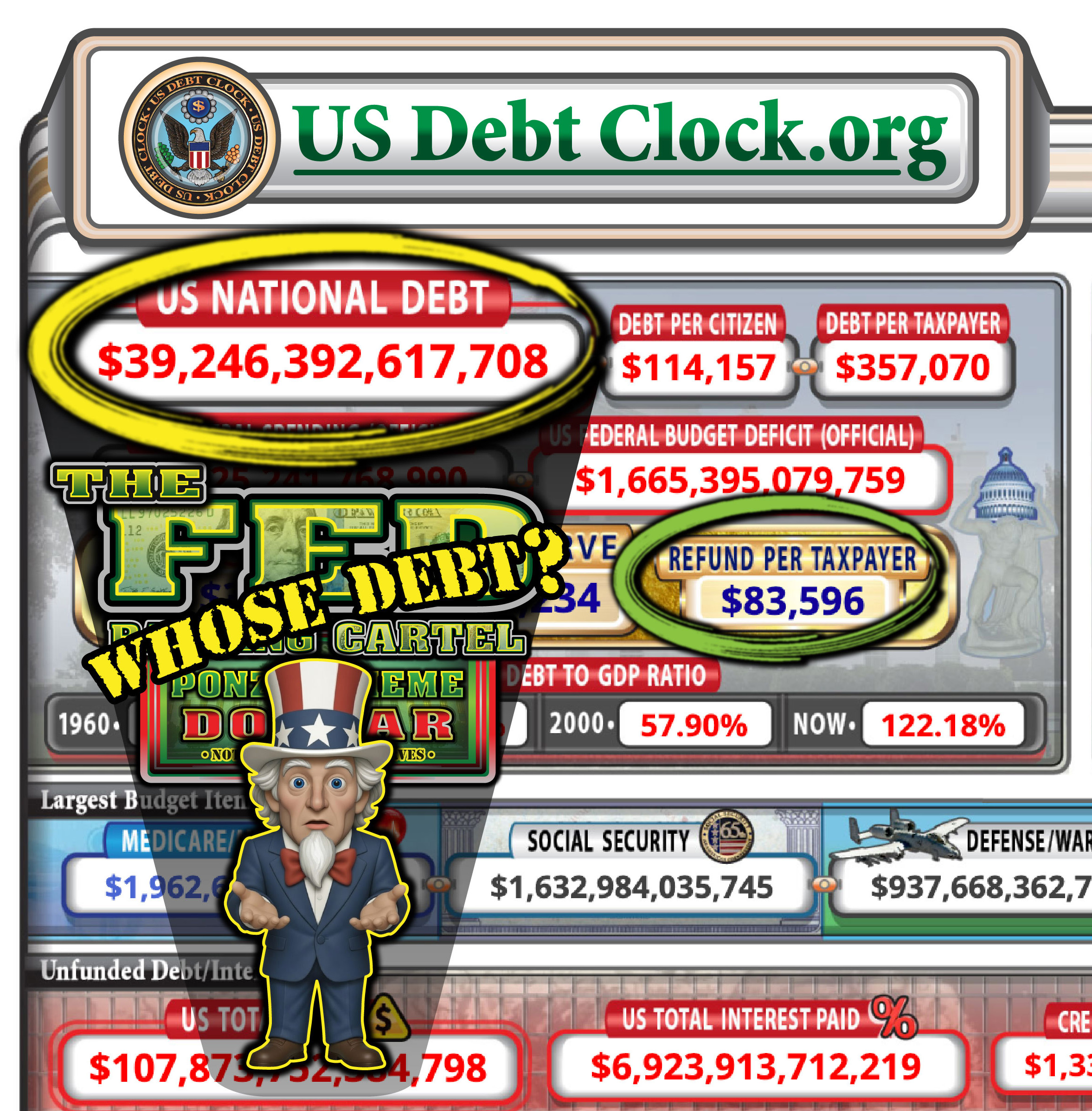
The US Debt Clock has done it again.
Its latest visual declaration does not whisper. It shouts.
Across the image, the national debt is circled in yellow like a crime scene. The figure shown is over $39 trillion, with debt per citizen and debt per taxpayer placed beside it like a bill nailed to the front door of every American household. Below it, another number is circled in green: “Refund per Taxpayer: $83,596.”
Then comes the message stamped across the dollar itself:
“The Fed Reserve Cartel Ponzi Scheme Dollar?”
“Whose Debt?”
This is not normal economic commentary. This is monetary theater. It is accusation, satire, warning, and prophecy rolled into one graphic.
The Question Behind the Image
The key phrase is not merely “debt.” It is “Whose Debt?”
That question goes straight to the heart of the modern financial system. If the government borrows, who benefits? If the people are taxed, who pays? If currency is issued as debt, who owns the obligation? And if the Federal Reserve System sits between Treasury borrowing, banking liquidity, interest rates, and monetary expansion, who is really carrying the burden?
The official Treasury definition is simple: the national debt is the money the federal government has borrowed to cover accumulated expenses when spending exceeds revenue. Treasury also notes that the government finances deficits by selling securities such as Treasury bills, notes, and bonds. (FiscalData)
But the US Debt Clock image is asking a more dangerous question: is this debt truly the people’s debt, or is it the cost of maintaining a financial architecture that has turned citizens into collateral?
Debt as the Operating System
The official Treasury “Debt to the Penny” dataset reports total public debt outstanding daily, including debt held by the public and intragovernmental holdings. (FiscalData) As of the latest TreasuryDirect data returned in search, total U.S. debt was listed at about $38.95 trillion on May 14, 2026, while the Debt Clock graphic shows a higher live-clock figure above $39.24 trillion. (TreasuryDirect)
That difference is part of the story. Official ledgers move by published reporting cycles. The Debt Clock moves like a living scoreboard.
And what it shows is brutal: the United States is no longer merely managing debt. It is operating through debt.
Debt funds the deficit. Debt rolls over old debt. Debt supports asset prices. Debt anchors the Treasury market. Debt influences the dollar. Debt sits under pensions, banks, insurance companies, money-market funds, derivatives, and global reserves.
The dollar is no longer simply money. It is a claim, a liability, a reserve instrument, and a control system.
The Fed Under the Spotlight
The image’s most provocative target is the Federal Reserve.
Calling the dollar a “Ponzi Scheme Dollar” is obviously loaded language, and it should be treated as political and monetary commentary rather than an official legal finding. But the emotional force of the phrase comes from a real structural frustration: Americans see rising debt, rising interest expense, rising asset prices, and rising financial complexity — while ordinary purchasing power feels weaker.
The Federal Reserve itself has also been operating through an unusual period. Its H.4.1 release explains that negative remittance balances represent a deferred asset position, created when Federal Reserve Bank earnings are not enough to cover operating costs, dividends, and surplus requirements; those earnings must be recovered before remittances to Treasury resume. (Federal Reserve)
In plain English: even the central bank’s own income mechanics have been distorted by the interest-rate cycle.
That does not mean the Fed is insolvent in the normal commercial sense. But it does mean the old idea that the Fed simply earns profits and sends money back to Treasury has been interrupted. The machine has changed.
The Green Circle: “Refund Per Taxpayer”
The green-circled “Refund Per Taxpayer” is the most fascinating part of the image.
Why call it a refund?
A refund implies overpayment. It implies that someone has been charged too much. It implies that the taxpayer may have a claim.
That is where the Debt Clock’s symbolism becomes powerful. It suggests that if the debt system was built on public credit, public labor, public assets, and public compliance, then the public may be owed something back.
Not just a tax refund.
Not just a stimulus check.
A systemic refund.
This connects directly to the growing speculation around sovereign wealth reserves, Treasury reform, asset-backed money, gold revaluation, silver signals, and a possible reordering of the American balance sheet.
From Debt Slavery to Incentive Economics
The latest declaration also fits the broader pattern of recent Debt Clock messaging: lower taxes, national balance-sheet repair, public credit, and a possible transition from a debt-punishment model to an incentive-based society.
The old model taxes income, taxes property, taxes capital gains, inflates currency, and then borrows against the future.
The new model — if these signals are pointing anywhere — would reward work, ownership, production, savings, and real asset formation.
That would be a revolution.
Not a left revolution.
Not a right revolution.
A balance-sheet revolution.
Why Offshore Investors Should Pay Attention
For Invest Offshore readers, the question is not whether one graphic is “official policy.” It is not.
The question is whether the narrative is changing.
And it is.
The public conversation is moving from taxes to tariffs, from fiat to asset-backed reserves, from paper claims to physical settlement, from central-bank credibility to sovereign balance sheets, and from debt expansion to debt accountability.
The Debt Clock is not Congress. It is not Treasury. It is not the Federal Reserve.
But it has become a strange public oracle for the financial mood of America.
When it asks “Whose Debt?”, offshore investors should hear a deeper question:
Who owns the risk?
Who owns the collateral?
Who owns the real assets?
Who owns the future cash flow?
Who owns the gold?
Who owns the land?
Who owns the production?
Because when the debt cycle breaks, paper promises are repriced against real things.
Conclusion: The Dollar Is on Trial
The US Debt Clock’s latest declaration puts the dollar itself on trial.
The defendant is the debt-based monetary order.
The evidence is $39 trillion and rising.
The jury is the taxpayer.
The verdict is still coming.
Whether the “Refund Per Taxpayer” becomes a real policy, a symbolic claim, or simply another clue in the growing Debt Clock mythology, the message is clear: the old system is losing its moral authority.
The debt is no longer just a number.
It is a question.
Whose debt?
And more importantly:
What comes next?
Invest Offshore continues to monitor the signals behind the New Money Revolution, including gold, Treasury reform, asset-backed finance, and sovereign infrastructure opportunities. We also continue to present investment opportunities in West Africa, including projects seeking investors for the Copperbelt Region.
Leave a Reply