
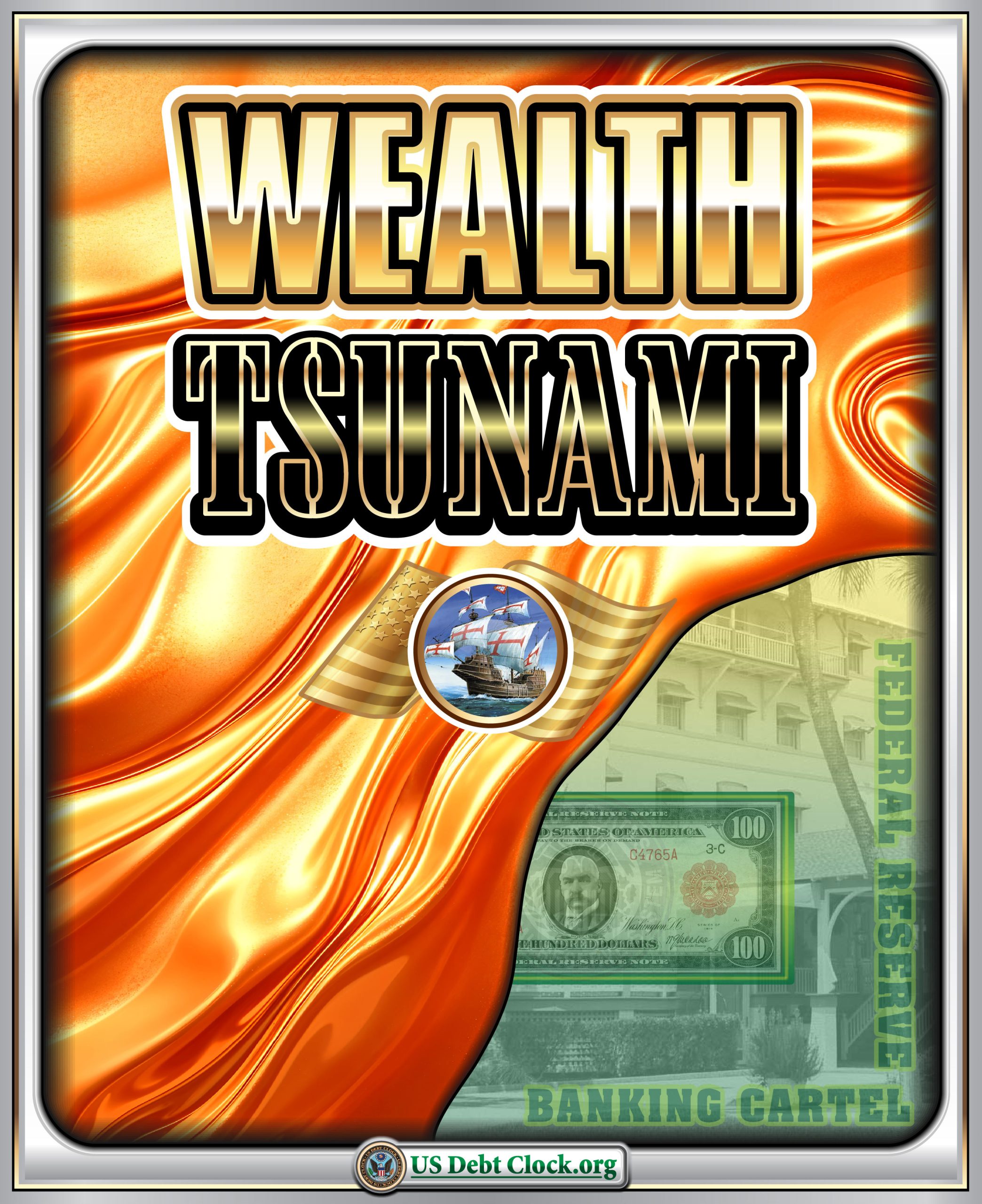
The March 29, 2026 US Debt Clock poster hits with one big phrase: “WEALTH TSUNAMI.” The visual is even louder than the text. A molten, gold-orange wave dominates the frame, surging left to right like liquid metal in motion. On the right side, half-covered by the incoming wave, sits the faint green imagery of the Federal Reserve Note world—“Federal Reserve,” “Banking Cartel,” and the familiar old-dollar aesthetic—like a shoreline about to be overwhelmed.
That’s the poster’s message in one glance:
A new monetary force is coming in so large it doesn’t “compete” with the old system. It washes over it.
And in the context of the New Money Revolution, the “tsunami” isn’t just a price spike. It’s a change in how money enters the economy.
The key idea: “spent into circulation” versus “lent into circulation”
The poster is pointing at a distinction most people never learn in school:
Old system: money is lent into circulation
In modern credit-based systems, much of what people call “money” enters the economy through loans:
- banks create deposits when they issue credit
- borrowers spend the deposits
- interest is owed back to the system
- defaults and contractions destroy money
- expansions create more money, but at the price of more debt
This is what the poster means when it says “Federal Reserve NOTES… lent into circulation.” It’s a worldview that sees the money supply as a byproduct of debt—growing and shrinking with borrowing.
New system (as implied): money is spent into circulation
“Spent into circulation” means the primary injection is not a loan, but an issuance that enters as:
- government spending (infrastructure, services, procurement)
- direct credits or dividends to citizens
- Treasury-issued instruments used for settlement
- public-benefit distribution tied to national assets or productivity
In this framing, the money arrives as purchasing power without creating a matching private debt obligation.
That difference is why the poster uses a wave. If you change the entry mechanism, you don’t just change “money.” You change the whole ecosystem built around money.
Why replacing “lent money” with “spent money” is disruptive
If a future regime truly shifted the dominant injection mechanism from credit to issuance, the impacts would be immediate—and messy.
1) Debt dynamics change
When money is lent into existence, the economy is forced to chase growth just to service the interest burden. When money is spent into existence, the system can—at least in theory—reduce dependence on ever-expanding private debt.
That’s the political appeal: less debt-serf psychology, more breathing room.
2) Banks’ role changes
Banks are most powerful when they are the gatekeepers of money creation via credit. If new money arrives through Treasury-style issuance, dividends, or public rails, banks begin to look less like creators and more like service providers:
- custody
- underwriting
- payments
- compliance
- treasury management
That’s a major re-rating of the financial hierarchy.
3) Asset prices can reprice fast
If a large supply of “new money” is introduced, markets react before the real economy does.
Historically, when liquidity increases, it often moves first into:
- equities,
- real estate,
- commodities,
- and alternative stores of value.
That’s one interpretation of the “wealth tsunami” phrase: not just more money, but a rapid repricing of everything that can’t be printed.
4) Inflation versus productivity becomes the battleground
The biggest question is not “is there new money?”
It’s: does output rise with it?
If issuance outruns productivity and supply chains, you get inflation.
If issuance is paired with higher productivity (AI, automation, energy abundance), you can get growth without the same inflation footprint.
That’s why the New Money Revolution narrative keeps orbiting the “AI abundance” idea—because it’s the cleanest argument for how large distributions could occur without breaking prices.
The “quadrillions” claim: how to interpret it
The poster language about “quadrillions” is rhetorical—meant to communicate scale. In conventional accounting, the broad money supply is measured in the trillions, while the derivatives notionals and global credit exposures can reach much larger notional figures.
The point isn’t the exact number. The point is:
The old system’s web of claims is enormous. Replacing the regime would feel like a flood.
That’s what the wave symbolizes: a reset of scale and direction.
What a “wealth tsunami” looks like in real life
If a new issuance regime ever arrived, it would likely show up as a combination of:
- new settlement rails (faster, more direct, more auditable)
- policy narratives about “restoring value” and “ending extraction”
- distribution mechanisms (rebates, credits, dividends)
- asset linkage (reserves, commodities, strategic collateral)
- repricing of hard assets as the public hedges
And crucially: it would unfold in stages. Systems that change overnight tend to break. Systems that change in phases tend to survive.
Bottom line
The March 29 “Wealth Tsunami” poster is not a forecast of a single day event. It’s a metaphor for what happens when society changes the way money is born:
- From money as debt (lent into circulation)
- To money as purchasing power (spent into circulation)
If that pivot ever happens at meaningful scale, the transition would be enormous—financially, politically, psychologically.
Because once new money enters the economy without the old debt leash attached, people don’t just feel richer.
They feel freer.
And that—more than any chart—explains why the New Money Revolution story has so much energy behind it right now.
Invest Offshore continues to track real-asset opportunities globally, including investment opportunities in West Africa seeking investors for the Copperbelt Region, plus verified gold for sale through our network and partners worldwide, and select mining concessions with documented title, geology, and clear pathways to production.
Leave a Reply