
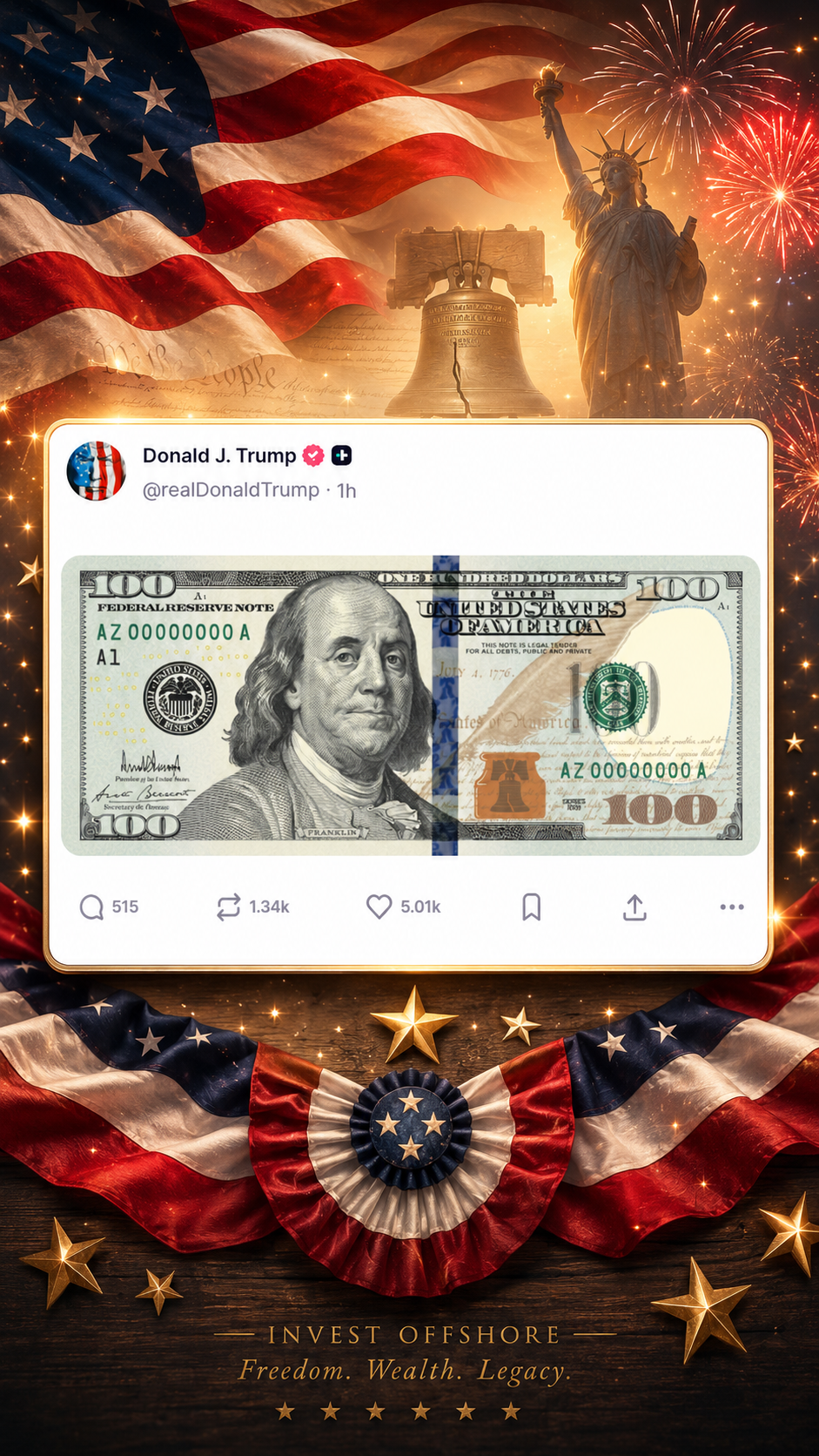
On July 3, 2026, President Donald J. Trump posted an image that, at first glance, looks like a patriotic redesign of the $100 bill. Benjamin Franklin remains at center stage. The date July 4, 1776 appears prominently. The image is wrapped in the symbolism of American founding, monetary power, and national renewal.
But the timing is what matters.
This was not posted randomly. It appeared on the eve of America’s 250th anniversary, at a moment when Washington is already preparing commemorative currency changes. The U.S. Treasury previously announced that Trump’s signature would appear on future U.S. paper currency in honor of the Semiquincentennial, calling it the first time a sitting president’s signature would appear on American paper money. (U.S. Department of the Treasury)
For ordinary observers, this is branding. For monetary historians, it may be a flare.
Why the $100 Bill?

The $100 bill is not just another denomination. It is the global cash instrument of the U.S. dollar system. It circulates offshore, settles private transactions, stores purchasing power, and represents America’s reserve-currency reach far beyond its borders.
So when the President posts a $100 bill on the eve of July 4, 2026, the message may be larger than patriotism. It may be preparing the public mind for a new chapter in Treasury-led monetary policy.
The image comes as speculation grows around two possible developments: gold-backed Treasury instruments or an official revaluation of America’s gold reserve.
The Gold Revaluation Question
The United States still carries its Treasury-owned gold at a statutory book value of roughly $42.222 per fine troy ounce, a value set in 1973 and dramatically below market reality. The Treasury’s own gold dataset states that book value is not market value, but rather the number of troy ounces multiplied by the statutory value. (Fiscal Data)
The Federal Reserve also confirms that it does not own gold directly. Instead, it holds gold certificates issued by the Treasury, valued at the same statutory price. Those certificates do not give the Fed redemption rights for physical gold. (Federal Reserve)
That accounting gap is the quiet giant in the room.
If the Treasury were ever to revalue its gold closer to market prices, it could create a major balance-sheet event without issuing conventional new debt. At $3,000 per ounce, for example, 261.5 million ounces of gold would imply roughly $784 billion in value. At higher market levels, the number rises quickly.
This is why gold revaluation has become one of the most important under-discussed monetary possibilities of the decade.
Historical Precedent: Roosevelt Did It Before

America has done this before.
In 1934, under the Gold Reserve Act, monetary gold was transferred to the U.S. Treasury, and the official gold price was raised from $20.67 to $35 per ounce. The Federal Reserve History account notes that this reduced the gold value of the dollar to 59% of its previous level. (Federal Reserve History)
That was not merely an accounting adjustment. It was a national monetary reset.
Today’s version would not need to restore a classical gold standard. It could be more sophisticated: gold-linked Treasury bonds, gold-backed Treasury certificates, or a sovereign reserve instrument designed for institutions, sovereign wealth funds, central banks, and high-net-worth capital.
Gold-Backed Treasury Bonds?
A modern gold-backed Treasury instrument would not necessarily mean Americans could redeem dollars for gold at the bank window. More likely, it would mean a Treasury-issued security whose value, collateral logic, or reserve treatment is linked to U.S. gold holdings.
Such an instrument could serve several purposes.
It could attract global capital into a patriotic 250th-anniversary bond. It could strengthen confidence in the dollar at a time of rising debt concern. It could give foreign holders a reason to keep holding U.S. paper. It could create a bridge between old-world hard money and new-world digital settlement.
Most importantly, it could allow Washington to say: the dollar is not weak, the dollar has been rebased.
Why July 4, 2026 Matters
America’s 250th anniversary gives the administration a once-in-a-generation stage. A monetary announcement tied to the founding date would carry historic weight. It would not be presented as panic. It would be presented as renewal.
That is the genius of the timing.
A gold revaluation announced during a crisis looks desperate. A gold revaluation announced during America’s 250th birthday looks like restoration.
The post may therefore be a test balloon, a coded preview, or simply a patriotic signal. But in the Trump era, symbols are rarely accidental.
What Investors Should Watch Next

Invest Offshore readers should watch Treasury language carefully over the coming days and weeks. The key terms to monitor are not only “gold,” but also “certificates,” “strategic reserve,” “sovereign wealth,” “Treasury accounts,” “currency modernization,” and “America 250.”
The official Treasury press page, as of the current public releases reviewed, shows active 250th-anniversary economic messaging but no formal gold-backed bond announcement yet. (U.S. Department of the Treasury)
That matters. The signal is not yet policy.
But markets often move before the document lands.
Gold, silver, Bitcoin, offshore banking, private custody, and sovereign-grade collateral markets could all be affected if Washington begins turning dormant gold accounting into active monetary architecture.
The Bottom Line
Trump’s July 3 post of a $100 bill may be dismissed as patriotic imagery.
That would be a mistake.
The $100 bill is the face of offshore dollar power. The July 4, 1776 reference is founding-era symbolism. The timing is America’s 250th anniversary. The backdrop is a Treasury already changing the signature tradition of U.S. currency. The deeper monetary question is whether America’s gold, still booked at $42.222 per ounce, is about to become politically useful again.
No official gold-backed Treasury bond has been announced yet.
But the signal has been sent.
And if the signal becomes policy, July 4, 2026 may be remembered not only as America’s 250th birthday, but as the opening bell of the next dollar system.
Leave a Reply