
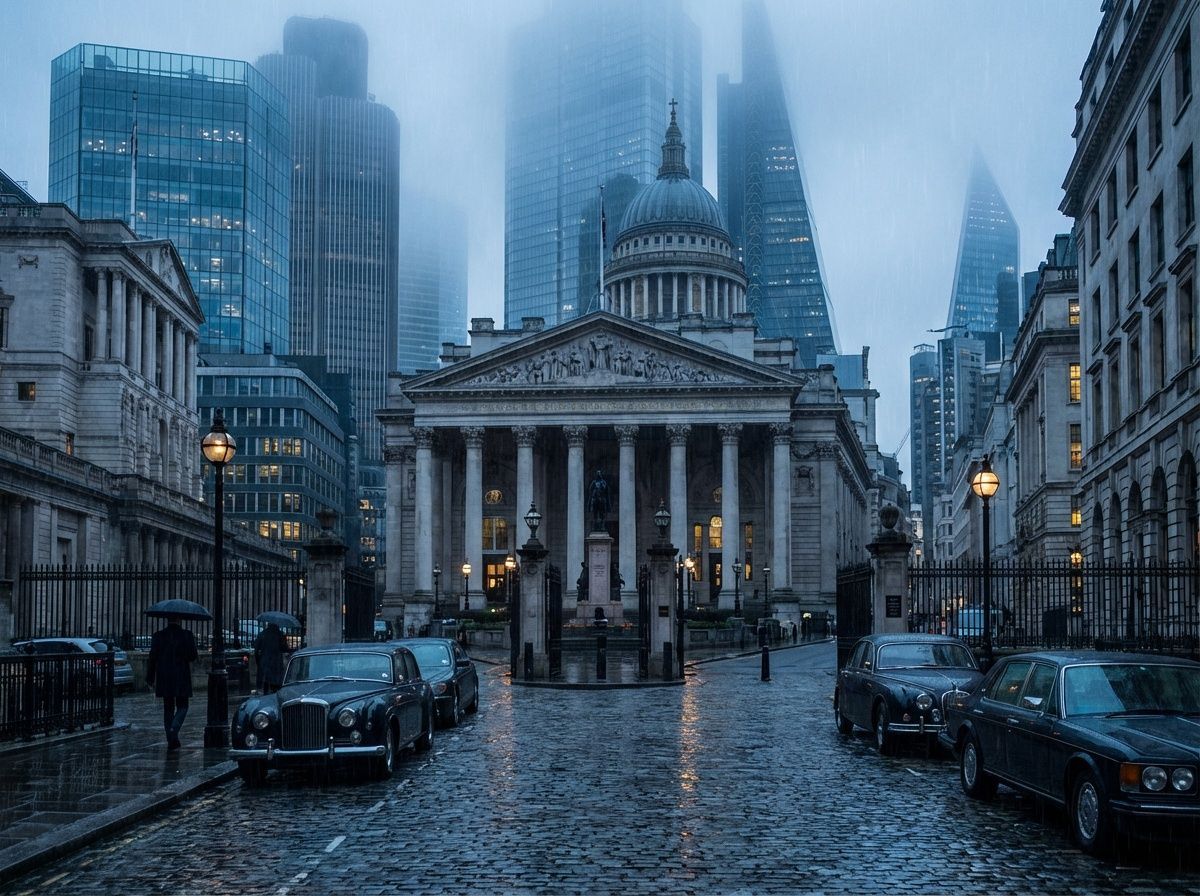
Most people think of London as one great metropolis. Fewer realize that, buried inside it, sits a political and financial organism of its own: the City of London, the ancient “Square Mile.” It covers just 1.12 square miles, yet it remains the historic core of London, home to roughly 8,600 residents, about 678,000 workers, its own government, its own Lord Mayor, and its own independent police force. In today’s market architecture, that tiny district still matters enormously. London remains one of the world’s premier financial centres, sitting just behind New York in the latest Global Financial Centres Index. (City of London)
That is why the City deserves to be understood not as a quaint relic, but as a power structure. It is not a sovereign state, and it does not sit outside British law. But by the standards of modern local government, it is exceptionally self-governing. The City Corporation itself says its government predates Parliament, and that its constitutional roots reach back before the Norman Conquest. William the Conqueror’s 1067 charter did not invent the City’s freedoms; it confirmed rights, privileges, and laws the City already claimed to possess from the time of Edward the Confessor. The Corporation’s own historical material says those privileges were then reinforced across more than a hundred royal charters. (City of London)
That long institutional memory still shapes the way the Square Mile works. The City is divided into 25 wards and governed by 25 Aldermen and 100 Common Councillors. Unlike almost every other municipality in the democratic world, its electorate is not based only on residents. The City officially maintains two categories of voters: resident and business. Companies can appoint voting representatives, and the number of those representatives rises with the size of the workforce. A firm with up to 50 workers can appoint one voter for every five employees, while larger firms can appoint 10 voters plus one additional voter for every 50 workers above the first 50. Even standing for office requires initiation into the system: candidates for Aldermanic and Common Council elections must hold the Freedom of the City of London. (City of London)
This is where old form meets modern capital. The City’s governance is not merely ceremonial pageantry. The Court of Common Council is the Corporation’s main decision-making body, and it also plays a formal role in policing governance. The City of London Police is a separate force for the Square Mile, and it carries a national role as the lead force for fraud, while also holding leadership responsibilities in economic crime and cybercrime. The City Corporation also maintains the Remembrancer’s Office, a dedicated parliamentary office that engages with MPs and peers on legislation affecting the Corporation’s interests and expertise. In plain English, the Square Mile does not just host money. It has a governing machine built to defend, represent, and project its interests into the wider British state. (City of London)
That helps explain why critics have long treated the City as more than a financial district. The real argument is not that one square mile alone “controls” the world, but that it sits at the centre of a much wider legal, banking, accounting, and offshore-services network. Tax Justice Network says its Financial Secrecy Index ranks jurisdictions by how much they help people hide finances from the rule of law, and stresses that the ranking is about both secrecy and scale. Transparency International UK, meanwhile, says the wider UK offshore network remains deeply embedded in global finance, “with the City of London at its centre,” and argues that London profits by supplying the legal, banking, and professional services that allow offshore wealth to circulate. (Tax Justice Network)
That criticism is not abstract. Transparency International UK said in late 2024 that £5.9 billion of suspicious funds had been used to buy UK property through shell companies registered in Britain’s Overseas Territories, with more than 90 percent of that total routed through the British Virgin Islands. Reuters separately reported that Britain had fined hundreds of offshore entities for failing to join a transparency register designed to expose illicit wealth in UK property, yet less than 3 percent of those penalties had been paid at the time of reporting. That does not prove the City Corporation itself is running criminal money. It does show why London, and especially the infrastructure clustered around the Square Mile, remains central to global debates about offshore finance, opacity, and enforcement weakness. (Transparency International UK)
And that is the real story of the City of London Corporation. It is an ancient municipal body that survived empire, industrialization, democratization, and globalization without surrendering its core privileges. It operates with a constitutional oddness no modern branding campaign can hide: business voting, medieval offices, a separate police force, a pre-parliamentary identity, and a global financial footprint wildly disproportionate to its land area. The Square Mile is not merely a neighborhood. It is a mechanism — one designed over centuries to attract capital, defend privilege, and remain indispensable to the movement of money. (City of London)
For Invest Offshore readers, that is the lesson worth keeping in view. If you want to understand how global wealth is routed, protected, layered, and legitimized, you do not start with maps. You start with institutions. And few institutions on earth reveal more about the marriage of history and money than the City of London Corporation. Invest Offshore continues to watch the structures behind global capital — and continues to present investment opportunities in West Africa for investors seeking exposure to the Copperbelt Region.
Leave a Reply