
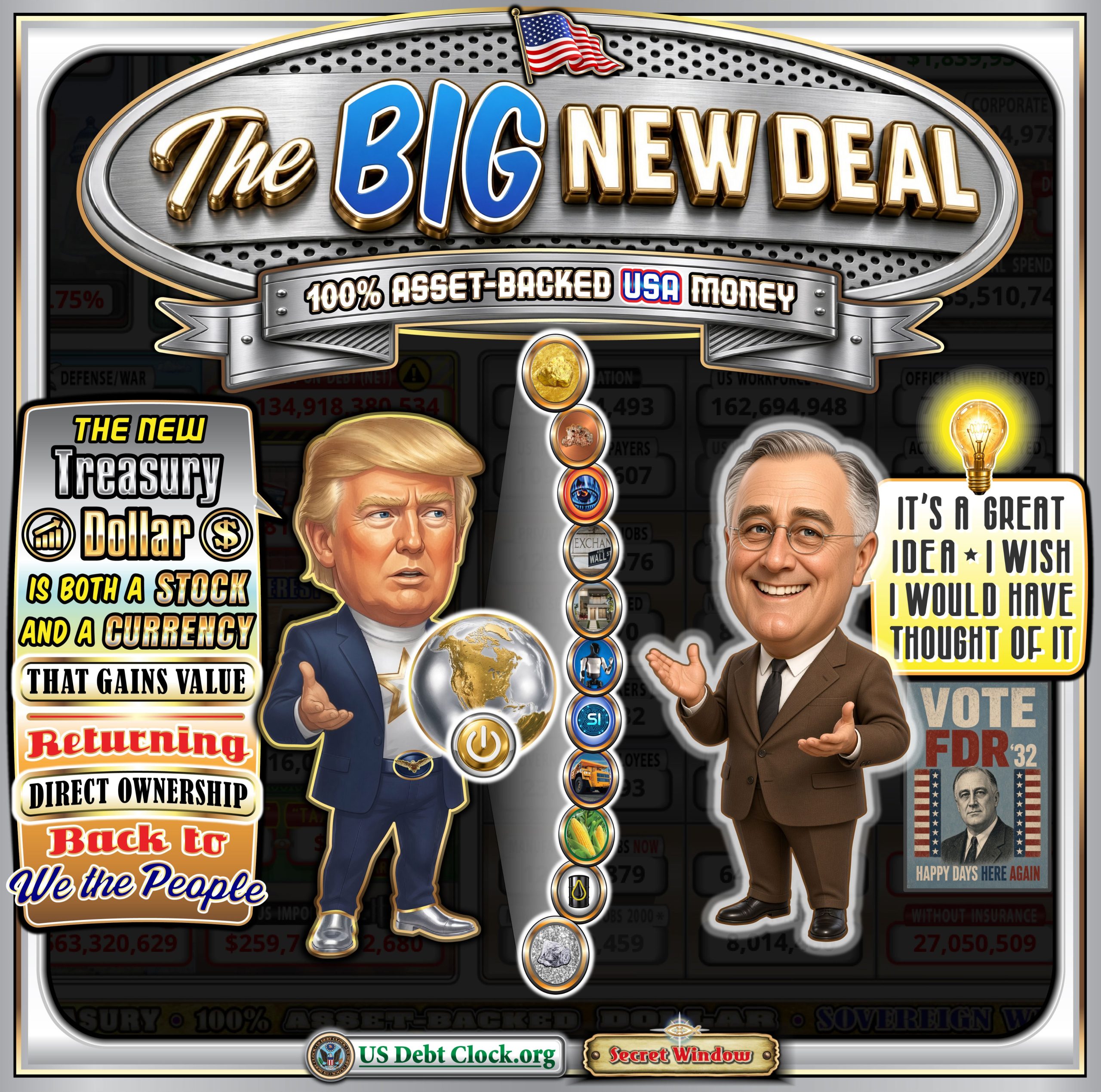
The US Debt Clock has released another “DJT” poster, and this one makes the New Money Revolution feel like a full economic program.
The headline reads:
The BIG New Deal
100% Asset-Backed USA Money
At the center of the poster, the new Treasury Dollar is described as something radically different from ordinary paper currency:
“The new Treasury Dollar is both a stock and a currency that gains value — returning direct ownership back to We the People.”
That is the key sentence.
This poster is no longer only about replacing the Fed debt-based dollar. It is about redefining what money itself represents.
From Currency to Ownership
The Debt Clock’s message is that the proposed Treasury Dollar would not merely circulate as a medium of exchange. It would also behave like a claim on national value.
That is why the poster uses the phrase:
“Both a stock and a currency.”
A currency is something people spend.
A stock is something people own.
By combining the two ideas, the poster imagines a form of money that gives citizens exposure to the national asset base: gold, silver, energy, minerals, land, infrastructure, productive enterprise, and sovereign wealth.
That is the “Big New Deal” concept.
Not simply relief.
Not simply stimulus.
Not simply debt spending.
Ownership.
Why the “New Deal” Language Matters
The poster deliberately echoes the language of the 1930s, when the original New Deal became a historic federal response to economic collapse. The National Archives describes the National Industrial Recovery Act of 1933 as part of a broad public-works and recovery program that included construction, natural-resource development, public infrastructure, and economic stabilization efforts. National Archives
The Debt Clock poster borrows that historical energy but changes the mechanism.
The original New Deal was built around government action, public works, relief, and recovery.
The Big New Deal being imagined here is built around asset-backed money, direct ownership, Treasury authority, and a national balance-sheet reset.
In other words:
The old New Deal tried to restore demand.
The Big New Deal tries to restore ownership.
100% Asset-Backed USA Money
The phrase “100% asset-backed USA money” is the poster’s monetary foundation.
The current U.S. dollar system does not operate as a direct gold-redeemable money system. Federal Reserve notes are legal tender and obligations of the United States, and they are accepted for taxes, customs, and public dues. Federal Reserve Federal Reserve notes have not been redeemable in gold since 1934. Federal Reserve
That is the present legal framework.
The poster is pointing toward a different model: a Treasury-centered currency backed by real national assets rather than debt expansion alone.
That is why the asset icons appear in the center column: gold, silver, energy, infrastructure, industry, agriculture, commodities, and natural resources. The Debt Clock is saying the new dollar should not be backed merely by confidence in debt rollover. It should be backed by the country’s tangible productive base.
The Treasury Dollar as a National Share
The most interesting idea in the poster is that the Treasury Dollar “gains value.”
That language makes the dollar sound less like a depreciating instrument and more like a national share certificate.
In the old system, the citizen earns dollars that gradually lose purchasing power through inflation and monetary expansion.
In the proposed system, the citizen holds dollars that are connected to national assets and may appreciate as those assets increase in value.
That is a huge philosophical shift.
The old model says: work, earn, pay tax, service debt.
The new model says: own, participate, preserve value, share in national wealth.
That is why the poster says ownership is returned to We the People.
The FDR Reference
On the right side of the poster, a visible campaign-style image reads “Vote FDR 32” and “Happy Days Here Again.” That visual reference places the poster in a recovery-era frame.
But the comparison is not exact.
The Debt Clock’s Big New Deal is not just about government spending. It is about monetary restructuring.
The message is that the next recovery program may not be a jobs program alone, or a spending program alone, or a banking rescue alone. It may be a new ownership architecture in which the currency itself becomes the delivery system for national wealth.
That is why the poster’s imagined answer says:
“It’s a great idea — I wish I would have thought of it.”
The line frames the Treasury Dollar as a bigger idea than twentieth-century stimulus: not just giving people money, but changing what money is.
The Constitutional Backdrop
The constitutional question remains central to the Debt Clock’s narrative. Article I, Section 8 of the U.S. Constitution gives Congress the power “to coin Money” and “regulate the Value thereof.” National Archives
The Debt Clock’s recent posters repeatedly return to that theme: America already has sovereign monetary authority, but the public has forgotten how powerful that authority could be if paired with Treasury issuance, asset backing, and a public ownership model.
That is the deeper “Yellow Brick Road” connection from the previous poster:
America did not need to beg the old banking system for permission forever.
It needed to rediscover its own authority.
Why This Matters to Offshore Investors
For Invest Offshore readers, this poster should be read as a capital-structure signal.
If a future Treasury Dollar were ever tied to national assets, the most important question would become:
Which assets back the money?
Gold?
Silver?
Oil?
Natural gas?
Uranium?
Copper?
Farmland?
Water?
Infrastructure?
Strategic minerals?
Public land?
Sovereign investment funds?
That matters because an asset-backed monetary system would reprice the real economy. Mines, royalties, energy assets, land, logistics corridors, industrial capacity, and sovereign infrastructure would move from the background to the center of the monetary story.
In a debt-backed world, financial paper dominates.
In an asset-backed world, custody, title, production, and reserves dominate.
The Invest Offshore Decode
The poster’s central message is simple:
The old dollar was a spending instrument.
The new Treasury Dollar is imagined as an ownership instrument.
That is a radical difference.
If money becomes a claim on national wealth, then the citizen is no longer merely a taxpayer or borrower. The citizen becomes a participant in the national balance sheet.
That is why the poster calls it the Big New Deal.
The “deal” is not just between government and citizens.
It is between money and ownership.
Reality Check
This poster should not be mistaken for current law or official policy. No public Treasury Dollar replacement has been launched, and Federal Reserve notes remain legal tender under existing law. Federal Reserve
But as symbolic monetary commentary, the poster is important because it shows where the Debt Clock narrative is going next.
The New Money Revolution is no longer only about ending the old system.
It is about designing a new one that gives citizens a direct stake.
Conclusion: The Ownership Dollar
The US Debt Clock’s Big New Deal poster may be one of the most important in the series because it turns the Treasury Dollar into something bigger than money.
It becomes a share.
A claim.
A reserve instrument.
A public ownership tool.
A bridge between currency and national wealth.
That’s decoded.
The original New Deal was about recovery from collapse.
The Big New Deal is about recovery from debt-money dependency.
And according to the US Debt Clock, the future of American money may not simply be printed.
It may be owned.
Leave a Reply