
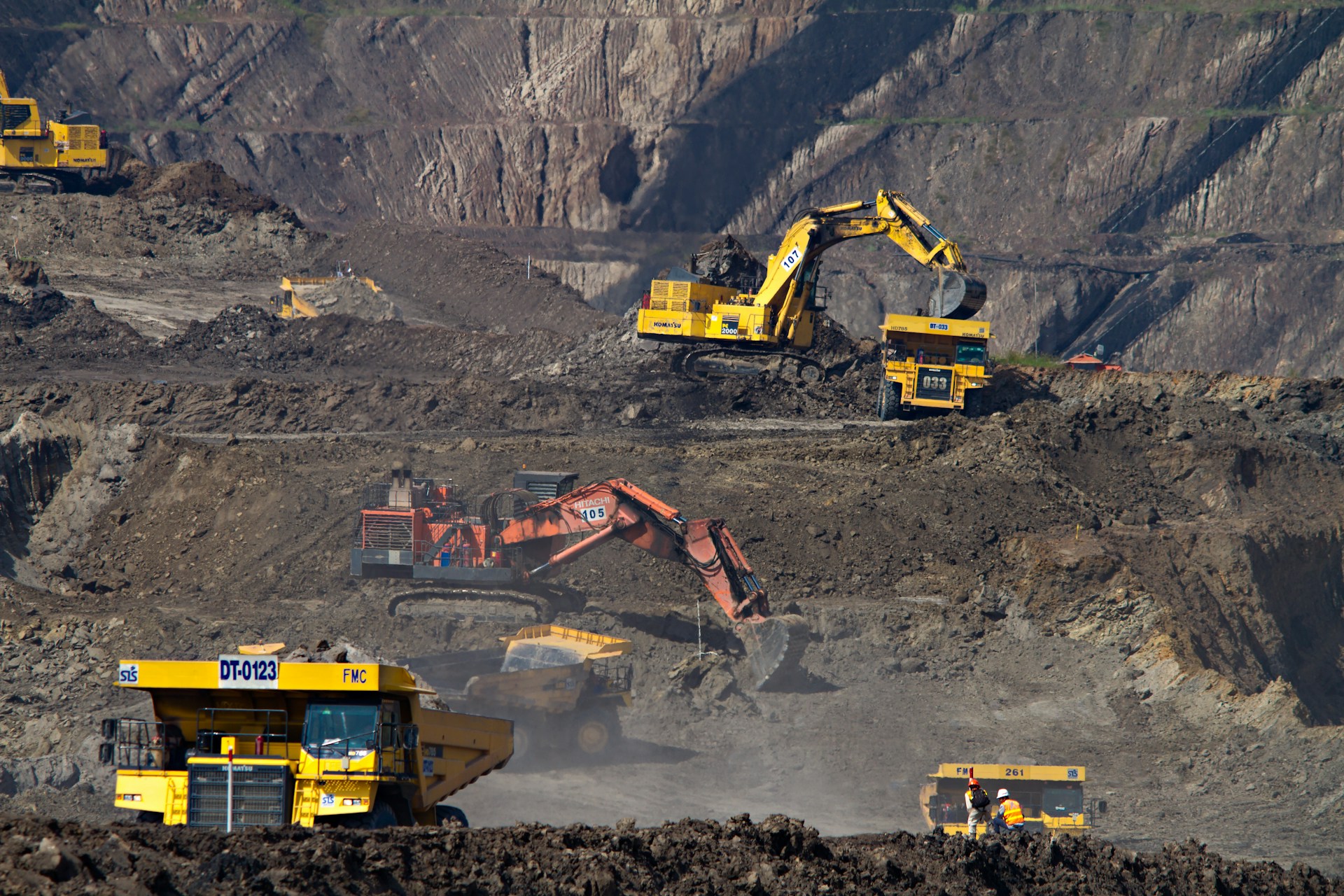
The next great investment cycle may not begin in Silicon Valley. It may begin thousands of feet underground.
For most of the past generation, the global economy was built around one overriding assumption: whatever material you needed could be purchased, manufactured or shipped from somewhere else.
Copper. Steel. Uranium. Rare earths. Nickel. Silver. Natural gas. Electricity.
The supply chain was treated almost like an invisible utility.
That assumption is breaking.
The world is moving away from the hyper-efficient, just-in-time economic model that defined globalization and toward something fundamentally different: a bifurcated global economy organized increasingly around security of supply.
Nations are building strategic inventories. Governments are identifying critical minerals as national-security assets. Export restrictions are multiplying. Manufacturers are reconsidering where their inputs originate. Technology companies are signing power agreements years in advance and moving deeper into the physical infrastructure required to keep their businesses running.
And suddenly, the mine matters again.
Globalization Rewarded the Asset-Light Economy
For decades, one of the great commandments of corporate finance was simple:
Own less.
Outsource manufacturing.
Reduce inventories.
Sell factories.
Lower working capital.
Move production to the lowest-cost jurisdiction.
Buy commodities whenever they are needed.
The corporate winners were frequently companies that owned intellectual property, brands, software and distribution rather than mines, factories, power stations and warehouses.
It was an extraordinarily profitable model.
But it depended on something rarely acknowledged: abundant energy, abundant materials and dependable international trade.
Just-in-time economics only works when the shipment arrives just in time.
When geopolitical rivalry, export restrictions, sanctions, wars, electricity shortages and strategic competition enter the equation, efficiency begins losing ground to resilience.
The corporate question changes from:
What is the cheapest source?
to:
Can we guarantee the source at all?
That is an enormous change.
Supply Security Is Becoming National Security
Washington’s evolving policy toward critical minerals makes the transformation unusually clear.
In 2026, the White House described processed critical minerals as essential to U.S. national security and warned that reliance on foreign sources could threaten supply. In July, the administration delegated Defense Production Act authority allowing restrictions on exports of certain recoverable critical minerals and materials. Federal policy also explicitly referenced the U.S. Strategic Critical Minerals Reserve, known as Project Vault.
This is no longer merely environmental policy.
It is industrial strategy.
It is defense policy.
It is trade policy.
And increasingly, it is monetary and geopolitical policy.
Once governments classify minerals as strategic resources, the economics surrounding those minerals begin to change.
A copper deposit is no longer merely a copper deposit.
A uranium deposit is not merely another mining project.
Rare-earth processing capacity is not simply another factory.
They become pieces on the geopolitical chessboard.
Big Tech Has Already Figured It Out
Perhaps the most important signal is coming not from governments, but from the world’s richest technology companies.
Artificial intelligence may appear to be a software revolution, but underneath the algorithms is an enormous physical machine.
Data centers require power stations.
Power stations require transmission infrastructure.
Transformers require copper and electrical steel.
Servers require enormous quantities of metals, semiconductors and cooling infrastructure.
Networks require yet more electricity.
AI cannot scale without mining.
BHP recently put the relationship into striking terms: it estimates that every additional $200 billion of annual data-center investment requires copper equivalent to the output of a new 150,000-tonne-per-year copper mine for computer hardware and associated power infrastructure.
That makes the AI boom simultaneously a copper boom, an electricity boom and an infrastructure boom.
And Big Tech is beginning to behave accordingly.
In January 2026, Amazon Web Services entered into a collaboration with Rio Tinto’s Nuton technology involving copper produced at Gunnison Copper’s Johnson Camp Mine in Arizona. AWS is expected to use the mine’s first Nuton copper in components for U.S. data centers while supplying cloud technology to help optimize the mining process.
Think about what that represents.
One of the world’s largest technology infrastructure companies is no longer several layers removed from the mine.
The digital economy is reaching directly toward the ore body.
Then Comes the Race for Power
Copper is only half the story.
AI companies have discovered that electricity itself may become one of the defining constraints on technological expansion.
Meta announced agreements in January supporting as much as 6.6 gigawatts of nuclear power through projects involving Vistra, TerraPower and Oklo, building on an earlier Constellation agreement.
Microsoft, Alphabet, Amazon and Meta have all entered nuclear-power arrangements as hyperscalers seek large quantities of reliable electricity for AI and cloud infrastructure. Carnegie estimates their arrangements could collectively provide roughly 6.9 GW of nuclear power by the early 2030s.
Google has meanwhile signed a 396-megawatt geothermal power agreement with Fervo Energy for its Utah Cape Station project.
Across the United States, data-center developers are even supporting fast-tracked off-grid natural-gas generation as the competition for dependable electricity intensifies.
This represents something larger than an energy procurement strategy.
Technology companies are moving closer toward vertical control of their critical inputs.
First chips.
Then data centers.
Then electricity.
Then transmission.
Then minerals.
Follow that chain far enough and eventually you arrive at a mine.
The Great Hoarding Game
Here is where the situation becomes particularly interesting.
If governments begin accumulating strategic metals, large corporations secure long-term supply and technology companies lock in power years ahead of delivery, everyone else faces a problem.
They must secure their own supply.
A company that traditionally purchased copper on the open market may suddenly find its competitor has guaranteed ten years of production.
A defense contractor may discover governments have reserved strategic output.
An automaker may find battery materials committed under long-term offtake contracts.
A utility may discover data centers have already contracted the incremental electricity generation it expected to use.
This creates a potentially self-reinforcing cycle.
Fear of scarcity produces stockpiling.
Stockpiling produces greater apparent scarcity.
Scarcity produces long-term contracts.
Long-term contracts remove supply from the spot market.
Reduced available supply encourages still more buyers to secure material.
And the bidding war accelerates.
At that point, the central question is no longer whether copper costs $4 or $6 per pound.
It becomes:
Do you have copper?
Access Trumps Price
This may become the defining economic principle of the coming resource era.
During globalization, price determined where commodities flowed.
During strategic competition, availability can overwhelm price.
A manufacturer can survive expensive copper.
It cannot manufacture without copper.
A defense contractor can absorb higher antimony prices.
It cannot deliver weapons systems without antimony.
A data center can tolerate more expensive electricity.
It cannot operate without electricity.
A semiconductor producer can pay more for critical inputs.
It cannot fabricate chips without them.
The difference sounds subtle, but from an investment perspective it is profound.
When commodities move from being ordinary inputs to strategic bottlenecks, the companies controlling the bottlenecks can gain economic and political importance far beyond what conventional valuation models anticipate.
Mining Is Becoming Technology Infrastructure
For decades, mining carried an image problem.
Old.
Dirty.
Cyclical.
Capital intensive.
Slow.
Environmentally controversial.
Silicon Valley represented the opposite: clean, fast, scalable and asset-light.
The AI revolution may ultimately expose how artificial that distinction always was.
The cloud has mines underneath it.
Every GPU begins with extracted materials.
Every transmission line begins with minerals.
Every battery begins with a mine.
Every nuclear reactor requires uranium and vast amounts of specialty materials.
Every electric motor requires metals.
Every modern defense system depends on mineral supply chains stretching around the world.
The supposedly weightless digital economy is astonishingly physical.
The next generation of mining companies may therefore increasingly be understood not merely as commodity producers, but as infrastructure providers to the technological economy.
And Yet Mining Represents Barely 1% of Global Equities
Here lies the investment paradox.
While the strategic importance of natural resources is increasing, mining’s representation in financial markets remains extraordinarily small.
The 2026 In Gold We Trust report estimates that mining represents approximately 1% of global equity market capitalization — its lowest level since 1900. The sector represented roughly 10% of world equity capitalization around the beginning of the twentieth century and reached around 11% during parts of the 1950s and 1960s.
One percent.
At the same time, the world is contemplating:
AI infrastructure on an unprecedented scale.
Grid expansion.
Reindustrialization.
Defense rearmament.
Electric vehicles.
Robotics.
Nuclear expansion.
Strategic mineral reserves.
Manufacturing reshoring.
Energy-security investment.
All of them consume enormous quantities of physical resources.
That discrepancy deserves attention.
A Capital Rotation Could Become Enormous
Imagine mining’s share of global equities simply returning from approximately 1% to 2%.
That sounds trivial.
It isn’t.
It would represent a doubling of the sector’s relative weight.
What happens if strategic competition, higher commodity prices, resource nationalism and persistent supply shortages push the sector toward 3%, 5% or something historically closer to previous cycles?
Nobody knows.
Markets rarely move in straight lines, and mining remains notoriously cyclical. Projects can suffer from political intervention, cost overruns, permitting delays, geological disappointment, dilution and commodity-price collapses.
Individual exploration companies are particularly speculative.
But this is precisely why the broader setup deserves attention.
The sector arguably sits near a historic low in financial-market importance at exactly the moment that the underlying resources are becoming extraordinarily important to governments and the world’s largest corporations.
That is the kind of asymmetry investors spend careers looking for.
The New Mining Hierarchy
Not every mineral will benefit equally.
Not every mine will become valuable.
The strongest strategic positions may belong to operations possessing several characteristics simultaneously:
Large-scale resources.
Long mine lives.
Reliable electricity and water.
Friendly jurisdictions.
Existing infrastructure.
Permitting visibility.
Domestic processing capacity.
Access to rail, ports and transmission.
Exposure to minerals governments classify as critical.
And perhaps most importantly:
The ability to actually produce.
In a scarcity economy, a world-class deposit waiting twenty years for approval is very different from a producing mine capable of shipping material tomorrow.
That distinction may increasingly determine valuations.
The Frontier Has Reopened
There is something almost ironic about the coming economic cycle.
The world’s most futuristic industries may revive one of civilization’s oldest.
Artificial intelligence.
Robotics.
Quantum computing.
Advanced weapons.
Electric transportation.
Space exploration.
Nuclear energy.
Every one ultimately reaches backward into the Earth for the materials required to move forward.
The digital revolution did not eliminate the resource economy.
It multiplied its appetite.
And the geopolitical fracture of globalization is now forcing countries and corporations to acknowledge something markets spent decades overlooking:
You cannot print copper.
You cannot code uranium.
You cannot download silver.
You cannot manufacture rare earths out of financial engineering.
Someone has to discover them.
Someone has to finance them.
Someone has to permit them.
Someone has to mine them.
Someone has to refine them.
And someone has to control access to them.
The Age of Mining Is About to Begin
The last economic era rewarded companies that eliminated physical assets from their balance sheets.
The next one may reward those who control them.
Mines.
Power plants.
Refineries.
Smelters.
Transmission.
Warehouses.
Strategic inventories.
Hard infrastructure.
The transition from just-in-time to just-in-case economics changes the value of everything upstream.
And once governments, Big Tech, defense contractors and industrial giants begin competing for guaranteed supplies of the same finite resources, the feedback loop could become extraordinarily powerful.
The great commodity investment story of the coming decade may therefore not simply be about higher metal prices.
It may be about something considerably more valuable:
ownership of the supply.
Mining currently occupies roughly 1% of global equities.
Yet underneath AI, national security, reindustrialization and the emerging multipolar world sits the same indispensable foundation:
metal, energy and the mines capable of producing them.
The world spent decades treating mining as yesterday’s industry.
It may soon discover that mining is the industry upon which tomorrow depends.
The age of mining is about to begin.
Leave a Reply