
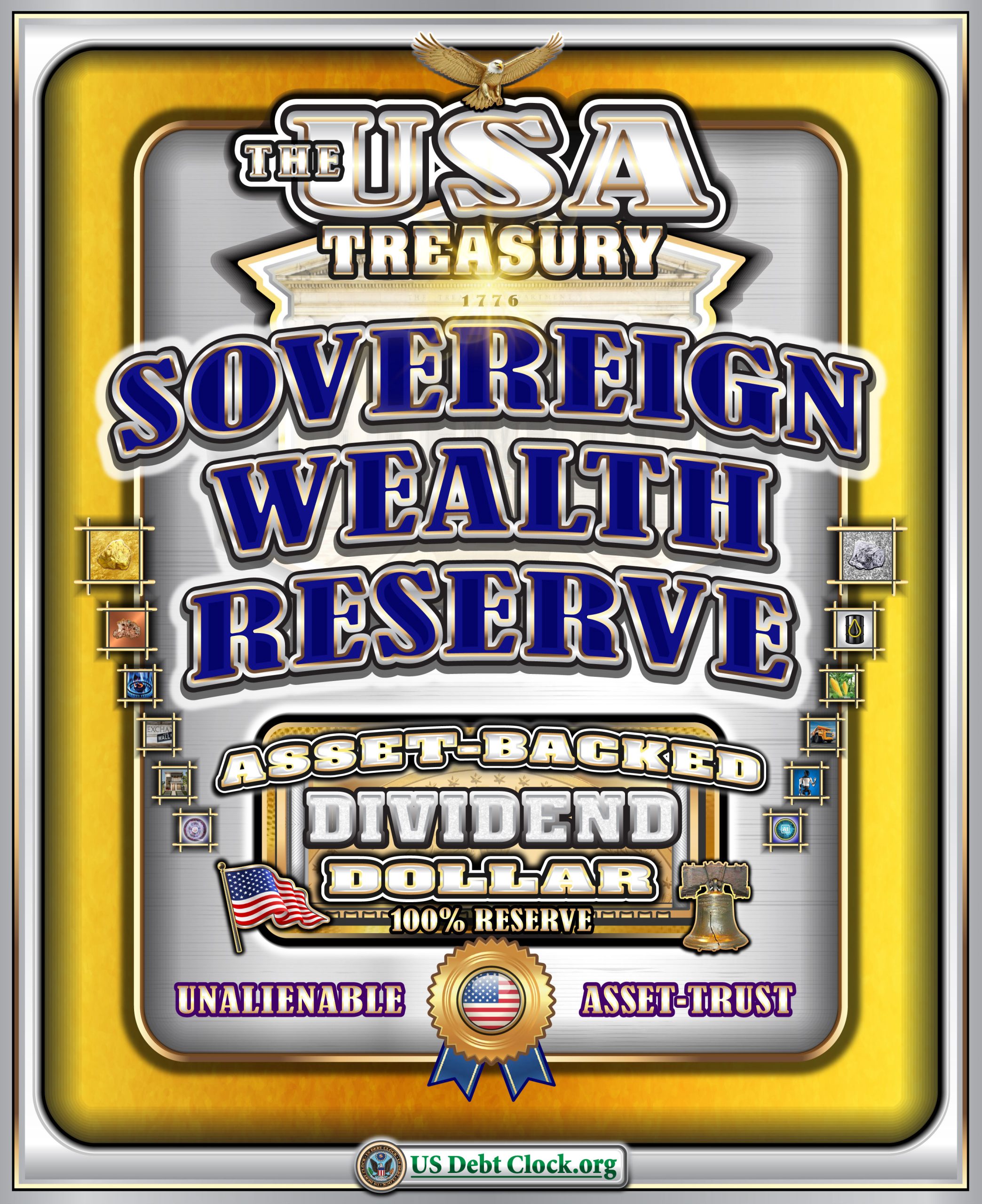
The April 12, 2026 US Debt Clock poster goes straight to the heart of the New Money Revolution storyline with a new phrase in giant letters:
“THE USA TREASURY — SOVEREIGN WEALTH RESERVE.”
Centered beneath it is the now-familiar promise we’ve seen building across weeks of posters: “ASSET-BACKED DIVIDEND DOLLAR — 100% RESERVE.” Around the borders are tiny icon tiles—gold, oil, agriculture, industry, infrastructure—like a visual inventory of “redeemable assets.” At the bottom, two words seal the message:
“UNALIENABLE” and “ASSET-TRUST.”
It’s designed like an official emblem, not a meme. And the concept it’s pushing is clear:
America is being framed not as a debtor nation, but as a nation with a sovereign balance sheet—a reserve of real assets that can back a new currency system and distribute benefits to citizens.
That’s the “Sovereign Wealth Reserve” idea in one sentence.
What is a “Sovereign Wealth Reserve” in this context?
In normal financial language, “sovereign wealth” refers to state-owned investment funds (often funded by oil revenues, trade surpluses, or foreign-exchange reserves). The poster is borrowing that concept and remapping it onto the U.S. Treasury:
- Reserve = a pool of assets with lasting value
- Sovereign wealth = national ownership or national benefit
- Treasury = the issuer and custodian of the system
So the implied structure is:
- Identify and consolidate national “real assets” (or claims on them) into a recognizable reserve framework
- Use that reserve as the credibility engine for a new currency design
- Distribute part of the system’s productivity back to citizens via a “dividend dollar” logic
This is less “print money” and more “monetize the balance sheet.”
The asset icons are the real message
Those small tiles along the sides are doing heavy lifting. They’re not random decoration. They are the poster’s claim that the backing isn’t theoretical—it’s commodity and infrastructure-linked:
- precious metals
- energy
- agriculture
- logistics/industry
- “strategic” national assets
The poster isn’t saying a dollar is backed by one thing. It’s saying the new backing is a basket—a broad base of productive, tangible value.
That matters because baskets are how modern systems avoid single-point fragility. A multi-asset reserve is harder to break than a single peg.
“Asset-Backed Dividend Dollar” — what that implies
The phrase “Dividend Dollar” is the ideological pivot.
A dividend is what you receive when you own something productive. So the poster is proposing that citizens become beneficiaries of national productivity—either directly through distributions or indirectly through a system that reduces extraction (lower interest burden, fewer taxes, more public benefit).
In the US Debt Clock worldview, the “old money” system is:
- debt-based
- interest-extractive
- intermediary-dominated
- inflation-prone
The “new money” system is being framed as:
- asset-backed
- reserve-disciplined
- Treasury-led
- citizen-benefiting
Whether or not that becomes formal policy, you can see why the narrative is spreading: it reframes money from a liability into a claim on shared wealth.
“100% reserve” — the trust signal
The words “100% reserve” are the poster’s trust lever. It signals that this new system would avoid fractional promises and instead run on higher assurance—meaning every “unit” is fully matched by reserves or collateral.
In practice, “100% reserve” can mean many designs (custodial, narrow banking, collateralized issuance, etc.). The poster is not specifying mechanics—only the marketing promise:
no more hidden leverage.
This is why the poster reads like a seal of legitimacy: it wants to replace confidence-based trust with collateral-based trust.
“Unalienable” and “Asset-Trust” — a legal and moral claim
Those two words at the bottom are subtle but important.
- Unalienable implies the benefits can’t be stripped away easily—framed like a right.
- Asset-Trust implies the reserve is held in trust for the people, not captured by private interests.
This is the “sovereign” part of Sovereign Wealth Reserve: the reserve is presented as belonging to the nation’s citizens in principle, not just the state apparatus.
It’s a moral claim and a governance claim, not just a monetary one.
Why this fits the New Money Revolution arc
Across the recent US Debt Clock posters, the story has been consistent:
- the debt system is reaching a limit
- the public is waking up to the plumbing
- a new model is emerging: redemption, reserves, dividends, asset linkage
- the Treasury becomes the symbol of legitimate issuance
- “paper promises” are replaced by “asset-trust claims”
“Sovereign Wealth Reserve” is simply the next chapter: the reserve framework that supposedly makes the rest possible.
The investor takeaway: treat it as a direction signal
Even if you view this as symbolism rather than a literal blueprint, it points to a durable trend:
the world is revaluing real assets and questioning purely confidence-based money.
In that environment, the themes that tend to outperform attention-wise (and often capital-wise) are:
- metals and strategic minerals
- energy and infrastructure
- productive land and essential commodities
- jurisdictions that protect title and repatriation
- transparent custody and auditability
Whether the U.S. ever formally launches a “Sovereign Wealth Reserve” or not, the poster is reflecting the same shift you can already feel globally:
money is moving back toward tangible anchors.
Invest Offshore continues to track real-asset opportunities globally, including investment opportunities in West Africa seeking investors for the Copperbelt Region, plus verified gold for sale through our network and partners worldwide, and select mining concessions with documented title, geology, and clear pathways to production.
Leave a Reply