
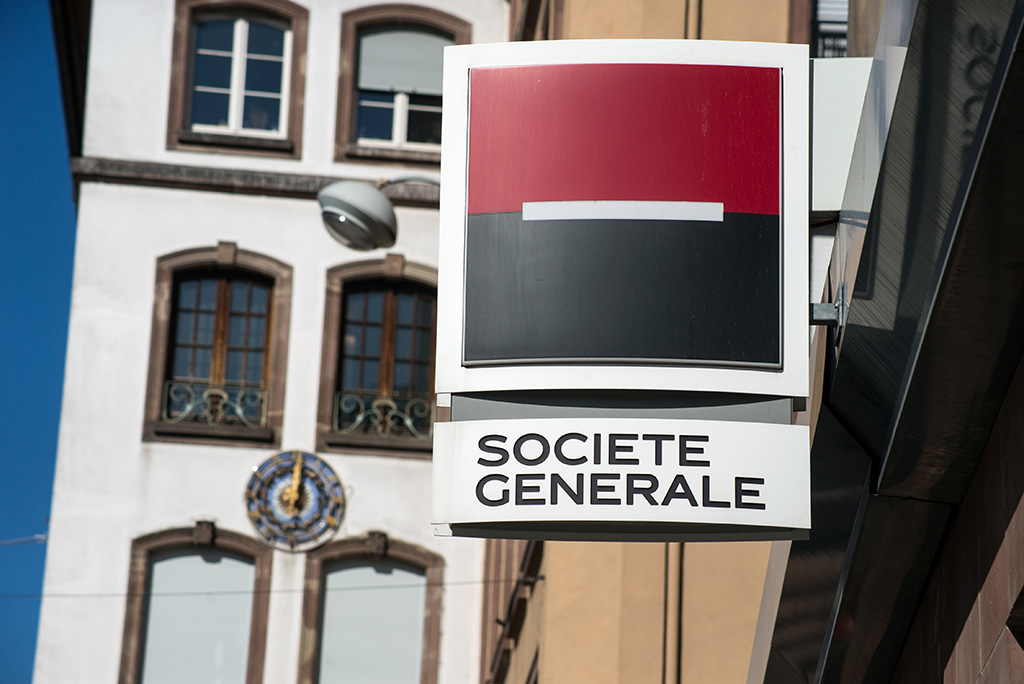
Few banks carry a name as fitting as Société Générale. Translated broadly, it means “General Company,” but its original mission was far more precise: to promote the development of commerce and industry. Founded on May 4, 1864, by decree of Napoleon III, Société Générale was born during the height of the Industrial Revolution, when railways, steel, infrastructure, shipping, and international trade were reshaping Europe’s economic map. (Société Générale)
From the beginning, Société Générale was not designed merely to hold deposits. It was created to finance growth. Its founders were industrialists and financiers who understood that modern economies require organized capital. The bank quickly became part of France’s transformation from a national economy into an international commercial power. Between 1870 and 1940, its French branch network expanded from 46 branches to roughly 1,500, making it a leading force in deposit banking during the interwar period. (Société Générale)
Its ambitions were international almost immediately. Société Générale opened its first foreign branch in London in 1871 and later established a presence in strategic cities including New York, Buenos Aires, and Dakar. That global reach made the bank more than a French institution; it became a financial bridge between Europe, the Americas, and Africa. (Société Générale)
The bank’s role in infrastructure finance also forms part of its legend. Société Générale was involved in financing essential infrastructure across Europe, Latin America, and North Africa, and its own historical timeline highlights its role in the innovative co-financing of the Eiffel Tower project, inaugurated in 1889. (Société Générale)
From Reconstruction to Modern Universal Banking
Société Générale’s history follows the major political and financial turns of modern Europe. Nationalized in 1945, the bank became part of France’s post-war reconstruction effort during the “Trente Glorieuses,” the thirty years of rapid growth that rebuilt the French economy after World War II. During this period, the bank helped expand credit, leasing, and commercial banking services to support industrial recovery. (Société Générale)
By the 1980s, deregulation, global capital markets, and financial innovation had changed banking once again. Société Générale was privatized in 1987 and strengthened its universal banking model, combining retail banking, capital markets, corporate finance, private banking, and international services. (Société Générale)
The bank was also an early mover in digital banking. In 1985, Société Générale introduced Logitel, described in its history as the first online banking services offered to customers. That matters today because the banking world is again being rewritten by technology—this time through tokenization, digital assets, mobile banking, artificial intelligence, and instant global settlement. (Société Générale)
Société Générale Today
Modern Société Générale is one of Europe’s major banking groups. The bank says it serves tens of millions of clients across dozens of countries, supported by roughly 110,000 staff and three core business lines: French Retail Banking, Private Banking and Insurance; Global Banking and Investor Solutions; and Mobility, International Retail Banking and Financial Services. (Société Générale)
Those divisions tell us where modern banking is headed.
The first pillar—French retail, private banking, and insurance—anchors the bank in traditional client relationships. Its French retail network serves individual, business, corporate, nonprofit, and municipal clients, while its private banking operations provide wealth management, structured products, private equity, real estate, hedge funds, and access to capital markets. (Société Générale)
The second pillar—Global Banking and Investor Solutions—is where Société Générale remains especially relevant to Invest Offshore readers. This division provides global markets, investor services, financing, advisory, transaction banking, and securities services to corporates, financial institutions, sovereigns, asset managers, pension funds, and financial sponsors. Société Générale specifically identifies global leadership in equity derivatives, structured finance, and ESG within this business line. (Société Générale)
The third pillar—mobility, international retail banking, and financial services—reflects the new economy. Through Ayvens, Société Générale has positioned itself in sustainable mobility, leasing, fleet management, and corporate transportation solutions, while also maintaining international banking operations in key markets. (Société Générale)
A Bank Built for the New Capital Era
Société Générale’s modern significance is not simply that it is old. Many institutions are old. The point is that Société Générale has repeatedly adapted to new capital systems: industrial finance in the 19th century, reconstruction finance after 1945, universal banking after privatization, digital banking in the 1980s, and now sustainable finance and tokenized assets.
The bank has committed to mobilizing €500 billion for sustainable finance by 2030, placing energy transition, infrastructure, and ESG-linked capital directly inside its strategic identity. (Société Générale)
It is also moving into regulated digital assets through Société Générale-FORGE. France’s AMF lists SG Forge as authorized for crypto-asset custody and administration, transfer services, and execution of orders for crypto-assets on behalf of clients. (AMF France) SG Forge’s CoinVertible product is presented as a MiCA-compliant e-money token, licensed by the ACPR, 100% backed by cash, and designed for institutional-grade digital settlement. (SG Forge)
For offshore investors, that is a major signal. The future of banking will not be a choice between old banks and new rails. The winners may be institutions that can combine regulated balance sheets, capital markets expertise, digital settlement, compliance, and cross-border reach.
2026 Performance: Resilience in Uncertain Times
Société Générale’s first-quarter 2026 results show a bank still operating at institutional scale. Net banking income for Q1 2026 was €7.106 billion, up 4.4% at constant perimeter and exchange rates. French Retail, Private Banking and Insurance revenues rose 8.9% year over year, while BoursoBank reached 8.9 million clients at the end of March 2026. (GlobeNewswire)
Global Banking and Investor Solutions reported €2.755 billion in Q1 2026 revenues, with equity revenues up 5.5% to a record high, supported by strong flow activity and financing activities. (GlobeNewswire)
In Mobility, International Retail Banking and Financial Services, Q1 2026 revenues reached €1.943 billion, up 2.9% at constant scope and exchange rates, while the Africa, Mediterranean Basin, and French Overseas Territories region generated €360 million of revenue, up 5.1% at constant scope and exchange rates. (GlobeNewswire)
This is why Société Générale remains significant. It is not merely a French bank with a famous history. It is a living example of how legacy financial institutions are trying to stay relevant in a world of geopolitical uncertainty, digital money, infrastructure demand, energy transition, private credit, and sovereign-scale capital needs.
Why It Matters to Invest Offshore Readers
The offshore investor should study Société Générale for three reasons.
First, it demonstrates the enduring power of institutional credibility. In cross-border finance, reputation, licensing, custody, compliance, and execution are not decorative. They are the infrastructure of trust.
Second, it shows that the future of finance belongs to institutions that can connect capital markets with real economic development. Société Générale was founded to support trade and industry. That same mission now extends into sustainable finance, mobility, structured finance, digital assets, and emerging market development.
Third, it proves that banking history is not dead. The same forces that created the great European banking houses—trade, infrastructure, industry, technology, and international capital—are reappearing in modern form. Today’s railways are energy grids, data centers, digital asset rails, green bonds, tokenized securities, and sovereign transition finance.
Société Générale’s illustrious history is a reminder that serious finance is built over generations. Its modern significance is that it continues to adapt while remaining tied to its original mandate: the development of commerce and industry.
For Invest Offshore readers, that is the lesson. The next era of wealth will not be won by speculation alone. It will be won by those who understand structure, jurisdiction, custody, compliance, settlement, and the disciplined movement of capital across borders.
Invest Offshore continues to review investment opportunities in West Africa and the Copperbelt Region seeking qualified investors.
Leave a Reply