
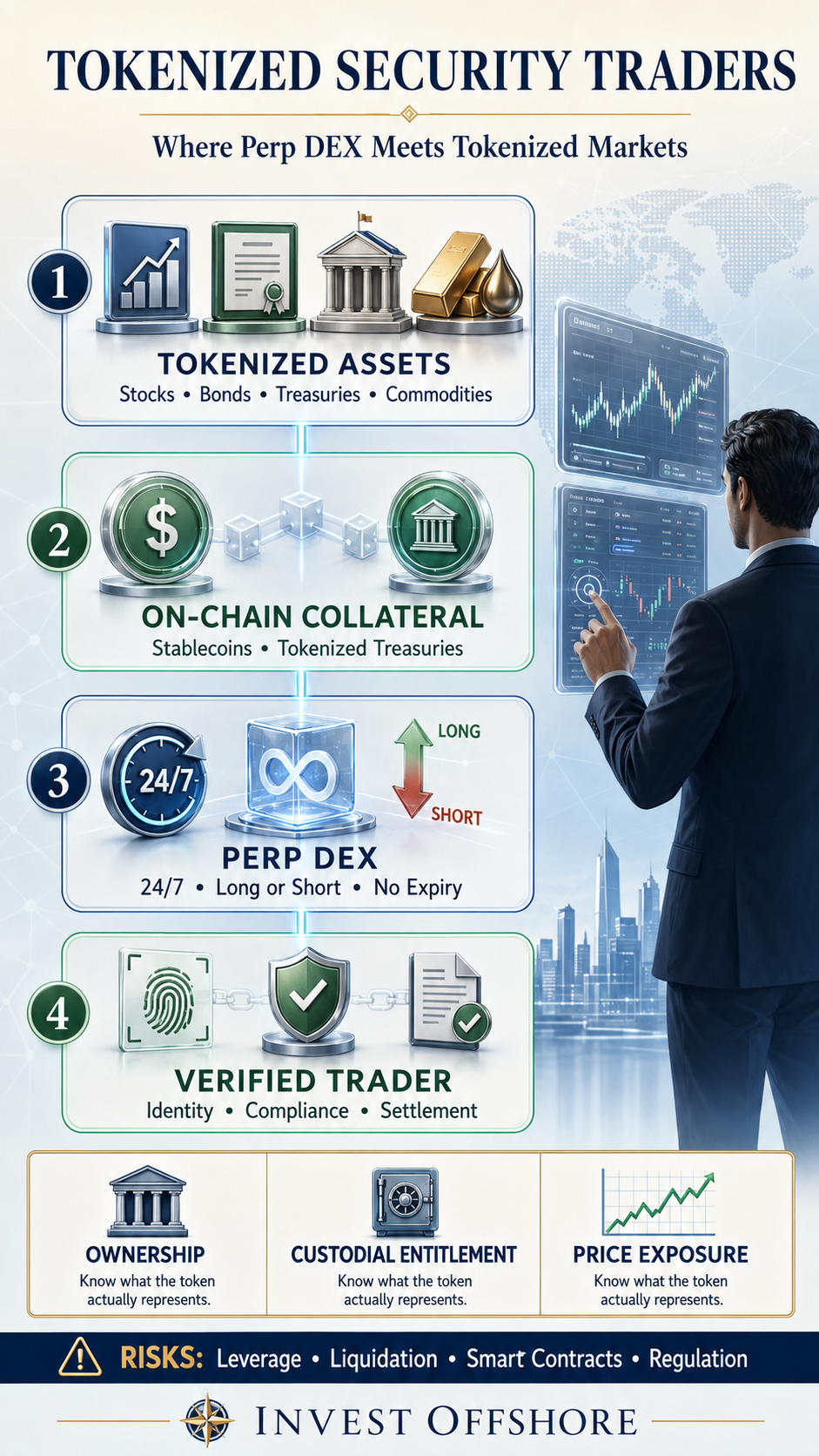
A powerful convergence is beginning to reshape global capital markets: the rise of perpetual decentralized exchanges, commonly called Perp DEXs, alongside the rapid expansion of tokenized securities.
Perpetual futures have already become one of decentralized finance’s most successful products. Unlike conventional futures contracts, “perps” have no expiration date. Traders can maintain long or short exposure while periodic funding payments help keep the contract’s price aligned with its underlying market.
Until recently, these exchanges concentrated almost entirely on cryptocurrencies. The next frontier could be much larger: tokenized stocks, bonds, Treasury securities, commodities and private-market assets.
Together, Perp DEX technology and tokenization could create an entirely new generation of security traders operating across programmable, continuously available markets.
What Is a Perp DEX?
A Perp DEX is a blockchain-based marketplace for perpetual derivative contracts. Trading, collateral management and settlement are performed through smart contracts or a hybrid on-chain system instead of relying entirely on a conventional centralized exchange.
The attraction is straightforward:
- Markets can operate around the clock.
- Positions settle using digital collateral.
- Traders retain greater control over their assets.
- Smart contracts automate margin and settlement.
- Anyone can independently examine on-chain activity.
- Global liquidity can gather around a common market.
The model has gained traction because it combines the speed and accessibility of crypto markets with financial instruments resembling traditional futures and swaps.
It also introduces serious risks. Leverage can magnify losses, funding payments can accumulate, smart contracts may fail, and automatic liquidations can occur rapidly during volatile markets. Perpetual contracts are derivatives—not ownership of the referenced asset.
Tokenized Securities Bring Wall Street Assets On-Chain
A tokenized security is a stock, bond, fund interest or other legally recognized security represented through a crypto asset or blockchain record.
The technology can allow ownership records, transfers, collateral movements and settlement instructions to operate across programmable networks. However, tokenization does not automatically eliminate the laws governing the underlying instrument.
In January 2026, the Securities and Exchange Commission outlined two broad classes: securities tokenized by or for their issuer, and securities tokenized by an unaffiliated third party. Third-party structures can represent a custodial interest in an actual security or provide synthetic exposure without conferring ownership rights in the referenced company. The SEC’s statement makes the distinction essential for investors.
A digital token displaying the price of a stock is not necessarily the same thing as owning that stock.
The holder must determine:
- Who issued the token?
- Is the underlying security held in custody?
- Does the token carry voting or dividend rights?
- Who maintains the official ownership record?
- What happens if the token issuer or custodian fails?
- Where and how can the token be redeemed?
These questions will separate legitimate financial infrastructure from instruments that merely imitate traditional securities.
When Perp DEXs Meet Tokenized Markets
The convergence could eventually allow a trader to post tokenized Treasury bills as collateral, trade a perpetual contract linked to a tokenized equity index and settle gains in regulated stablecoins—all within a connected on-chain environment.
That would produce three distinct layers:
- Tokenized assets: Digital representations of stocks, bonds, funds and commodities.
- On-chain collateral: Stablecoins, tokenized Treasuries and other eligible assets securing positions.
- Perpetual derivatives: Contracts offering continuous long or short price exposure without transferring ownership of the referenced security.
This architecture could make capital considerably more mobile. A security that settles through conventional infrastructure during limited market hours could become collateral inside a programmable financial network available across borders and time zones.
But derivatives referencing securities create additional regulatory complexity. Depending on their construction and jurisdiction, these products may be treated as securities-based swaps, futures, contracts for difference or other regulated instruments. A decentralized interface does not make those obligations disappear.
Tokenized Security Traders
The expression “tokenized security traders” describes more than investors trading digital stocks. It points toward a new market participant whose identity, collateral, assets and transactions can all be verified through connected digital infrastructure.
A compliant version of this model could include:
- Verified digital identity and investor eligibility
- Whitelisted wallets
- Programmable transfer restrictions
- Tokenized collateral and real-time margin
- Automated compliance reporting
- Transparent proof of reserves
- Near-instant settlement
- Permanent, auditable transaction records
This does not necessarily mean anonymous trading. Institutional tokenized markets are more likely to combine blockchain efficiency with identity controls, qualified custody, jurisdictional restrictions and regulated access.
The result could be an on-chain security trader: verified at the entrance, programmable within the market and auditable at settlement.
The Difference Between Ownership and Exposure
The biggest conceptual danger is confusing a perpetual contract with the asset it tracks.
Buying a tokenized share may provide an ownership or custodial interest, depending on the structure. Opening a perpetual position generally provides only economic exposure to price movements. The trader may have no voting rights, no direct claim against the referenced company and no entitlement to an ordinary shareholder account.
Price exposure can also separate from the underlying market when liquidity weakens or price oracles malfunction. That makes market surveillance, reliable reference prices and clearly disclosed liquidation procedures critical.
For investors, the decisive question will be: Do I own the asset, hold an entitlement backed by the asset, or merely possess a contract linked to its price?
The Opportunity for Global Capital
Tokenized securities could expand access to assets historically limited by geography, operating hours and fragmented settlement systems. Perp DEX infrastructure could add hedging, price discovery and continuous liquidity around those assets.
Potential benefits include:
- Twenty-four-hour risk management
- Faster movement of collateral
- Fractional market participation
- Reduced settlement friction
- Global price discovery
- Programmable corporate actions
- New liquidity for less-accessible assets
The strongest opportunity may not be nonstop speculation. It may be the creation of continuous risk-management tools surrounding tokenized real-world assets.
A business holding tokenized commodities, for example, could eventually hedge price exposure through an on-chain perpetual market. A fund holding tokenized bonds might obtain liquidity without waiting for conventional settlement. International investors could manage currency and market exposure within a unified digital system.
Regulation Will Determine the Winners
The United States is developing clearer distinctions among digital commodities, tokenized securities and derivatives, but important questions remain. The SEC has emphasized that securities remain securities when placed on a blockchain. Meanwhile, the regulated U.S. market has begun admitting some crypto perpetual products, although authorization for crypto perps does not automatically extend to traditional equities or other securities.
Successful platforms will therefore need more than fast software and deep liquidity. They will need credible custody, transparent legal structures, resilient price feeds, responsible leverage limits and clear regulatory standing.
The winners may be hybrid markets: decentralized enough to deliver transparency and programmability, yet structured enough to satisfy securities, derivatives, custody and investor-protection requirements.
A New Class of Security Traders
Traditional markets separated brokers, exchanges, clearinghouses, custodians and transfer agents into distinct institutions. Tokenization can connect these functions through shared programmable infrastructure, while Perp DEXs demonstrate how quickly global liquidity can form around an always-open market.
The convergence is still in its early stages, and substantial legal and technical risks remain. Nevertheless, its direction is becoming visible.
Tomorrow’s security traders may not wait for an opening bell. They could hold tokenized assets, post programmable collateral, hedge through perpetual markets and settle internationally within minutes.
The market is not merely putting securities on-chain. It is beginning to place the entire trading relationship—identity, ownership, collateral, risk and settlement—into a digital financial architecture.
That is where Perp DEX technology could meet the future of Security Traders.
This article is for informational purposes only and does not constitute investment, legal or trading advice. Perpetual derivatives involve substantial risk, including the possibility of rapid liquidation and complete loss of posted collateral.
Leave a Reply