
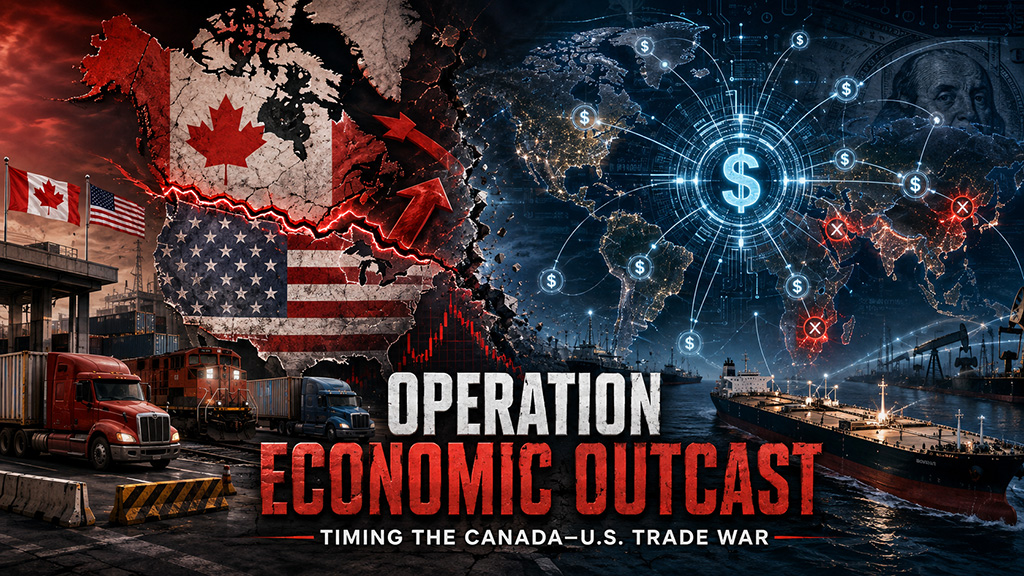
August 2026 may be remembered as the week Washington demonstrated two very different forms of economic warfare at the same time.
On August 21, Canada–U.S. trade negotiations collapsed. On August 22, new American tariffs of 50% took effect on C$27.6 billion of Canadian goods. Two days later, on August 24, U.S. Treasury Secretary Scott Bessent stepped before the world and announced something dramatically more consequential: Operation Economic Outcast.
The target is Iran. The implications are global.
And for Canadians watching an escalating trade confrontation with their largest economic partner, the timing deserves attention.
Note:
Iran may be the target of Operation Economic Outcast, but measured against the scale of criminal capital connected to China—and Ukraine—Iran is comparatively small. Canada already has an uncomfortable international reputation for what is called “snow washing”: using Canada’s clean, stable financial reputation, corporations, real estate and banking system to give questionable foreign capital a respectable Canadian face.
The China-linked “Vancouver Model” is not internet folklore; it has been examined in Canadian parliamentary testimony and major anti-money-laundering investigations. Separately, FINTRAC has warned that sanctioned actors and their proxies use shell companies, nominees, correspondent banking and complex international structures to conceal ownership and move funds, including circumstances in which Canadian financial institutions may serve as transit points.
Canada lost $7B USD on Ukraine war.
But put the all the events side by side and a broader Trump administration doctrine becomes visible:
Access to the American market and the American financial system is no longer being treated merely as a commercial privilege. It is increasingly being deployed as strategic leverage.
That is something every international investor should understand.
What Is Operation Economic Outcast?

On August 24, 2026, Treasury formally launched Operation Economic Outcast, describing it as a sustained campaign designed to isolate the Iranian government economically and sever the international financial networks supporting it.
Bessent used extraordinary language, comparing the operation to an economic “D-Day.”
Treasury says it has mapped the international networks Iran uses to move petroleum, money, technology and other assets through third countries. It is now threatening consequences not merely for Iranian entities, but for foreign institutions that continue facilitating prohibited activity.
That distinction is critical.
Traditional sanctions say:
You cannot do business with us.
Secondary sanctions effectively say:
If you continue doing certain business with them, you may lose the ability to do business with us.
And the size of the American financial system makes that threat enormously powerful.
Bessent made the point explicit:
“Any entity that facilitates money laundering on behalf of Iran will be removed from the U.S. dollar system.”
Treasury says governments around the world are being given defined timelines to terminate specified Iran-related activities, while OFAC has expanded potential sanctions exposure across digital assets, technology, gold, aviation and shipping. Nearly 60 entities, individuals and vessels were sanctioned in the initial action.
For Invest Offshore readers, those five sectors should jump off the page.
Digital assets. Gold. Shipping. Technology. Aviation.
These are precisely the kinds of cross-border assets and infrastructure through which increasingly mobile global capital operates.
Now Look North

The timing becomes fascinating because Washington launched this global financial offensive only days after its negotiations with Canada imploded.
Prime Minister Mark Carney announced on August 21 that Canada had suspended negotiations after deciding that the latest American terms were not in Canada’s national interest.
Carney’s statement emphasized something deeper than tariff percentages: Canada intended to maintain its “flexibility, independence, and sovereignty.”
The following day, new American tariffs took effect.
Canada responded on August 25 by announcing matching tariffs covering C$27.6 billion of U.S. imports, with rates of 15%, 25% and 50% scheduled to begin September 8. Ottawa also unveiled another C$7.5 billion in support for Canadian workers and businesses affected by the conflict.
This is no longer a minor disagreement over dairy quotas or softwood lumber.
The world’s most integrated bilateral trading relationship is undergoing a fundamental reassessment.
Two Economic Weapons, One Source of Power

It would be wrong to equate tariffs on Canada with sanctions against Iran.
The objectives, legal mechanisms and geopolitical circumstances are completely different.
But both strategies originate from the same underlying source of American power:
Access.
Access to the world’s largest consumer economy.
Access to U.S. banks.
Access to dollar clearing.
Access to American technology.
Access to American capital markets.
Access to American financial institutions.
And ultimately, access to the enormous commercial ecosystem operating around the United States.
For most of the postwar era, countries regarded this infrastructure as the largely neutral plumbing of globalization.
Operation Economic Outcast illustrates how aggressively Washington can weaponize that plumbing.
The Canada trade dispute demonstrates something less severe but potentially more important for America’s allies: even highly integrated economic relationships can be renegotiated using market access as leverage.
That represents a profound change in how sovereign economic risk must be calculated.
The Dollar Is the Ultimate Sanctions Weapon

The United States possesses something no aircraft carrier can duplicate.
It sits near the center of global finance.
International trade frequently touches dollars even when neither party to the transaction is American. Banks around the world maintain relationships with American correspondent banks. Global shipping, commodities, energy transactions, securities and institutional finance routinely intersect with the U.S. financial system.
That gives Treasury extraordinary reach.
Operation Economic Outcast is essentially an attempt to turn that network effect into geopolitical coercion.
The message to international institutions is unmistakable:
Choose your counterparties carefully because access to the American system may depend upon it.
And this is where the story becomes particularly relevant to offshore investors.
Offshore Doesn’t Mean Outside the System

There is a persistent misconception that owning assets offshore removes them from American financial influence.
Often it does not.
A Singapore company may bank through a financial institution that depends upon U.S. correspondent banking.
A Swiss intermediary may process dollar transactions.
A Dubai trading company may rely upon insurers, banks or shipping companies with U.S. exposure.
A Hong Kong entity may transact through institutions unwilling to risk OFAC sanctions.
A digital-asset platform may use dollar-backed stablecoins whose reserves or issuers ultimately intersect with American financial infrastructure.
Even gold—the traditional stateless monetary asset—is specifically identified by Treasury as one of the sectors covered by the expanded Iran sanctions framework.
The lesson is important:
Asset jurisdiction and transaction jurisdiction are not necessarily the same thing.
Your gold might be in Switzerland.
Your company might be in Singapore.
Your vessel might be registered in Panama.
Your crypto wallet might exist nowhere in the traditional geographic sense.
But somewhere in the transaction chain there may still be a bank, custodian, insurer, exchange, clearing institution or technology provider with exposure to Washington.
The Great Diversification Accelerates

Ironically, America’s willingness to weaponize its financial dominance could ultimately encourage the rest of the world to reduce dependence upon it.
That process was already underway.
Central banks have been accumulating gold.
Countries are experimenting with bilateral settlement arrangements.
China continues developing yuan-denominated trade infrastructure.
Stablecoins are creating programmable settlement networks.
Tokenized deposits are emerging.
BRICS governments continue discussing alternative payment architecture.
Financial centers including Singapore, Dubai, Hong Kong and Switzerland compete to intermediate capital moving between economic blocs.
None currently offers a credible replacement for the entire dollar system.
That isn’t the point.
The emerging financial world may not replace one dominant network with another.
It may become multipolar.
Investors increasingly may maintain assets, banking relationships, currencies, custodians and corporate structures across several jurisdictions rather than relying upon one financial center.
In that environment, geographic diversification becomes something more than tax planning.
It becomes geopolitical risk management.
Canada May Have Just Received the Message

Canada is unusually vulnerable to changes in American economic policy because approximately three quarters of Canadian merchandise exports have traditionally gone south across the border.
For decades, geographic proximity to the United States was Canada’s greatest economic advantage.
In 2026, the same concentration increasingly looks like strategic dependency.
Carney’s response has therefore emphasized diversification, internal Canadian trade and greater economic independence. His August 21 statement explicitly acknowledged that “America has changed” and that Canada will not simply return to its previous relationship with the United States.
That may ultimately prove more important than the current tariff schedule.
Canada has enormous assets to work with:
energy,
uranium,
potash,
critical minerals,
agriculture,
fresh water,
Arctic geography,
hydroelectric power,
artificial-intelligence expertise,
and direct access to Atlantic and Pacific markets.
The strategic question is whether Canada can turn those advantages into greater international optionality without damaging the extraordinarily valuable continental economy it shares with the United States.
The Strange Timing of Economic D-Day

Consider the sequence again.
August 21: Canada–U.S. negotiations collapse.
August 22: New 50% U.S. tariffs on selected Canadian goods begin.
August 24: Treasury launches Operation Economic Outcast and warns foreign governments and financial institutions that continued economic relationships with Iran can jeopardize access to the American financial system.
August 25: Canada announces C$27.6 billion in retaliatory tariffs and billions in domestic economic support.
There is no demonstrated operational connection between these events.
But there is certainly a philosophical connection worth examining.
The United States is rediscovering economic power as an instrument of statecraft.
Tariffs.
Sanctions.
Secondary sanctions.
Market access.
Financial-system access.
Technology restrictions.
Shipping restrictions.
Dollar clearing.
These tools can accomplish geopolitical objectives without immediately putting soldiers on battlefields.
President Trump’s America increasingly appears willing to use them.
What Invest Offshore Investors Should Learn

Operation Economic Outcast is therefore bigger than Iran.
The Canada trade war is bigger than Canada.
Together they demonstrate something investors have been slowly discovering throughout the 2020s:
Political jurisdiction has become an investment variable.
For the internationally diversified investor, the old question was:
Where can I earn the best return?
The better questions now include:
Where is the asset legally domiciled?
Who has custody?
Which currency settles the transaction?
Which correspondent banks are involved?
Which sanctions regimes apply?
Which country controls the payment rail?
Can capital move if geopolitical conditions suddenly change?
What happens if two jurisdictions in the structure become economic adversaries?
And perhaps most importantly:
Who can turn the system off?
The Offshore Advantage Is Optionality

This does not mean abandoning the United States.
Quite the opposite.
The sheer power demonstrated by Operation Economic Outcast illustrates why American markets, institutions and dollars remain central to global wealth.
Nor does Canada’s confrontation with Washington mean investors should abandon Canada.
It means concentration risk should finally be recognized for what it is.
True offshore planning isn’t about fleeing one country for another.
It is about creating optionality.
Multiple jurisdictions.
Multiple banking relationships.
Multiple currencies.
Multiple custodians.
Multiple asset classes.
Multiple payment rails.
And enough legal and financial flexibility that an investor isn’t trapped when governments suddenly rewrite the rules.
For decades, offshore finance was marketed primarily around taxes and privacy.
The world of 2026 is adding a third pillar:
geopolitical resilience.
Operation Economic Outcast may have been designed for Tehran.
But its timing—arriving in the middle of the most serious Canada–U.S. economic confrontation in generations—offers a lesson extending far beyond Iran.
Washington is showing the world exactly how powerful economic access can be.
Sophisticated investors should be watching.
Because in the emerging financial order, the most valuable asset may not be dollars, gold, Bitcoin or real estate.
It may simply be the ability to choose which system you use.

Leave a Reply