
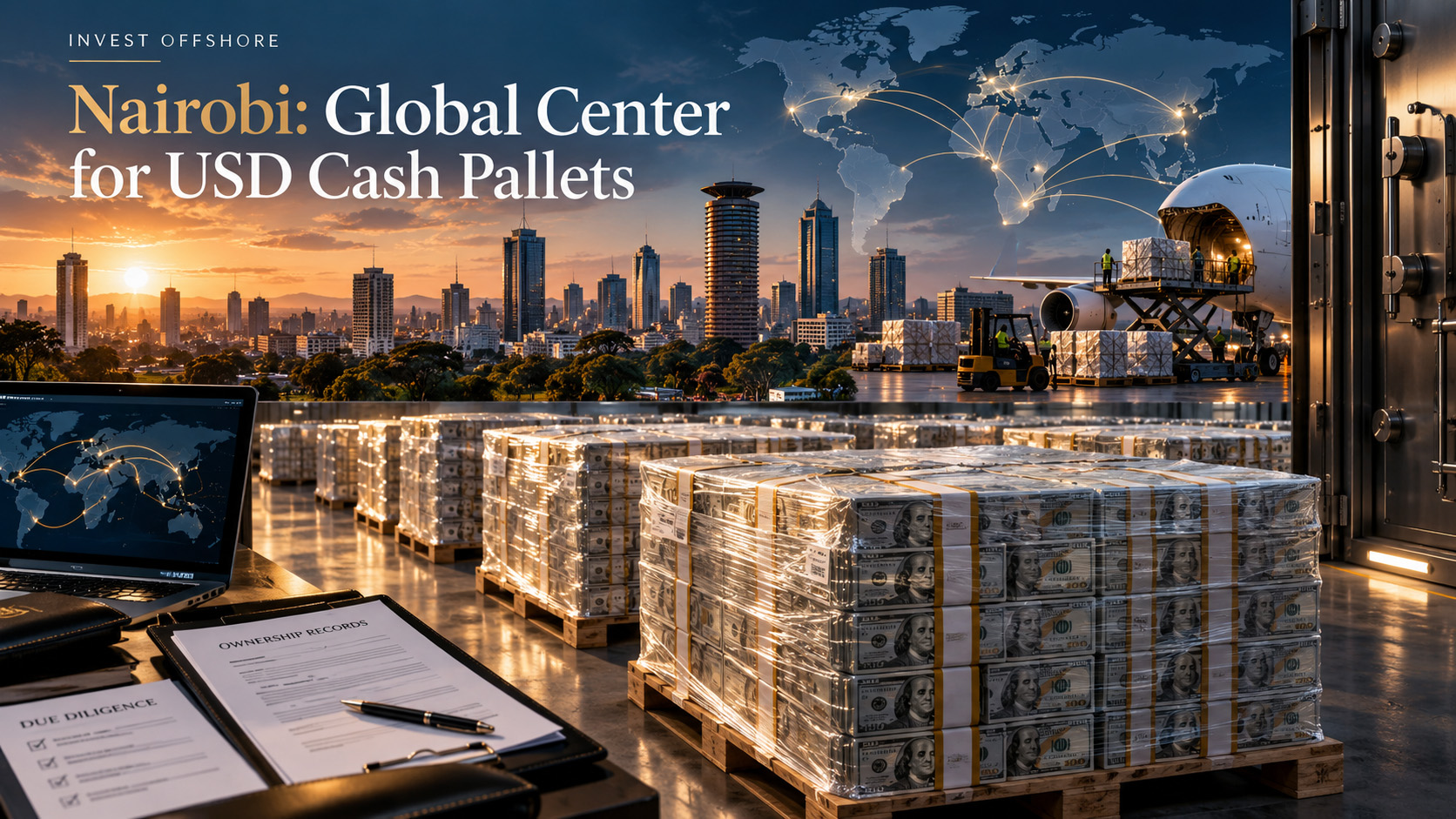
Something significant appears to be happening in Nairobi.
Over the past several years, Invest Offshore has followed the highly specialized market surrounding large holdings of physical U.S. currency—often described within private transaction circles as USD cash pallets. Activity has surfaced in traditional financial and logistics centers including Zurich, Frankfurt, Dubai and Hong Kong.
But the flow of information reaching us is changing.
Nairobi, Kenya is now emerging, according to our sources, as perhaps the most concentrated center of USD cash-pallet activity we have encountered.
This morning, Invest Offshore received the following communication from a source active in the market:
“We currently have $10+B in cash pallets located in Nairobi, Kenya.”
Separately, another agent has advised that 30 additional pallets are available in Nairobi. Other parties have been transmitting photographs, videos and extensive documentation which they say establishes possession, provenance and ownership of additional holdings.
Taken together, the volume of activity being reported to us is striking.
Why Nairobi?


For years, the cash-pallet market we have monitored tended to orbit a handful of global locations. Switzerland naturally figured prominently because of its banking and secure-custody infrastructure. Dubai became another important junction because of its position between Europe, Africa, the Middle East and Asia. Hong Kong appeared repeatedly in transactions involving Asian counterparties.
Now Nairobi is appearing with remarkable frequency.
That does not mean Nairobi has somehow replaced Zurich or Dubai as an international banking center. Rather, within this extremely narrow market, our incoming deal flow increasingly points toward Nairobi as a physical concentration point for dollar holdings seeking institutional counterparties.
There are several reasons why that possibility deserves attention.
Kenya occupies an important financial and logistical position in East Africa. Nairobi hosts major banks, international organizations, multinational corporations, logistics companies and professional-service firms, while serving as a commercial gateway into a much larger regional economy.
More importantly for physical-currency transactions, Kenya already has a formal regulatory framework governing the movement and reporting of large quantities of cash.
The Kenya Revenue Authority states that currency or monetary instruments of US$10,000 or more must be declared to Customs on arrival or before departure. Kenya Revenue Authority
Central Bank of Kenya guidance similarly addresses cross-border movements of physical cash and monetary instruments, including large-scale transportation rather than merely ordinary passenger cash. Central Bank of Kenya
That regulatory infrastructure becomes extraordinarily important when the numbers involved move from thousands of dollars to millions—or billions.
$10+ Billion Changes the Conversation
The latest report reaching Invest Offshore is not about several boxes of currency.
It is a reported $10+ billion holding in Nairobi.
At that scale, the transaction ceases to resemble anything remotely connected with conventional cash handling. It becomes an institutional exercise involving custody, provenance, customs, authentication, beneficial ownership, banking compliance, security and settlement.
And the $10+ billion report is apparently not isolated.
We have also been advised that another agent controls access to 30 pallets in Nairobi, while additional parties have supplied videos, photographs and documentation concerning other holdings.
That clustering is what makes Nairobi noteworthy.
One seller appearing in Kenya would be an individual transaction.
Several independent sources presenting substantial holdings in the same city begins to look like a market.
What Does “Verified” Actually Mean?
This distinction is crucial.
In the USD cash-pallet world, the word verified can mean very different things to different participants.
A seller may describe a holding as verified because there are photographs of the cash. Another may have warehouse documentation. Another may possess airway bills, customs documents, storage receipts, ownership papers, box registers, certificates or other supporting records.
Those materials can be important.
But documentary presentation should never be confused with final institutional verification.
Invest Offshore has received and reviewed photographs, videos and documentation supplied by sources in connection with Nairobi holdings. Those materials are significant enough to warrant reporting the emergence of Nairobi as a center of activity. They do not, by themselves, constitute an independent audit by Invest Offshore of every note, document, owner or claimed dollar amount.
For a serious buyer, verification must go considerably further.
The critical questions include whether the currency physically exists at the stated location; whether the presenting party has legal authority to transact; whether title and provenance can be established; whether customs declarations and cross-border records are legitimate; whether the currency passes authentication; whether the beneficial owners clear KYC and sanctions screening; and whether the proposed settlement can move through regulated institutions.
Those safeguards are not obstacles to a transaction.
They are what make a transaction possible.
Kenya’s Compliance Framework Matters
The sheer size of these reported holdings makes Kenyan compliance particularly relevant.
Kenya’s Financial Reporting Centre states that reporting institutions must file reports covering cash transactions equivalent to or exceeding US$15,000, regardless of whether those transactions appear suspicious. FRC Kenya
That gives some perspective to the compliance gulf separating ordinary commerce from a transaction measured in billions.
Kenya Revenue Authority guidance also makes clear that currency exceeding prescribed thresholds must be declared, while newer import-documentation rules have strengthened requirements surrounding supporting export and import records. Kenya Revenue Authority
Consequently, anyone considering a large physical-currency transaction in Nairobi should expect an institutional process—not a handshake transaction in a hotel lobby.
The Buyer Has Become the Scarce Asset
Perhaps the most interesting development is that the apparent constraint in Nairobi is no longer supply.
It is qualified buying capacity.
Our sources are telling us plainly: buyers are needed in Nairobi.
But there is an important qualification to that statement.
The market does not need more intermediaries forwarding PDFs through WhatsApp. It needs genuine institutional counterparties capable of performing compliance, authenticating physical currency, establishing legal title, coordinating secure custody and completing a documented settlement.
With reported inventories reaching into the billions of dollars, proof of funds alone is not sufficient.
A credible counterparty needs an executable procedure.
That typically means regulated banking relationships, experienced legal counsel, AML/KYC capability, security and custody infrastructure, independent authentication and a settlement process understood by everyone before anyone touches the assets.
From Nairobi to the Global Financial System
If even a portion of the inventory currently being presented in Nairobi ultimately survives rigorous institutional verification, the implications are substantial.
These transactions raise a much bigger question:
How much physical U.S. currency sits outside the conventional banking system waiting for a compliant pathway back into it?
Physical dollars circulate globally because the U.S. dollar remains the world’s dominant international currency. But extraordinarily large accumulated holdings create a completely different problem. Ownership has to be demonstrated. Authenticity has to be established. Customs history matters. Source of funds matters. Beneficial ownership matters. Settlement matters.
In other words, the physical cash may be the most visible component of the transaction—but it is not necessarily the most valuable one.
The valuable commodity is a credible path from physical custody to regulated financial settlement.
That is why Nairobi is worth watching.
Nairobi: From Outpost to Marketplace?
Invest Offshore has spent years receiving information concerning USD cash holdings in Europe, the Middle East, Asia and Africa. There have been promising transactions, complicated transactions and plenty of transactions that never crossed the finish line.
The lesson has always been the same:
Cash is easy to claim. Clean execution is difficult.
What makes the current Nairobi activity different is the concentration.
A reported $10+ billion holding.
Another source presenting 30 pallets.
Additional sellers transmitting ownership documentation, photographs and videos.
Multiple independent streams are now pointing toward the same city.
We therefore believe Nairobi deserves to be watched as an emerging center of this highly specialized international market.
Whether it ultimately becomes the global center for USD cash-pallet transactions will depend on something much more important than the quantity of cash sitting in secure storage.
It will depend on whether Nairobi can connect legitimate sellers with regulated, capitalized and compliance-ready institutional buyers capable of actually closing transactions.
For the moment, however, the message reaching Invest Offshore could hardly be clearer:
The pallets are increasingly appearing in Nairobi. The next requirement is credible institutional buying capacity.
Invest Offshore will continue following developments in Nairobi and the international physical-currency market. References to holdings, documentation or verification in this article describe information and materials supplied by market sources and should not be interpreted as an independent audit, authentication, investment recommendation, solicitation, or confirmation of legal title. Any prospective transaction involving physical currency should be independently verified and conducted through qualified legal, banking, customs, AML/KYC and secure-custody professionals.
Leave a Reply