
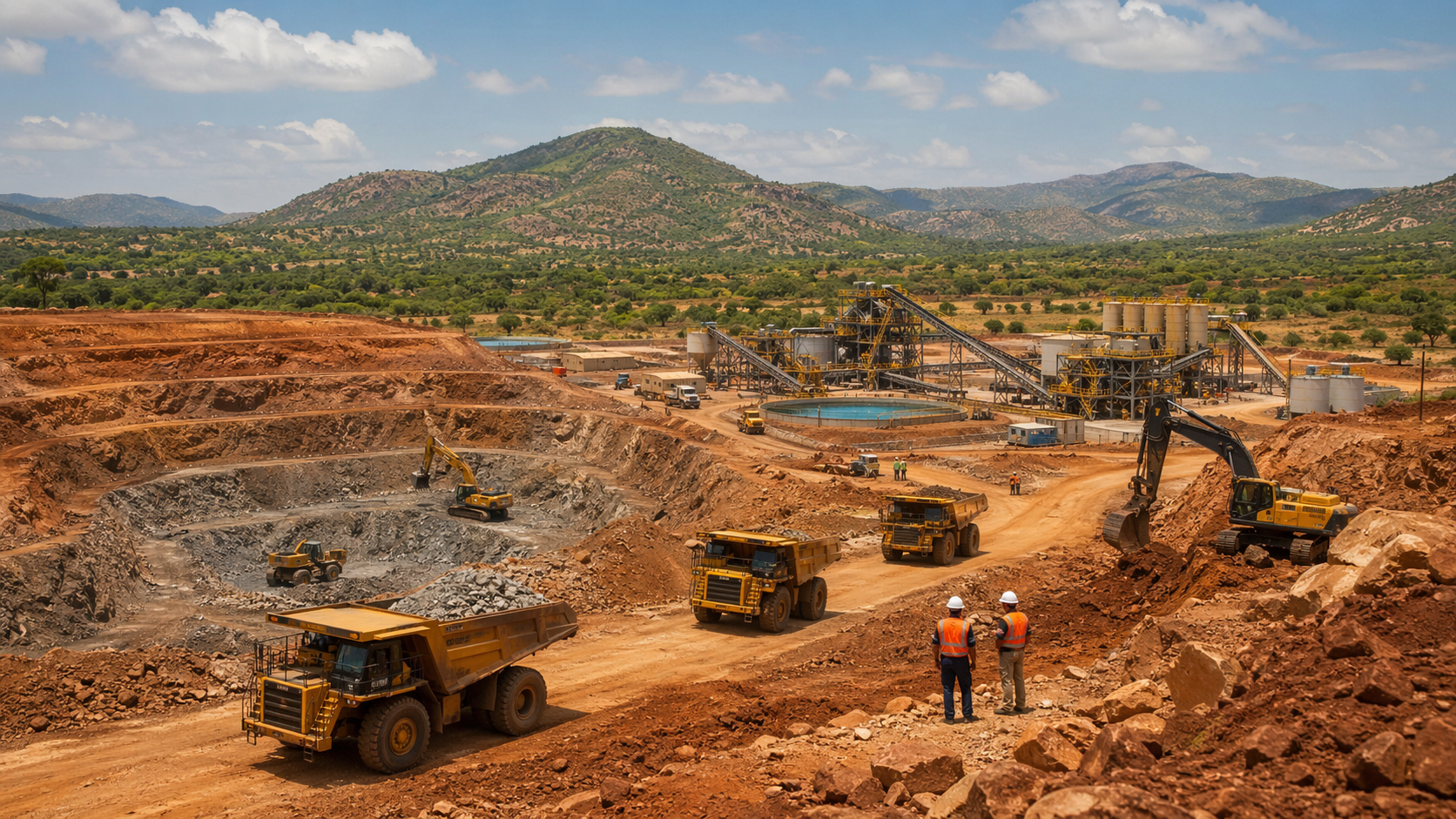
Every now and then, an opportunity lands in the Invest Offshore inbox that deserves a closer look. This week, a reader reached out seeking an investor for a gold mining property in Kilosa, Tanzania, describing a broader holding of roughly 120 acres across three separate Primary Mining Licenses. To support the pitch, they later supplied a formal technical proposal tied to the Kilosa Gold Project, giving potential investors something far more useful than loose promises: a defined exploration plan, a timeline, a technical team structure, mapped survey grids, and a phased work program.
The document is not a reserve report and it is not a production guarantee, but it is the kind of early-stage material serious investors expect to see before taking the next step.
According to the proposal, the current program centers on PML2823MOR in the Kilosa area of Morogoro, Tanzania, and covers a block of about 9.13 hectares. The exploration plan was prepared by Tuff Rock Company Limited, a Tanzania-based mining and exploration contractor, and dated 17 April 2026. Its stated purpose is straightforward: to search for a potential gold ore deposit through a phased exploration campaign beginning with geological mapping, geochemical sampling, and ground magnetic work, followed by ERT/IP geophysical surveying in Phase II.
That matters because many so-called mining opportunities arrive with little more than a location pin and a story. This one at least comes with a process. The proposed geological mapping is designed on systematic survey lines spaced at 50 meters, while the geochemical program calls for 55 soil samples and 2 stream sediment samples. On the geophysics side, the plan combines ground magnetic surveying with electrical resistivity tomography and induced polarization, two tools commonly used to identify subsurface structures, faults, quartz veins, and sulfide-bearing zones that may be associated with gold mineralization. In plain English, the aim is to move the project from “interesting ground” toward “targeted anomalies worth drilling or following up.”
The proposal also lays out a practical work schedule. Phase I is expected to require up to 10 days in the field and 20 days for data processing, interpretation, and reporting. Phase II is projected at 7 field days plus 15 days for interpretation and reporting. The final output, as stated in the report, is to identify anomalies related to gold mineralization and then recommend either deeper follow-up work or an exit from the project if results do not justify more capital. That kind of decision tree is exactly how disciplined exploration capital should be deployed.
Another encouraging feature is that the package includes more than narrative text. The annexures include a location map, a geological and geochemical survey grid, a ground magnetic survey plan, an ERT/IP survey plan, and a copy of a primary license document. The proposal also lists the intended field team, including a project manager/geologist, geophysicist, geochemist, technicians, and laborers, alongside the tools expected to be used in the field. For investors, that does not remove risk, but it does signal that the opportunity is being framed in operational terms rather than as pure speculation.
Of course, gold investors should keep their heads. Early-stage exploration is a high-risk business. A proposal like this is not the same thing as a NI 43-101 report, a JORC-compliant resource, or a producing mine. It is an invitation to investigate, not a promise of ounces in the ground. Any investor considering participation should ask for the full license package, ownership structure, legal standing of the PMLs, proof of tenure, budget breakdown, planned earn-in or equity structure, local permitting status, and an independent technical review before wiring a dollar.
Still, this is exactly the sort of frontier opportunity that attracts investors who understand that real upside often begins before the crowd arrives. Tanzania remains one of Africa’s recognized gold jurisdictions, and when a small project comes forward with a mapped program, a named contractor, and a phased exploration methodology, it deserves a hearing. The smart move now is not blind enthusiasm. It is structured due diligence.
For readers of Invest Offshore who like getting in early on hard-asset plays, the Kilosa Gold Project is one to place on the watchlist and investigate seriously. Those who want to review the package or explore whether this reader-submitted opportunity fits their portfolio can contact Invest Offshore for an introduction.
And as always, Invest Offshore continues to highlight select mining, infrastructure projects, and natural resource opportunities across Africa, including West Africa and the Copperbelt region, for investors looking beyond the usual markets.
Leave a Reply