
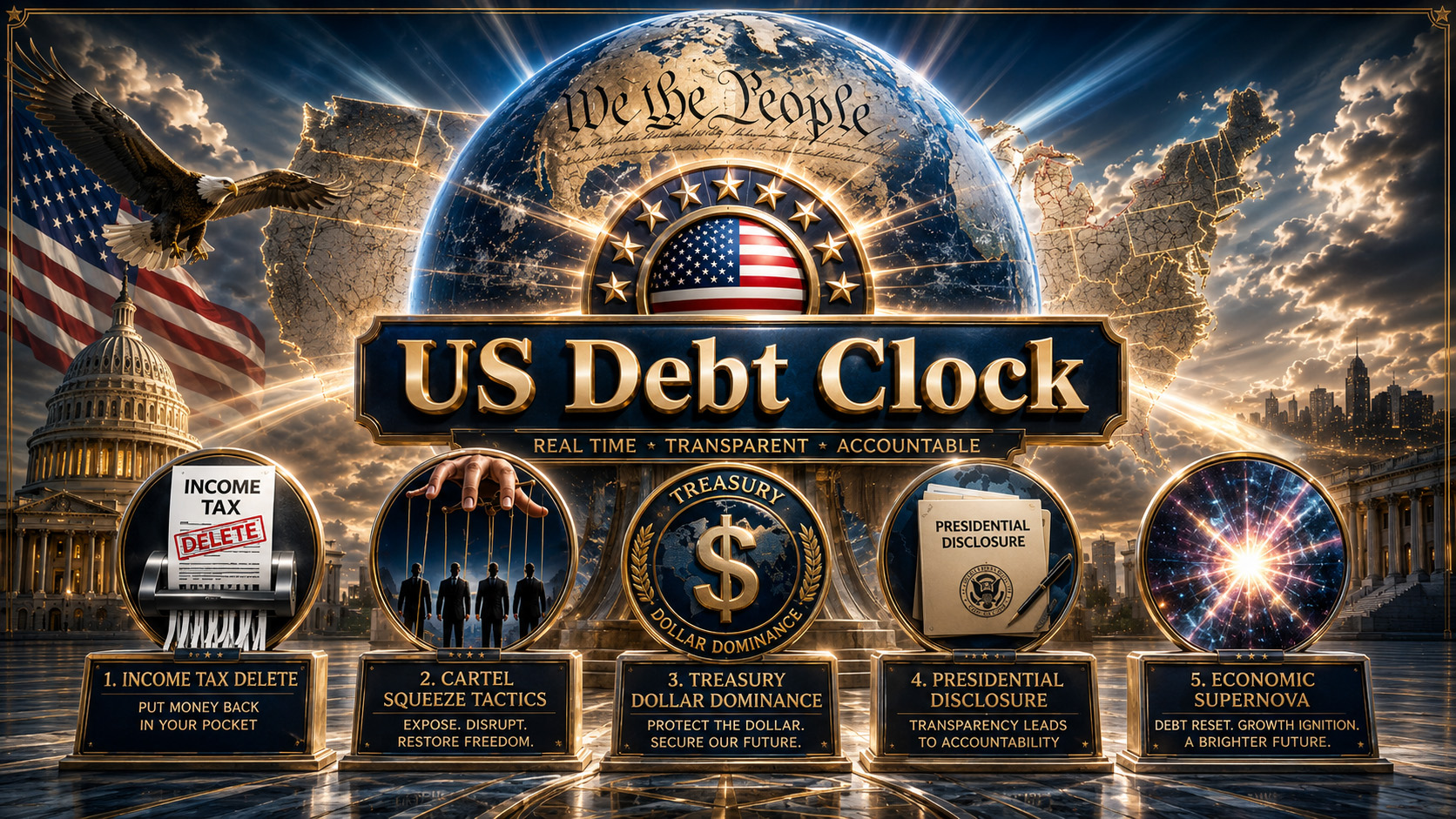
The US Debt Clock spent August doing something far more interesting than simply warning Americans about debt.
Across five striking new posts, it appeared to sketch an entire monetary transition.
The sequence began with the possibility of eliminating income tax for most Americans. It then moved into pressure tactics against the existing banking architecture, followed by the idea of a dominant asset-backed Treasury Dollar, a historical “disclosure” narrative involving the Federal Reserve and John F. Kennedy, and finally a dramatic vision of what the American economy could look like after such a transformation.
Taken individually, the posts are provocative.
Taken together, they read almost like chapters.
Taxation. Banking. Currency. Disclosure. Ownership.
That may be the real August story.
The US Debt Clock is no longer merely depicting the excesses of the existing financial system. It is increasingly presenting an alternative monetary philosophy—one centered on Treasury authority, tangible assets, reduced debt dependency and a much broader ownership economy.
None of this should be confused with enacted government policy. The ideas presented by the Debt Clock remain speculative, symbolic and, in several cases, extraordinarily ambitious.
But for investors, the significance lies in the questions being raised.
What happens if the monetary architecture itself changes?
And more importantly, who owns the assets when it does?
Income Tax Delete: From Taxpayer to Stakeholder

The first major August message went directly after one of the foundations of modern federal finance: the individual income tax.
The US Debt Clock’s Income Tax Delete concept imagined a future Treasury Dollar system capable of dramatically reducing—or potentially eliminating—income taxation for the overwhelming majority of Americans.
That is not current law. Federal income tax remains a central pillar of government revenue.
The interesting part is the monetary logic behind the proposal.
If government finances were increasingly supported by tariffs, sovereign assets, natural resources, productive infrastructure, recovered capital or other Treasury-controlled sources of value, could Washington eventually depend less heavily on taxing individual income?
That would represent much more than tax reform.
It would change the relationship between the individual and the financial system.
Under the conventional model, the citizen earns income and transfers part of that income to the state.
Under the Debt Clock’s implied alternative, the citizen becomes increasingly connected to the productive wealth and assets of the nation itself.
The philosophical shift is subtle but enormous:
from taxpayer to stakeholder.
For internationally minded investors, that matters because tax systems influence almost every major financial decision.
Residence.
Citizenship.
Trust structures.
Corporate entities.
Private banking.
Estate planning.
Offshore investment.
Asset protection.
If the tax architecture changes, the investment architecture changes with it.
Cartel Squeeze Tactics: Attacking the Architecture

The next US Debt Clock message moved from theory to strategy.
Cartel Squeeze Tactics portrayed the existing monetary system as something larger than a collection of banks.
Modern financial power resides in an interconnected network of liquidity, credit creation, collateral, central-bank policy, settlement systems, sovereign debt and control over payment infrastructure.
That means meaningful monetary reform cannot simply involve printing a new type of dollar.
It has to change the machinery surrounding the dollar.
The Debt Clock’s implied strategy appears to be based on reducing dependence on the old architecture through alternatives:
Asset-backed reserves.
Alternative payment rails.
Alternative settlement.
Lower dependence on interest.
Greater transparency.
Different collateral structures.
Treasury-centered monetary authority.
This is especially relevant to offshore investors because offshore finance is inherently architectural.
Capital does not live in only one jurisdiction.
A sophisticated international investor may simultaneously use banks in multiple countries, trusts in another jurisdiction, precious-metals custody elsewhere, corporations in several legal systems and digital settlement rails that operate globally.
The question therefore becomes much larger than whether the Federal Reserve changes interest rates.
The real question is whether the underlying financial network begins to change.
That would affect nearly everything.
Treasury Dollar Dominance: What Is Your Currency Backed By?

The third August signal moved from domestic finance to global monetary competition.
USA Treasury Dollar Dominance imagined a 100% asset-backed Treasury Dollar capable of forcing the world’s other major currencies to defend their own monetary foundations.
The claim is intentionally dramatic.
Introducing an asset-backed US currency would not suddenly cause the euro, yen, pound or yuan to disappear.
Currencies derive value from a broad combination of taxation, legal tender requirements, banking systems, economic output, trade, national credibility and market demand.
But the Debt Clock raises an unusually important question.
What happens if the world’s dominant reserve currency suddenly claims superior collateral?
That immediately changes the comparison.
Investors would begin asking:
What backs the currency?
How large are the country’s reserves?
How much gold does it possess?
What energy resources does it control?
What commodities?
What productive infrastructure?
How much sovereign debt exists against those assets?
How much confidence exists in the institutions issuing the money?
The traditional global currency contest has largely been framed as dollar versus euro, dollar versus yen or dollar versus yuan.
An asset-backed Treasury Dollar would introduce an entirely different comparison:
asset-backed money versus debt-backed money.
If that competition ever becomes real, offshore investors would be among the first to feel it.
Foreign exchange would adjust.
Gold would adjust.
Sovereign bonds would adjust.
Private banking would adjust.
International deposits would adjust.
Commodity pricing could adjust.
Even the concept of the “safe haven” could change.
Presidential Disclosure: Understanding the Old System

The fourth Debt Clock post changed tone.
Instead of focusing exclusively on the future, Presidential Disclosure looked backward.
The imagery connected Donald Trump, John F. Kennedy, the Federal Reserve and Q Post 4962 into a larger narrative about monetary power, inflation and long-term wealth transfer.
The historical and political claims associated with this narrative are contested and should not be treated as established fact simply because they appear in a Debt Clock graphic.
But the underlying economic issue deserves attention.
Inflation is not merely an increase in prices.
It is also a decline in the purchasing power of money.
And that decline does not affect everyone equally.
Those with substantial ownership of appreciating assets can sometimes benefit during periods of monetary expansion.
Those relying heavily on wages, pensions or cash savings may experience the opposite effect.
This is where the Debt Clock’s concept of “disclosure” becomes more interesting than the political symbolism.
Before people can evaluate a new monetary system, they need to understand the mechanics of the existing one.
How does debt compound?
How does leverage amplify financial cycles?
Who benefits first from expanding credit?
How does inflation redistribute purchasing power?
What happens to asset prices when money becomes cheaper?
Who is forced to sell during a crisis?
Who has the liquidity to buy?
Those questions are not conspiracy theories.
They are basic questions of financial structure.
And they lead naturally toward one of the oldest principles of offshore investing:
diversification of ownership.
That can include jurisdictional diversification, precious metals, productive businesses, real assets, energy, land, private banking relationships and multiple payment channels.
The purpose is not to predict one perfect outcome.
It is to avoid depending completely on one outcome.
Economic Supernova: What Comes After the Reset?

The fifth August post may have been the most ambitious of all.
After months of warnings about debt, banking power, monetary expansion and financial control, the Debt Clock turned toward what it believes could come next.
It called the idea Economic Supernova.
The graphic imagined dramatically cheaper credit, lower taxation, asset-backed money and explosive economic expansion.
Once again, these are not enacted policies or reliable economic forecasts.
They are a proposed destination.
And that destination is fundamentally about ownership.
Consider the logic.
If the cost of borrowing falls substantially, more households can potentially acquire homes and productive assets.
If taxes fall, more income remains available for investment and consumption.
If debt servicing consumes less household and business cash flow, capital can move elsewhere.
If business formation becomes easier, entrepreneurship increases.
If monetary stability improves, long-term planning becomes easier.
Put those forces together and the economic system potentially moves away from perpetual debt servicing and toward capital formation.
That is why Economic Supernova feels different from the earlier Debt Clock messages.
The earlier graphics focused largely on confrontation.
This one focuses on the dividend.
The old system is portrayed as being built around debt.
The new one is portrayed as being built around ownership.
The old system makes the individual a borrower.
The new system tries to make the individual an owner.
The old system extracts through interest and taxation.
The new system attempts to redirect more capital toward production, investment and asset accumulation.
Whether anything resembling this model ultimately emerges remains unknown.
But investors would be wise to understand the implications if even part of it does.
The Five-Part August Sequence
Viewed together, the five August Debt Clock messages create an unusually coherent sequence.
Income Tax Delete questions the tax architecture.
Cartel Squeeze Tactics questions the banking architecture.
Treasury Dollar Dominance questions the currency architecture.
Presidential Disclosure questions the historical monetary architecture.
Economic Supernova proposes an ownership architecture.
That progression may be more important than any individual prediction.
The Debt Clock appears to be moving beyond “the debt is too high” and toward a much more ambitious argument:
America’s financial problem cannot be solved simply by reducing government spending or raising taxes.
The entire relationship between money, debt, government, banking and ownership may eventually have to change.
That is an enormous claim.
But it is also precisely the kind of claim international investors should examine rather than dismiss automatically.
Why This Matters to Offshore Investors
Offshore investment has traditionally been associated with diversification.
Diversification of countries.
Diversification of currencies.
Diversification of banking relationships.
Diversification of political risk.
Diversification of ownership structures.
The current Debt Clock narrative adds another layer:
diversification against monetary architecture itself.
If the world’s financial system begins moving toward harder collateral, greater Treasury influence, digital settlement, commodity-linked value or reduced reliance on traditional banking intermediaries, investors will need to understand where their wealth actually sits within that transition.
The important question will not simply be:
“What currency do I own?”
It may increasingly become:
“What assets do I own?”
Where are they held?
Under whose laws?
Who is the custodian?
What liabilities exist against them?
How quickly can they be transferred?
And what role will those assets play if the monetary rules change?
Those are classic Invest Offshore questions.
From Protecting Wealth to Owning the Future
Perhaps that is the most intriguing part of the August Debt Clock sequence.
For decades, offshore investing has often been defensive.
Protect the assets.
Diversify political risk.
Protect purchasing power.
Reduce jurisdictional concentration.
Preserve capital.
The New Money Revolution narrative introduces a more offensive possibility.
What if the next major financial cycle is not solely about protecting wealth from a failing system?
What if it is also about positioning for a new ownership cycle?
A meaningful reduction in taxes, borrowing costs or monetary instability could cause extraordinary repricing across real estate, precious metals, equities, private companies, commodities and productive assets.
People who understand ownership before such a transition would be positioned very differently from people who understand only currency.
That may ultimately be the most important message buried inside August’s five US Debt Clock posts.
The argument is no longer simply that the old financial system is unsustainable.
The argument is that something else could replace it.
And if that happens, the greatest transfer may not simply be from one currency to another.
It may be the transfer from debt dependence to asset ownership.
That is why Invest Offshore will continue watching the US Debt Clock.
Not because every graphic is a prediction.
Not because every claim should be accepted literally.
And certainly not because speculation should be confused with legislation or monetary policy.
We watch because the themes being raised—Treasury money, gold, sovereign assets, taxation, banking power, collateral, settlement, purchasing power and ownership—sit directly at the intersection of global investment and wealth preservation.
August’s message can therefore be reduced to one deceptively simple question:
If the monetary system changes, what will you own when it does?
Leave a Reply