
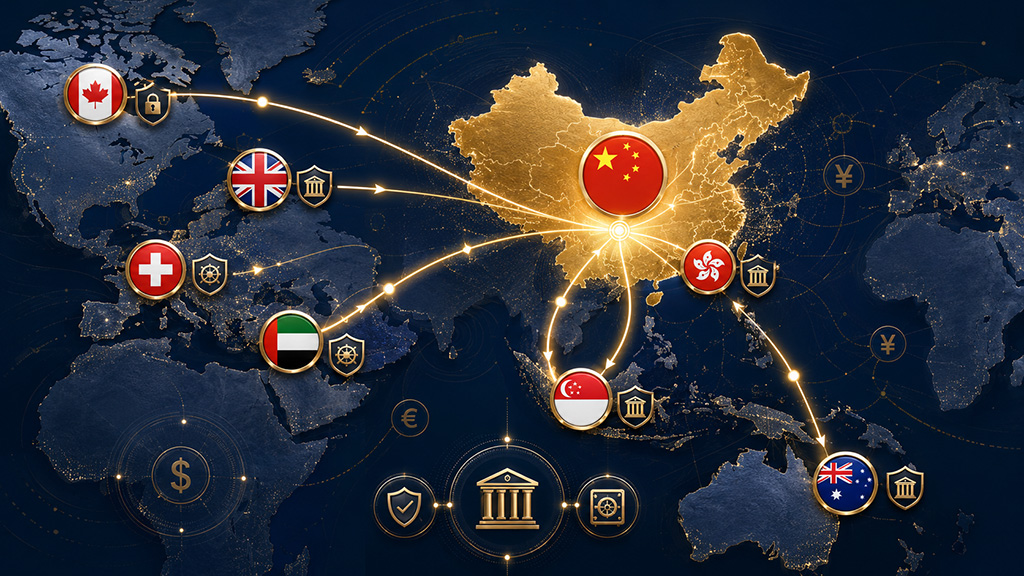
For China’s increasingly global class of entrepreneurs, executives, investors and families, asset protection is no longer simply about moving money offshore. It is about building a lawful financial architecture around where you live, where your wealth is held, which currency you earn, and which payment corridor connects the pieces.
There is a new Chinese diaspora spreading capital and talent through Hong Kong, Singapore, Dubai, Vancouver, Sydney, London, Zurich, New York and dozens of secondary financial centers.
Call it the Great Diaspora.
Some are entrepreneurs expanding internationally. Some are professionals working abroad. Some have children studying overseas. Others have already established permanent residence, businesses and investment portfolios outside mainland China.
For all of them, one question eventually becomes unavoidable:
How should offshore assets be protected—and how does the money actually move?
The answer in 2026 is increasingly a network rather than a single offshore destination.
The emerging architecture looks something like this:
Mainland China → Hong Kong → Singapore / UAE / global private banking → country of residence
The important point is that each part of that chain performs a different job.
Hong Kong: The Financial Front Door
For Chinese wealth going global, Hong Kong remains the obvious first bridge.
Its importance has actually increased.
Hong Kong’s Securities and Futures Commission reported in July 2026 that total assets under management reached a record HK$42.2 trillion, or approximately US$5.4 trillion, at the end of 2025—up 20% in a single year. Private banking and private wealth management assets alone reached approximately US$1.7 trillion. The SFC also cited research identifying Hong Kong as the world’s largest cross-border wealth centre in 2025, with approximately US$2.9 trillion of cross-border wealth.
That tells us something important.
Hong Kong is no longer merely China’s offshore bank account. It is becoming the switching station between Chinese capital and the global financial system.
Hong Kong asset managers invested 56% of their managed assets outside Hong Kong and mainland China during 2025. At the same time, the city handled roughly three-quarters of global offshore RMB payments.
The RMB infrastructure underneath that market is formidable. Hong Kong held more than RMB1 trillion in RMB deposits by March 2026, while the HKMA says the territory processes more than 70% of global offshore RMB payments.
That makes Hong Kong the natural place to maintain RMB liquidity while gaining access to HKD, USD and international investment markets.
Payment Connect Changes the Everyday Corridor
The China-Hong Kong corridor is also becoming faster at the retail level.
Hong Kong’s Faster Payment System, or FPS, has now been linked with mainland China’s Internet Banking Payment System under Payment Connect. It allows participating banks to facilitate cross-boundary transfers between mainland and Hong Kong users.
That matters for families and expats.
A Chinese professional living in Hong Kong does not necessarily need the same cumbersome correspondent-bank chain that would once have been required for relatively ordinary family transfers.
But there is an important distinction.
Payments infrastructure does not eliminate capital controls.
China’s SAFE framework continues to distinguish ordinary current-account uses of foreign exchange from capital-account investment. SAFE’s published rules maintain the familiar US$50,000 annual individual foreign-exchange facilitation quota, while transactions above the facilitated amount can require documentation proving the legitimate underlying purpose. SAFE also explicitly prohibits dividing transactions among people or accounts to circumvent quota and authenticity controls.
In other words, the smart offshore strategy is not finding a clever way around the rules.
It is using the correct corridor for the correct transaction.
Wealth Management Connect: A Legal Investment Bridge
For eligible residents of the Greater Bay Area, China’s Cross-boundary Wealth Management Connect is particularly significant.
Its Southbound Scheme provides a regulated mechanism through which eligible mainland investors can purchase qualifying wealth-management products in Hong Kong and Macao.
The individual investor quota was expanded to RMB3 million.
This is a useful illustration of where China’s financial policy appears to be heading.
Rather than unrestricted capital-account convertibility, Beijing is gradually creating controlled financial corridors.
That may ultimately prove far more consequential than simply increasing an annual FX quota.
Singapore: The Diversification Hub
If Hong Kong is the front door, Singapore increasingly looks like the second vault.
For Chinese families already possessing legitimately established offshore wealth, Singapore provides something Hong Kong cannot completely provide: jurisdictional diversification away from Greater China while remaining inside Asia.
Singapore combines private banking, fund management, trusts, variable capital companies, family offices, strong rule of law and an enormous ASEAN commercial network.
Its payment relationship with China is also getting deeper.
In June 2025, UOB and UOB China became direct participants in China’s Cross-border Interbank Payment System—CIPS. UOB said the arrangement gives its customers direct access to RMB clearing and settlement while connecting them with more than 1,600 CIPS participants worldwide.
That institutional bridge is now being complemented at the consumer level.
DBS has introduced transfers directly into recipients’ Weixin Pay wallets, while OCBC customers can make payments at Chinese Weixin Pay, Alipay+ and UnionPay QR merchants directly from Singapore bank accounts.
For the Chinese expat, that creates an intriguing two-way ecosystem:
assets can be managed internationally from Singapore while day-to-day financial connectivity with China remains remarkably strong.
That is precisely the combination internationally mobile families need.
Dubai and the UAE: China’s New Westbound Corridor
Then comes the most interesting emerging route.
China → UAE.
Dubai and Abu Dhabi increasingly sit between Asia, Africa, Europe and the Middle East. Chinese companies understand this, and payment infrastructure is beginning to catch up.
In June 2025, the Central Bank of the UAE signed a memorandum of understanding with CIPS specifically aimed at improving cross-border payment connectivity between China and the Emirates. First Abu Dhabi Bank also became a direct CIPS participant.
China already maintains RMB clearing infrastructure in the UAE, including an authorized RMB clearing bank in Dubai. The PBOC has also established currency cooperation with Gulf central banks and direct RMB/AED trading.
By late 2025, Bank of China was participating in pilot infrastructure connecting China’s IBPS instant-payment system with the UAE’s instant-payment infrastructure, while China and the UAE have also been participating in central-bank digital-currency settlement experiments.
This does not mean Dubai replaces Hong Kong or Singapore.
It means the UAE increasingly becomes the westbound treasury corridor.
A Chinese entrepreneur with operations in Shenzhen, a holding company or treasury relationship in Hong Kong, customers in Saudi Arabia, commodities in Africa and a residence in Dubai suddenly has a financial geography that makes sense.
Twenty years ago, London might have occupied that central position.
Today Dubai increasingly can.
Where Should the Expat Actually Be Paid?
This is where offshore planning often becomes unnecessarily complicated.
If someone lives and works in Canada, the UAE, Singapore, Britain or Australia, the most logical destination for salary and ordinary living expenses is generally a regulated bank account in the country where that person actually lives.
The offshore architecture should sit above the household account—not replace it.
A useful 2026 corridor map looks like this:
| Function | Primary Corridor |
|---|---|
| Mainland family/current-account payments | China ↔ Hong Kong |
| Greater Bay Area investment | Mainland ↔ Hong Kong Wealth Management Connect |
| Asian offshore wealth management | Hong Kong ↔ Singapore |
| ASEAN business and executive payments | China/Hong Kong ↔ Singapore |
| Gulf, Africa and Middle East business | China/Hong Kong ↔ UAE |
| Western expatriate payroll | Hong Kong/Singapore/UAE → local resident bank |
| Global portfolio custody | Hong Kong/Singapore → international custodians |
| Ultra-high-net-worth diversification | Hong Kong/Singapore → Switzerland/Luxembourg/global private banks |
The final payment leg into New York, Vancouver, London, Sydney or Zurich can still travel through conventional correspondent banking and SWIFT in USD, CAD, GBP, AUD, EUR or CHF.
The innovation is taking place farther upstream.
CIPS Is Becoming Impossible to Ignore
For years, virtually every discussion of Chinese international payments eventually returned to SWIFT.
That is no longer sufficient.
CIPS is now a substantial wholesale payment infrastructure specifically designed for cross-border RMB settlement.
Meanwhile, Bank of China reported in June 2026 that it alone had 46 direct and nearly 770 indirect CIPS participant banks, with RMB8.86 trillion of cross-border RMB settlement conducted by the bank during the first five months of 2026.
SWIFT remains enormously important, particularly once money moves into dollars, euros and other international currencies. The RMB was the fifth-most-active currency for global payments by value in January 2026, accounting for 3.13% of SWIFT payments.
The emerging system therefore isn’t really CIPS versus SWIFT.
It is increasingly:
CIPS for the RMB leg; global correspondent banking for the rest.
That distinction will matter enormously to Chinese multinationals, family offices and expatriate professionals.
Asset Protection Is About Jurisdictional Separation
The bigger lesson extends beyond payments.
For the wealthy expat, leaving everything in one country, one bank, one currency and one legal structure creates concentration risk.
True asset protection begins with separation.
Operating capital belongs in operating accounts. Long-term investments belong with regulated custodians. Family assets may belong inside appropriately structured trusts, holding companies or family investment vehicles. Property should normally be separated from operating businesses. Emergency liquidity should not necessarily sit beside speculative investments.
Hong Kong currently offers a 0% concessionary profits-tax regime for qualifying family-owned investment holding vehicles managed by eligible single family offices, subject to conditions including an aggregate asset threshold of HK$240 million and substantive Hong Kong activity.
The Hong Kong government is actively expanding that framework. Legislation introduced in June 2026 proposes broader qualifying investment categories and further improvements to the family-office and private-fund tax regimes.
Singapore offers another sophisticated family-office ecosystem.
Switzerland remains important for custody.
The UAE is increasingly useful for international business ownership, residency and treasury operations.
No single jurisdiction has to do everything.
That is the central philosophy.
Offshore Does Not Mean Invisible
There is one final misconception that needs to disappear.
The modern offshore world is not built around secrecy.
It is built around legal jurisdictional diversification.
China participates in international tax-information exchange arrangements under the OECD Common Reporting Standard, as do major financial centres across Asia, Europe and the Middle East. The OECD maintains an extensive network of activated CRS exchange relationships.
Hong Kong is actually strengthening its own automatic financial-account reporting system, with new CRS-related requirements scheduled to take effect beginning January 1, 2027.
Tax residence matters as much as banking residence.
Under China’s Individual Income Tax Law, a person domiciled in China—or generally spending at least 183 days there during a tax year—can fall within Chinese tax-residency rules, including taxation of overseas income depending upon the circumstances and applicable exemptions.
For somebody who has genuinely relocated, tax obligations increasingly follow the individual’s new residence, applicable treaties and continuing connections with China.
That makes professional tax advice essential before restructuring significant assets.
The Great Diaspora Financial Architecture
The Chinese diaspora of this decade looks very different from previous generations.
Its members can be simultaneously connected to a factory in Guangdong, a private bank in Hong Kong, an investment vehicle in Singapore, a company in Dubai and children attending university in Canada.
Their financial architecture has to reflect that reality.
The most important offshore centers are therefore no longer competing to become the single home of Chinese wealth.
They are increasingly becoming specialized nodes.
Hong Kong is the gateway.
Singapore is the diversification center.
Dubai is the westbound commercial bridge.
Switzerland remains a custody and private-banking destination.
North America, Britain, Australia and Europe are frequently the final residential and payroll endpoints.
And underneath all of them is an increasingly sophisticated network of RMB clearing, CIPS, SWIFT, instant-payment systems, multicurrency banking and interconnected digital-payment rails.
For the Chinese expat in the Great Diaspora, that may be the most important asset-protection development of all.
The objective is no longer simply to get money out.
It is to build a legitimate financial structure in which capital can live, invest, diversify and move internationally without depending upon any single bank, currency or jurisdiction.
That is what offshore asset protection was always supposed to accomplish.
Invest Offshore note: International tax, foreign-exchange, trust and securities rules vary by citizenship, domicile, tax residence, source of funds and destination jurisdiction. The structures and corridors discussed above are intended as an overview of regulated financial architecture, not a method of circumventing Chinese foreign-exchange controls or tax-reporting obligations.
Leave a Reply