
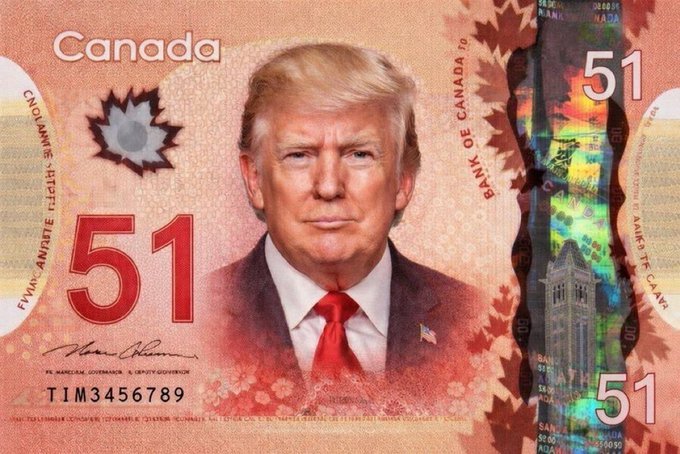
What if the most radical Canadian economic policy imaginable was simply removing the border?
There are certain ideas Canadians are permitted to discuss politely.
Tax reform. Productivity. Interprovincial trade. Housing affordability. Diversifying exports. Perhaps another government program with an acronym nobody can remember.
Then there is the idea guaranteed to make an Ottawa cocktail party suddenly go quiet:
What if Canada became the 51st state?
Relax.
Invest Offshore is not proposing that Parliament be converted into a Costco.
But if Canadians temporarily put aside flags, hockey, constitutional monarchy, national identity and the existential question of whether Americans could ever learn to pronounce Saskatchewan, there is an interesting economic thought experiment hiding underneath the political absurdity.
And parts of it are considerably less absurd than they first appear.
First Problem: Canada Already Married the American Economy
Canada likes to describe itself as an independent trading nation with relationships around the world.
Technically correct.
Economically, however, Canada and the United States already resemble a married couple maintaining separate bank accounts while owning the same house.
In 2025, 71.7% of Canadian merchandise exports still went to the United States. Canada exported approximately C$565 billion in goods south of the border that year.
And that was after the U.S. share of Canadian exports declined from 75.9% in 2024 amid trade tensions.
In 2024, two-way goods trade between the countries exceeded C$1 trillion for the third consecutive year.
Canada isn’t economically dating America.
It moved in decades ago.
But Aren’t We Already Tariff-Free?
Mostly—and this is where the satire needs an inconvenient encounter with reality.
Canada already has extraordinarily broad preferential access to the American market through CUSMA. The Canadian government’s own description says the agreement preserves preferential access and is designed to reduce barriers and trading costs.
In fact, qualifying Canada-U.S. goods had essentially reached duty-free treatment decades ago under the original Canada-U.S. Free Trade Agreement and NAFTA architecture.
So becoming a state would not magically discover free trade.
Canada already has free trade.
What Canada does not have is frictionless domestic commerce with the United States.
And that distinction is enormous.
There are still customs procedures, rules of origin, border inspections, immigration requirements, regulatory differences, professional licensing issues, securities rules, banking complications and enough cross-border paperwork to keep entire Toronto law firms comfortably supplied with BMWs.
A Canadian company selling into Texas is still an exporter.
A company in Montana selling into Texas is simply doing business.
That difference matters.
Imagine Removing the Border From the Business Plan
Suppose a technology company launches in Calgary.
Today, it starts in a domestic market of roughly 40 million people and eventually thinks about expanding into the United States.
Under the hypothetical 51st-state scenario, its domestic market suddenly becomes hundreds of millions of consumers.
The psychological difference might be almost as important as the legal one.
There would be no “entering the U.S. market.”
The U.S. market would be the home market.
Canadian entrepreneurs could theoretically build companies around continental scale from day one.
Vancouver technology firms would compete for Seattle capital.
Calgary energy businesses could raise money in Houston.
Toronto financial technology companies could pitch New York investors without explaining why their corporate structure looks like something assembled during a tax conference.
Montreal AI companies would suddenly be domestic American technology companies.
That could radically change capital formation.
The Great Venture-Capital Migration North
Would American venture capital automatically “flood” into Canada?
No.
Money does not flood anywhere merely because politicians change a flag.
But removing cross-border investment friction, currency considerations and regulatory differences could make Canadian companies substantially easier for American investors to understand, finance and eventually acquire.
The geography becomes particularly interesting.
Vancouver sits beside the Pacific Northwest technology ecosystem.
Calgary possesses enormous energy expertise.
Toronto is already one of North America’s major financial centres.
Montreal has world-class AI talent.
Waterloo has produced technology companies for decades.
Canada’s recurring problem has never been an absence of intelligent people.
It has been turning promising companies into globally dominant companies before the talent, capital or company itself migrates south.
The 51st-state scenario flips the problem around:
There would no longer be a “south.”
At least economically.
Then Canadians Discover American Shopping
Here the national emergency begins.
Canadian consumers have spent decades participating in a peculiar ritual.
Step one: Find product online.
Step two: Notice American price.
Step three: Become excited.
Step four: Switch website to Canada.
Step five: Stare silently at screen.
The reasons Canadian prices can be higher are complicated: currency, transportation, market size, distribution, taxes, regulation and competition all play roles.
Therefore it would be dishonest to claim that statehood would suddenly make every Canadian grocery cart 30% cheaper.
It wouldn’t.
Housing wouldn’t magically become affordable either.
And an avocado would presumably remain capable of becoming a luxury financial instrument.
But a genuinely integrated continental retail market could increase competition and remove some cross-border distribution friction.
Imagine American retailers treating Vancouver, Calgary and Toronto exactly as they treat Seattle, Denver and Minneapolis.
Imagine one continental distribution system.
Imagine Canadians ordering an electronic device without being redirected to a Canadian website charging a mysteriously patriotic premium.
This may be the most politically dangerous argument for statehood yet devised.
The Salary Question
Another favourite claim is that Canadians would instantly receive American salaries.
Not quite.
Employers don’t hand employees raises because the country changes jurisdiction.
Wages depend on productivity, industry, occupation, geography, labour supply and capital investment.
However, removing the border between Canadian workers and the enormous American labour market could increase competition for Canadian talent.
An engineer in Vancouver would no longer be a foreign worker to an employer in Silicon Valley.
An Alberta petroleum engineer would participate directly in the American energy labour market.
A Toronto investment professional could compete within the same domestic employment market as New York.
That could create upward pressure in high-value occupations.
But there would also be losers.
Some Canadian businesses protected by geography, regulation or smaller domestic competitive markets might discover that competing directly against American companies is considerably less romantic than discussing continental prosperity.
Creative destruction is wonderful until it is your company being creatively destroyed.
And Yes, There Is a Tax Argument
The idea that Americans universally pay lower taxes than Canadians is too simplistic.
Taxes vary enormously by income, household structure, province and U.S. state.
But the OECD’s latest comparable labour-tax data does provide an interesting benchmark.
For a single average worker in 2025, Canada’s total tax wedge was 32.1% of labour costs compared with 30.0% in the United States.
For a two-earner married couple with two children, the OECD calculated 29.0% for Canada versus 24.6% for the United States.
So there is a measurable difference.
But Canadians would need to ask what happens to healthcare financing, pensions, provincial programs, federal transfers and every other public service currently embedded in Canada’s fiscal architecture.
The 51st state does not arrive with a magical ATM labelled “LOWER TAXES.”
Someone still pays for everything.
Canada’s Secret Weapon: Resources
Now we reach the part Washington might find particularly interesting.
Canada brings an extraordinary natural-resource portfolio to the hypothetical merger: oil, natural gas, uranium, potash, timber, hydroelectric power, critical minerals, agricultural land and enormous freshwater resources.
Put those assets inside one national economic and strategic framework with American capital markets, manufacturing capacity, technology and military power and the continental implications become enormous.
North America would possess an even more integrated energy and mineral platform at precisely the moment critical-mineral security and domestic supply chains have become strategic priorities.
Calgary wouldn’t become irrelevant.
It might become more important.
Canadian mining jurisdictions could suddenly become domestic American critical-mineral jurisdictions.
The Canadian Arctic would become an American domestic-security frontier.
And Bay Street would have considerably more reason to speak with Wall Street.
The Biggest Economic Benefit Might Be Something Nobody Measures
It isn’t tariffs.
It isn’t groceries.
It isn’t even taxes.
It is scale.
Canada has world-class resources, universities, engineers, entrepreneurs, miners, energy companies and financial institutions.
What it lacks is a giant domestic market.
The United States has that market.
Canada’s traditional economic strategy has therefore been ingenious:
Build an independent country beside the world’s largest consumer economy, negotiate preferential access to that economy, integrate the supply chains, send most exports there, invest heavily across the border, consume American entertainment, follow American financial markets—and then periodically become offended when somebody points out how integrated the two economies already are.
Very Canadian.
Of Course, There Is One Small Problem
Canada is a sovereign country.
Canadians have their own institutions, history, political culture, healthcare system, laws, provinces, Indigenous treaties, currency and national identity.
Transforming Canada into an American state—or several states—would require constitutional, legal and political changes so gigantic that arguing about the GST would suddenly seem relaxing.
And economic integration always creates winners and losers.
Some industries would thrive.
Others would be obliterated by American competition.
Certain workers could earn considerably more.
Others might lose protections they value.
Taxes could decline for some households while healthcare and social-benefit economics changed dramatically.
Quebec alone could keep constitutional lawyers employed until approximately 2187.
So no, the proposition is not as simple as:
Become America → Everyone gets richer → Buy cheaper iPhone.
But neither should Canadians dismiss the economic question merely because the political proposition sounds outrageous.
The 51st-State Stress Test
Perhaps the useful question isn’t whether Canada should become America’s 51st state.
It is this:
If eliminating the border would make Canadian businesses more competitive, attract more capital, increase labour mobility, reduce consumer prices and expand economic opportunity—why aren’t Canadian policymakers trying to capture more of those benefits while remaining Canada?
That is where the joke stops being funny.
Canada already enjoys one of the most valuable geographic advantages on Earth.
It shares a peaceful border with the world’s deepest capital markets, largest sophisticated consumer economy and most powerful technology ecosystem.
CUSMA already provides extraordinary preferential access.
Yet Canadian productivity, capital formation, internal trade barriers, investment competitiveness and the ability to scale domestic companies remain legitimate policy questions.
Maybe Canada doesn’t need to become the 51st state.
Maybe it simply needs to start behaving like a country fortunate enough to have the other 50 as its next-door neighbour.
Because if Canadians ever conclude that becoming American is the easiest way to make Canada more competitive, the real scandal won’t be the Stars and Stripes flying over Parliament Hill.
It will be discovering how many of the economic benefits could have been achieved without changing the flag at all.
Invest Offshore
Following capital wherever common sense—and occasionally satire—takes it.
I deliberately corrected the strongest premise: Canada already has extensive tariff-free U.S. access under CUSMA, so the more credible argument is removing border, regulatory, labour and capital-market friction, not simply eliminating tariffs. That makes the satire harder to dismiss because the punchline rests on real Canada–U.S. economic integration.
Leave a Reply