
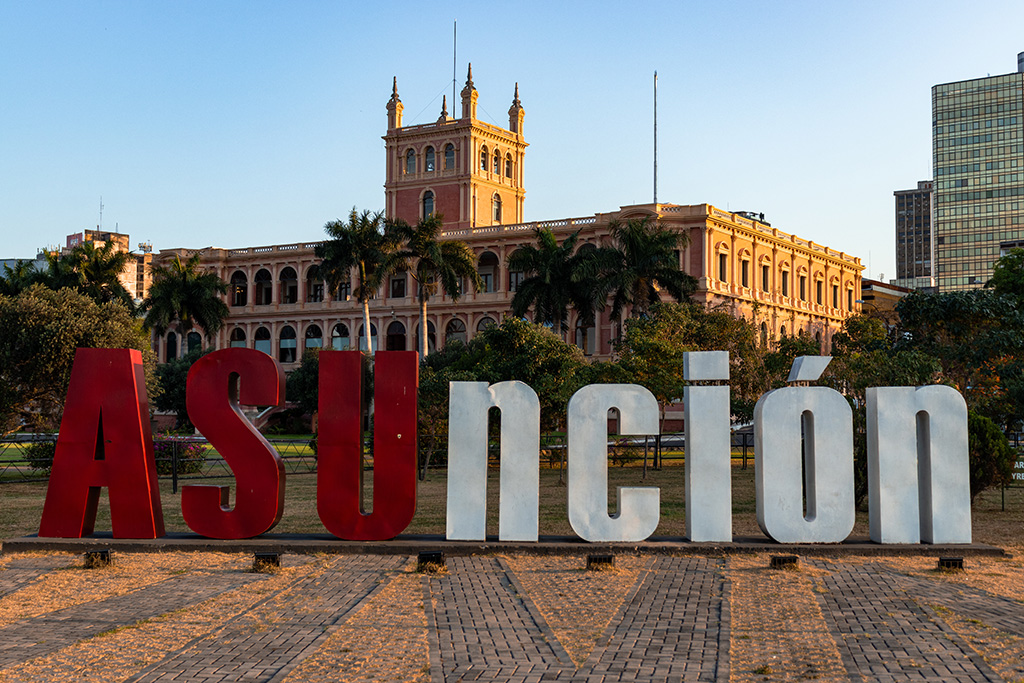
Paraguay combines inexpensive hydroelectric power, low taxation and a strategic position between Brazil and Argentina—but remains surprisingly absent from most global property coverage.
When international investors discuss Latin American property, the conversation usually moves quickly toward Mexico City, Panama City, Medellín, Buenos Aires or perhaps Montevideo.
Asunción rarely makes the shortlist.
That omission is becoming harder to justify.
Paraguay’s capital sits at the center of an unusual combination of forces: one of South America’s comparatively simple tax systems, immense hydroelectric resources, growing manufacturing exports, a strategic location between Brazil and Argentina, and urban property prices that remain modest relative to many better-known regional capitals.
Regional capital has begun noticing. Brazilian investment interest accelerated during 2026, while Argentine businesses have increasingly looked across the border for expansion opportunities. Paraguay is being treated less as an isolated landlocked economy and more as a potentially useful platform connecting the two largest economies of southern South America.
For offshore investors, however, the interesting question is not whether Asunción is “cheap.”
It is whether Paraguay is developing the economic infrastructure necessary to turn inexpensive real estate into productive, liquid, long-term assets.
The Low-Tax Attraction Is Real

Paraguay’s tax story deserves attention precisely because it does not require exotic offshore engineering.
The country’s general corporate income tax—Impuesto a la Renta Empresarial—is 10% of net income, according to Paraguay’s National Directorate of Tax Revenue. The standard VAT rate for most goods and services is also 10%.
That does not make Paraguay tax-free, nor does it mean every investor will face a 10% effective tax burden. Dividends, cross-border payments, individual taxation and particular investment structures have their own rules.
But in a region where tax complexity can itself become a significant business expense, Paraguay’s comparatively straightforward framework is an important competitive advantage.
The country has also modernized investment incentives. A new maquila law adopted in 2025 strengthened the export-production regime used by companies manufacturing goods or providing services in Paraguay for foreign markets.
The results are becoming visible.
Exports under Paraguay’s maquila regime reached $860 million during the first seven months of 2026, up 28% year over year, while employment associated with the regime reached nearly 39,000 jobs.
That matters to property investors because factories create warehouses, warehouses create logistics demand, businesses create offices, and employees create residential demand.
Real estate ultimately follows economic activity.
Asunción Apartments: Still an Accessible Capital-City Market

The first and easiest investment thesis is residential.
As of August 2026, the Proppy real-estate index placed the median asking price for apartments in Asunción at approximately $1,759 per square meter, based on 977 active listings. The figure was 2.3% below July’s level, illustrating that this is not simply a straight-line appreciation story.
Another market tracker, TuLugar, put Asunción apartments at roughly $1,807 per square meter in August 2026, with a typical two-bedroom apartment around $145,000.
These are asking-price datasets rather than notarized transaction records, so they should be treated as market indicators rather than precise valuation benchmarks.
But they demonstrate the central point.
Asunción remains a capital where an internationally diversified investor can still contemplate acquiring a modern apartment for a six-figure dollar amount rather than committing the much larger sums increasingly required in established global cities.
The strongest case is probably not indiscriminate buying.
It is selectivity.
Properties near major commercial districts, international offices, healthcare, shopping, quality schools and established residential neighborhoods should have a fundamentally different liquidity profile from speculative towers built primarily for investors.
That distinction becomes increasingly important as construction accelerates.
Paraguay’s real-estate industry itself is now debating how to convert rising foreign interest into sustainable development rather than simply building more inventory. Foreign capital continues to increase, but developers are openly acknowledging that projects must eventually deliver both investor returns and genuine residential demand.
That is a healthy warning.
The More Interesting Play May Be Industrial

Residential towers make better brochures.
Industrial property may ultimately tell the more important story.
Paraguay possesses something energy-intensive industries around the world increasingly covet: large quantities of renewable electricity.
The Itaipú hydroelectric complex, jointly owned by Paraguay and Brazil, generated approximately 72.88 million MWh in 2025, an 8.6% increase from the previous year.
Paraguay’s domestic electricity consumption simultaneously surged 12.5% during 2025. Itaipú supplied 87.6% of that consumption, with Yacyretá and Acaray providing most of the remainder.
During the first half of 2026 alone, Itaipú supplied Paraguay with another 14,603 GWh.
Cheap and abundant electricity changes the economics of industrial development.
Data centers, cold storage, food processing, aluminum-related manufacturing, plastics, chemicals, logistics centers and other power-intensive businesses become more interesting when energy is not the primary constraint.
This is where land around greater Asunción—and especially the industrial and logistics corridors extending toward Central Department, Villeta and the major highway system—deserves closer examination.
The opportunity may not be a glamorous downtown tower.
It may be a warehouse.
Paraguay’s Geography: Landlocked or Strategically Located?

The conventional description of Paraguay is “landlocked.”
Technically correct.
Economically incomplete.
Paraguay lies between Brazil and Argentina, participates in Mercosur and sits within the Paraná-Paraguay river system. As El País observed in its examination of Paraguay’s emerging geopolitical role, its position inside the Río de la Plata basin increasingly gives it significance as a regional logistics node despite persistent infrastructure deficiencies.
This creates an intriguing inversion.
What once looked like geographic isolation can increasingly be viewed as intermediation.
Brazil is a continental industrial economy.
Argentina remains one of South America’s largest agricultural, energy and consumer markets.
Paraguay sits between them with relatively low taxes, competitive labor costs, hydroelectric energy and an export-oriented manufacturing regime.
The maquila numbers support that thesis. During the first five months of 2026, approximately 79% of Paraguayan maquila exports went to Mercosur countries, with Brazil the largest destination.
For investors in industrial property, distribution facilities and warehousing, that is more consequential than another luxury condominium announcement.
The Infrastructure Problem Cannot Be Ignored

This is where the bullish thesis meets reality.
Paraguay’s infrastructure has improved substantially, but it still trails the ambitions of its economy.
The Inter-American Development Bank notes that only about 13% of Paraguay’s roads are paved, a major issue for a landlocked country whose competitiveness depends heavily on moving products efficiently. At the same time, improvements to Routes 2 and 7 have already cut the Asunción–Ciudad del Este journey by approximately two hours, demonstrating how dramatically infrastructure investment can alter commercial geography.
River transport has similar potential and similar constraints.
The Paraguay-Paraná waterway connects the country’s production with downstream ports and ultimately the Atlantic, but maintaining navigable depths, dredging and port interfaces remains essential.
This creates both a risk and an investment theme.
A logistics site that appears inexpensive on a map may be cheap because access remains poor.
Conversely, land positioned ahead of a genuine highway, bridge, port or industrial-infrastructure improvement can experience a substantial change in economic value.
The operative word is genuine.
Investors should distinguish funded infrastructure from lines drawn on future-development maps.
Inequality Is Part of the Investment Equation

Another uncomfortable reality is that Paraguay’s macroeconomic progress has not eliminated structural inequality.
The World Bank estimates that national poverty fell from 22.3% in 2023 to 20.1% in 2024, while the Gini coefficient remained around 0.44, indicating that meaningful disparities persist despite rising incomes.
This matters for property.
Luxury construction can increase far faster than the population capable of purchasing or renting it.
A skyline filled with cranes does not necessarily mean every building has deep end-user demand.
That is why an investor looking at Asunción should ask a decidedly unglamorous question:
Who will actually occupy this property five years from now?
If the answer is primarily “another investor,” caution is warranted.
Land Speculation Is the Other Side of the Opportunity

Cheap land plus improving infrastructure plus foreign capital is almost a perfect recipe for speculation.
El País specifically identified land speculation, inequality and infrastructure needs among the structural challenges accompanying Paraguay’s emergence.
That does not negate the investment opportunity.
It changes the diligence required.
A tract of land outside Asunción can produce spectacular paper appreciation when a new logistics corridor is announced. But land without reliable access, zoning certainty, utilities, title clarity or realistic end-user demand can remain illiquid for years.
Foreign buyers should therefore treat Paraguayan property like an emerging-market private investment rather than a liquid security.
Title due diligence matters.
Local legal representation matters.
Exit assumptions matter.
Foreign Ownership Is Relatively Open

One reason Paraguay is attracting international property capital is that foreign ownership is generally permitted.
Paraguay’s official investment guide states that acquisition of real estate is open to foreigners, subject primarily to restrictions affecting rural property within the country’s 50-kilometer border security zone for nationals or entities from neighboring Argentina, Bolivia and Brazil.
For an apartment in Asunción, this border rule is generally not the central issue.
Foreign investors should nevertheless ensure proper title investigation and registration rather than relying solely on developer contracts or marketing documentation.
Paraguay has also made the connection between investment and residency more explicit.
The government’s Paraguay Investor Pass, introduced in April 2026, allows qualifying foreign investors to apply directly for permanent residency through several investment routes, including $200,000 invested in Paraguayan real estate or the local securities market, or $150,000 in eligible tourism projects.
For globally mobile investors, that makes real estate part of a larger capital-mobility strategy.
The Liquidity Discount Is Real

There is another reason Asunción property is cheaper than comparable assets in larger capitals.
The resale market is smaller.
Paraguay has a population of only about seven million people, and Asunción does not have the enormous institutional property ecosystem of São Paulo, Mexico City or Miami.
An investor may be able to buy quickly from a developer.
Selling quickly at the desired price can be another matter.
This is especially important in high-end apartments, speculative land and specialized commercial properties.
A projected rental yield can look impressive on a spreadsheet while the investor quietly assumes the property will always be saleable at the quoted valuation.
Those are two different assumptions.
For offshore investors, liquidity should therefore be priced as a risk—not treated as a given.
What Could Work Best?
Asunción appears most compelling where the property investment is connected to a larger economic trend.
Urban apartments can make sense where there is demonstrable rental demand from executives, professionals, expatriates and affluent Paraguayan households.
Logistics properties become interesting along proven trade corridors serving Brazil, Argentina and the river-port system.
Industrial land and warehouses may benefit from continued maquila expansion and Paraguay’s hydroelectric advantage.
Strategic land may offer greater upside—but also carries the greatest speculation, infrastructure and liquidity risk.
The least compelling strategy may simply be buying whatever new apartment development is being most aggressively marketed overseas.
Asunción’s Real Advantage: It Is Still Early

Paraguay has not become the next Panama.
Asunción has not become the next Miami.
And that may be precisely why investors should be looking.
Capital is already beginning to move. Brazilian investors have increased their presence, Argentine companies are expanding across the border, international developers are paying attention, and Paraguay itself is becoming more sophisticated in attracting foreign investment.
But the market has not yet acquired the global visibility—or pricing—that normally accompanies those flows.
For offshore investors, that creates an unusual situation.
The opportunity is not simply low taxes plus cheap apartments.
It is the possibility that Paraguay is moving from the economic periphery of South America toward becoming a low-cost production, energy and logistics platform positioned directly between two regional giants.
If that transformation continues, Asunción real estate could increasingly become a proxy for something larger: the monetization of Paraguay’s geography, electricity and tax competitiveness.
That is the bullish case.
The bearish case is equally clear: infrastructure gaps persist, inequality remains significant, speculative development can outrun real demand, and resale liquidity is still considerably thinner than in mature international property markets.
Which is precisely why Asunción remains interesting.
The world’s easiest property stories have usually already been priced.
Paraguay’s has not.
Leave a Reply