
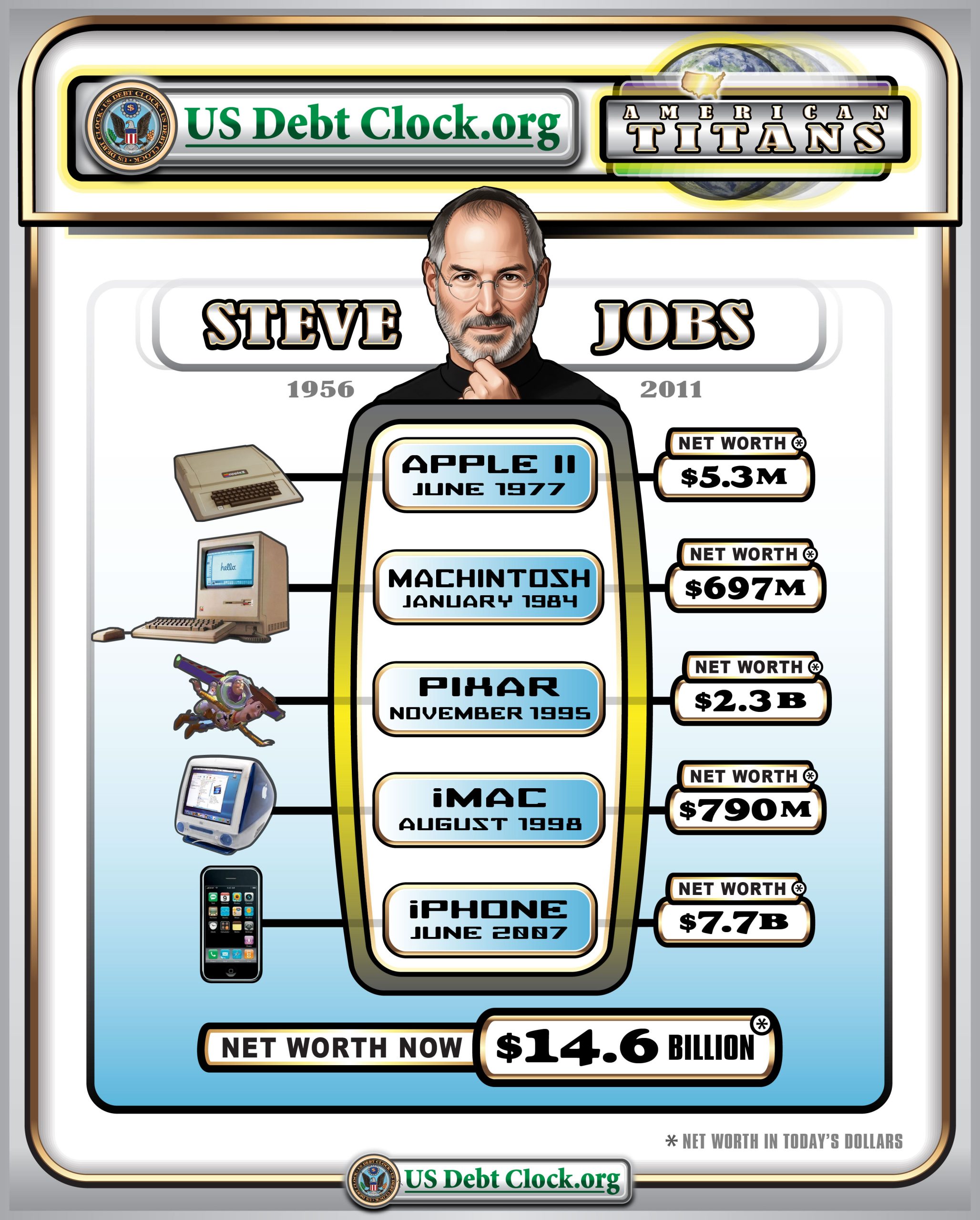
The March 10, 2026 US Debt Clock “American Titans” poster uses one of the most recognizable innovators of the modern era—Steve Jobs—to make a bigger point about wealth creation cycles in America, and why the “Dividend Dollar” narrative keeps showing up in these graphics.
On the poster, Jobs sits at the top like a legend on a trading card. Down the center runs a product timeline—Apple II (1977), Macintosh (1984), Pixar (1995), iMac (1998), iPhone (2007)—paired with “net worth” snapshots, ending with a bold estimate: “Net Worth Now: $14.6 Billion” (in today’s dollars, per the poster’s footnote). The message is clear: innovation compounds—and America manufactures titans.
Why the timing matters: Forbes just confirmed a surge in American “Titans”
This poster didn’t land in a vacuum. It dropped the same day Forbes’ annual billionaires data hit the news cycle, and the U.S. numbers are staggering.
According to reporting on Forbes’ 2026 billionaire list, the United States is now home to a record 989 billionaires, with combined wealth of about $8.4 trillion. (Anadolu Ajansı)
And compared to late 2025, that is meaningfully higher. The Institute for Policy Studies (using Forbes data) cited 905 U.S. billionaires holding $7.8 trillion as of Sept. 29, 2025. (Inequality.org)
So in simple terms, the “American Titans” story is accelerating:
- How many more American Titans? Roughly 84 more (989 vs. 905). (Anadolu Ajansı)
- How much total net worth? About $8.4 trillion for U.S.-based billionaires on the 2026 list. (Anadolu Ajansı)
That’s exactly the kind of macro backdrop these posters are trying to capture: more titans, more concentrated wealth, more pressure for a new distribution mechanism.
So how does this affect the “Dividend Dollar” idea?
In US Debt Clock language, a Dividend Dollar is essentially “America, issuing a payout” rather than relying on the old debt-and-credit treadmill. Whether you view that as future policy, symbolism, or speculation, the billionaire surge impacts the conversation in three practical ways:
1) A bigger “funding base” makes dividend concepts more plausible politically
When wealth concentrates at the top—especially via AI-driven equity booms—public pressure grows for mechanisms that share productivity gains. A larger billionaire class with a larger combined fortune increases the perceived capacity for:
- AI/automation-linked levies,
- sovereign productivity dividends,
- or restructured public distributions tied to national assets.
(That doesn’t mean it will happen—only that the political math shifts when numbers get this large.)
2) It sharpens the debate: is this “dividend” ownership—or redistribution?
The poster frames Jobs as the archetype: build something transformational, and the market rewards you massively. But the 2026 stats highlight the other side: the system increasingly rewards those who already own the rails (platforms, compute, IP, networks).
That tension is exactly where “Dividend Dollar” narratives live:
- ownership economy logic says: people should participate in national productivity,
- market purity logic says: payouts should reflect risk and innovation.
As “American Titans” multiply, that debate gets louder.
3) If a dividend regime ever existed, timing and expectations would be everything
A universal dividend-style currency (or payout) would change incentives across markets—labor, consumption, savings, and risk assets. If traders thought they knew an exact rollout date, you’d likely see front-running behavior (FX moves, risk repricing, liquidity hoarding). That’s why any real-world version—if it ever came—would be managed carefully and probably staged.
The Steve Jobs angle: the “Titan” template in one image
Jobs is used here because he compresses a full American wealth cycle into a clean narrative:
- Build the tools (Apple II, Macintosh)
- Shape culture (Pixar)
- Reset consumer behavior (iPhone)
- Create enormous downstream wealth (Apple’s ecosystem)
The poster’s quiet subtext is: America can still create new titans—and the system is still minting them at scale. The Forbes numbers suggest it’s not slowing down. (Anadolu Ajansı)
Bottom line
“American Titans” is less about Steve Jobs the person—and more about what he represents: innovation → asset appreciation → concentrated wealth → growing demand for a new kind of money narrative.
And when the U.S. is sitting at 989 billionaires worth about $8.4 trillion, the “Dividend Dollar” storyline becomes easier for millions of people to believe—because the question shifts from “Is there enough wealth?” to “Who gets to share in the wealth the system is now creating?” (Anadolu Ajansı)
Invest Offshore continues to track real-asset opportunities globally, including investment opportunities in West Africa seeking investors for the Copperbelt Region, plus verified gold for sale through our network and partners worldwide, and select mining concessions with documented title, geology, and clear pathways to production.
Leave a Reply