
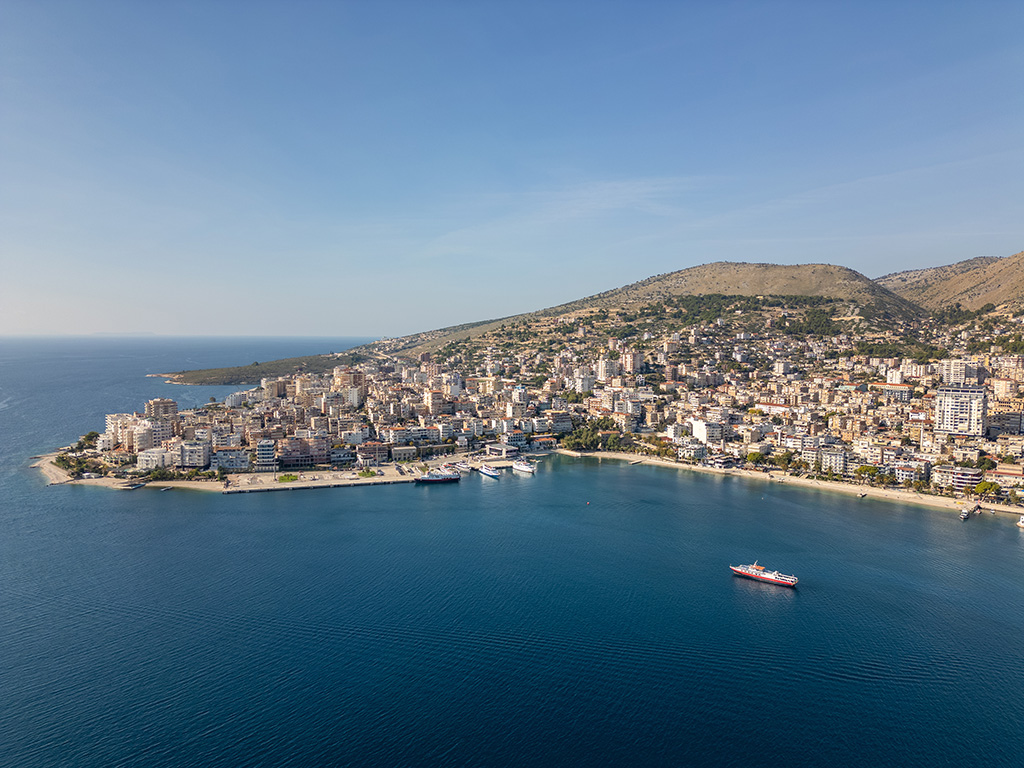
The turquoise coast from Vlorë to Sarandë is attracting tourists, developers and foreign capital at extraordinary speed. Albania may still offer one of Europe’s most compelling coastal property opportunities—but the window for buying cheaply is already beginning to close.
For decades, Mediterranean real estate followed a fairly predictable progression.
Spain became expensive. Then Portugal. Croatia was “discovered,” Montenegro followed, and Greek islands once considered inexpensive were repriced by tourism, short-term rentals and international buyers.
Now investors searching for the next Mediterranean value story keep arriving at the same place:
Albania.
More specifically, the extraordinary stretch of Adriatic and Ionian coastline running south from Vlorë through Dhërmi, Himarë, Borsh, Sarandë and Ksamil.
Crystal water, dramatic mountains, long summers and proximity to Italy and Greece make the Albanian Riviera look suspiciously like places that cost several times more on the opposite side of the sea.
But there is an important twist.
Albania is no longer a secret.
And that raises a question offshore property investors should be asking before simply joining the rush:
Is the Albanian Riviera still Europe’s last great coastal bargain—or are we watching the early stages of its next property bubble?
The Bargain Is Real—But It Is Disappearing
On a European basis, Albania remains relatively inexpensive. But focusing only on the absolute price of property misses what may be the more important story: the velocity of the repricing.
Deloitte’s 2025 European Property Index found that Vlorë and Tirana recorded approximately 25% year-over-year increases in new-apartment prices, placing them among the fastest-rising cities covered by the study.
That is not the price behavior of an undiscovered market.
It is the price behavior of a market being discovered in real time.
Listings illustrate how wide the market has become. Conventional apartments around Sarandë can still appear around the low-to-mid six figures, while premium resort projects in locations such as Dhërmi and Palasë have moved decisively into Western European second-home territory. Current listings include a 64-square-meter Sarandë apartment around €142,000, while high-end Riviera developments command dramatically more. These are asking prices rather than transaction indices, but they demonstrate how rapidly Albania’s coastal market is stratifying.
The bargain, therefore, increasingly depends on what Albania you are buying.
There is a tremendous difference between buying a well-titled apartment several streets back from the water, buying into a branded resort development, purchasing raw coastal land, or speculating on an unfinished project because somebody promises that a new marina, airport or highway will make it valuable someday.
That distinction matters.
Tourism Has Changed the Equation

The strongest argument for Albania’s coastal property market is not speculation.
It is tourism.
Official Albanian statistics show just how quickly foreign demand is growing. In September 2025, total visitors using accommodation establishments increased 31.7% year over year, while non-resident visitors rose 37.8%. The largest increase in foreign visitors occurred specifically in coastal areas, where numbers jumped 44.1%.
That is an enormous change in the economic value of a beachfront apartment.
A property that historically depended on Albanian domestic demand can increasingly be marketed to vacationers from Poland, Italy, Germany, France, Kosovo and the broader European market.
Instagram and TikTok have also done something no government tourism campaign could accomplish so quickly: they have visually introduced millions of Europeans to Ksamil’s Caribbean-looking water, Dhërmi’s mountains and beaches, and the extraordinary coastline around Himarë.
The tourism story has become self-reinforcing.
More visitors create more flights, hotels, restaurants and investment.
More infrastructure attracts more visitors.
More visitors support higher nightly rental rates.
Higher rental expectations attract property investors.
And investors push property prices higher.
That cycle can create genuine wealth.
It can also create bubbles.
Follow the Credit
This is where the Albanian story becomes especially interesting.
The Bank of Albania reported in August 2026 that private-sector credit expanded 14% year over year during the second quarter, with lending growth directed partly toward household housing purchases. The central bank simultaneously described financial conditions as favorable, with ample liquidity and low interest rates.
Earlier in 2026, the Bank was already noting that the upward trend in Albanian housing prices and rents had “accelerated significantly.” Rent inflation reached 7.7% during January and February, its highest level in the cited series.
None of this proves that Albania has a property bubble.
But experienced investors recognize the ingredients.
Rapid tourism growth.
Foreign capital.
Easy storytelling.
Expanding mortgage credit.
Aggressive development.
Rising rents.
Double-digit property appreciation.
And increasingly widespread conviction that prices can only go higher.
Those ingredients deserve respect.
The EU Convergence Trade
There is another powerful reason investors are paying attention: Albania’s European Union trajectory.
By July 2026, Albania had opened all 33 negotiating chapters in its EU accession process and provisionally closed its first three.
There is no guarantee regarding when Albania will become an EU member, and accession remains dependent upon continued reforms.
Nevertheless, markets frequently price political and institutional convergence before the formal event occurs.
The investment thesis is straightforward.
If Albania continues integrating economically, legally and physically with the European Union, assets purchased before that convergence could eventually be valued against a substantially larger European buyer pool.
We have seen versions of this movie before.
The risk is that everyone else has seen it too.
Once investors begin buying today’s property based on tomorrow’s EU valuation, part of the future appreciation has already been pulled into the present price.
Vlorë Is Becoming a Different Market

Vlorë deserves particular attention because it sits between two investment identities.
It is a functioning Albanian city rather than simply a seasonal beach destination, yet it is also becoming the northern gateway to the Riviera.
That combination provides something investors should value: economic activity outside July and August.
A beautiful beach village can produce spectacular summer occupancy while becoming nearly dormant during winter. A larger coastal city has residents, businesses, restaurants, government, commerce and year-round housing demand.
This helps explain why Vlorë’s extraordinary price growth deserves both enthusiasm and caution. Deloitte measured a 25% annual increase in new-apartment pricing there.
At 5% appreciation, investors can debate valuation.
At 25%, investors need to debate psychology.
Sarandë and Ksamil: The Tourism Trade

Farther south, Sarandë and Ksamil represent the purest version of Albania’s international tourism opportunity.
Sarandë faces Corfu across the Ionian Sea and increasingly functions as an international resort city. Ksamil has become one of the country’s visual calling cards.
The investment proposition is obvious: acquire property near an internationally marketable beach at prices that can still appear reasonable compared with mature Mediterranean resort markets.
But these locations also demonstrate the danger of extrapolating peak-season demand across twelve months.
A vacation apartment should be valued using realistic annual occupancy—not a spreadsheet assuming August prices for half the year.
Investors should stress-test rental income.
What happens if additional apartment supply doubles?
What happens if local restrictions eventually tighten around short-term rentals?
What happens if nightly rates fall 20% while operating costs rise?
What happens if the property sits largely empty from November through March?
A good property should survive those questions.
Himarë and Dhërmi: Scarcity May Win

The most compelling long-duration property may ultimately be found where construction cannot endlessly reproduce the product.
Parts of the Riviera around Himarë and Dhërmi combine mountains with limited coastal land, creating the possibility of genuine geographical scarcity.
Scarcity matters because developers can build thousands of apartments.
They cannot manufacture another kilometer of Ionian coastline.
This is where the sophisticated investor separates property from land economics.
A generic apartment in a large building may eventually compete against hundreds of similar apartments.
A uniquely positioned property with protected views, walking access to the sea and unquestionably clean title occupies a different economic category.
That premium can become enormous as a destination matures.
The Biggest Risk May Not Be Price
Foreign investors accustomed to Western European property markets must recognize that Albania still carries institutional risks that cannot simply be priced by comparing euros per square meter.
The European Commission’s 2025 assessment was unusually important for property investors. It stated that while Albania’s legal and institutional framework for property rights is broadly in place, the enjoyment of those rights remains limited. At the time of the report, about 91% of land had been registered, but only 43% of ownership titles and 10% of cadastral maps had been digitized. The Commission also said roughly 80% of previously registered data had yet to be verified for accuracy and identified problems involving unclear ownership and overlapping boundaries.
That should immediately change an offshore investor’s priorities.
The question is not:
“How close is it to the beach?”
The first question is:
“Can my independent attorney establish exactly what I am buying?”
Title verification, cadastral records, planning permission, construction authorization, liens, access rights, utility status and the developer’s legal standing should be investigated independently.
The prettier the rendering, the more boring the due diligence should become.
That is especially true when buying land or unfinished construction.
So Is Albania in a Bubble?
Probably not in the traditional sense—at least not yet.
Albania has genuine fundamentals supporting higher coastal property valuations: rapidly expanding international tourism, rising incomes, infrastructure investment, greater financial integration with Europe and a dramatically advancing EU accession process. The Bank of Albania said in August that tourism-related income remains one of the factors supporting economic expansion.
But there is also enough evidence to conclude that the easy-money phase of the Albanian property story may be ending.
Vlorë increasing 25% in a year is not normal appreciation.
Coastal tourism increasing 44% is not normal demand growth.
Housing credit expanding alongside rapidly rising prices is exactly the combination prudent investors should watch.
The danger is not necessarily that Albanian property prices collapse.
The more plausible risk is that buyers increasingly pay 2029 prices in 2026.
That can produce disappointing returns even when the country itself continues prospering.
The Invest Offshore Approach
The best Albanian Riviera investment today may therefore be neither the cheapest apartment nor the flashiest luxury development.
It is the asset where five characteristics overlap:
Clean title. Genuine scarcity. Year-round or defensible rental demand. Conservative purchase price. A location that does not require speculative future infrastructure to make the investment work.
Buy the property that makes sense under today’s conditions.
Let EU convergence, new infrastructure and tourism growth become the upside.
Do not pay for all three in advance.
That distinction separates investment from speculation.
Europe’s Last Coastal Bargain?
Albania may indeed represent the final major Mediterranean coastline where international investors can still acquire quality real estate without automatically entering millionaire territory.
But “cheap” is relative.
The Albanian Riviera is no longer cheap because nobody knows about it.
Increasingly, it is cheap because it is being compared with places that have already undergone twenty years of international repricing.
That makes Albania one of Europe’s most fascinating asymmetric property markets.
It also means the clock is running.
The first wave bought Albania because it was inexpensive.
The second wave is buying because tourism is booming.
The third wave will buy because everyone else is buying.
Offshore investors should make very sure they arrive with the second wave—not the third.
Invest Offshore views international real estate as a diversification asset, not a substitute for legal, tax or investment advice. Cross-border buyers should obtain independent Albanian legal and tax advice and complete full title and cadastral due diligence before committing capital.
Leave a Reply