
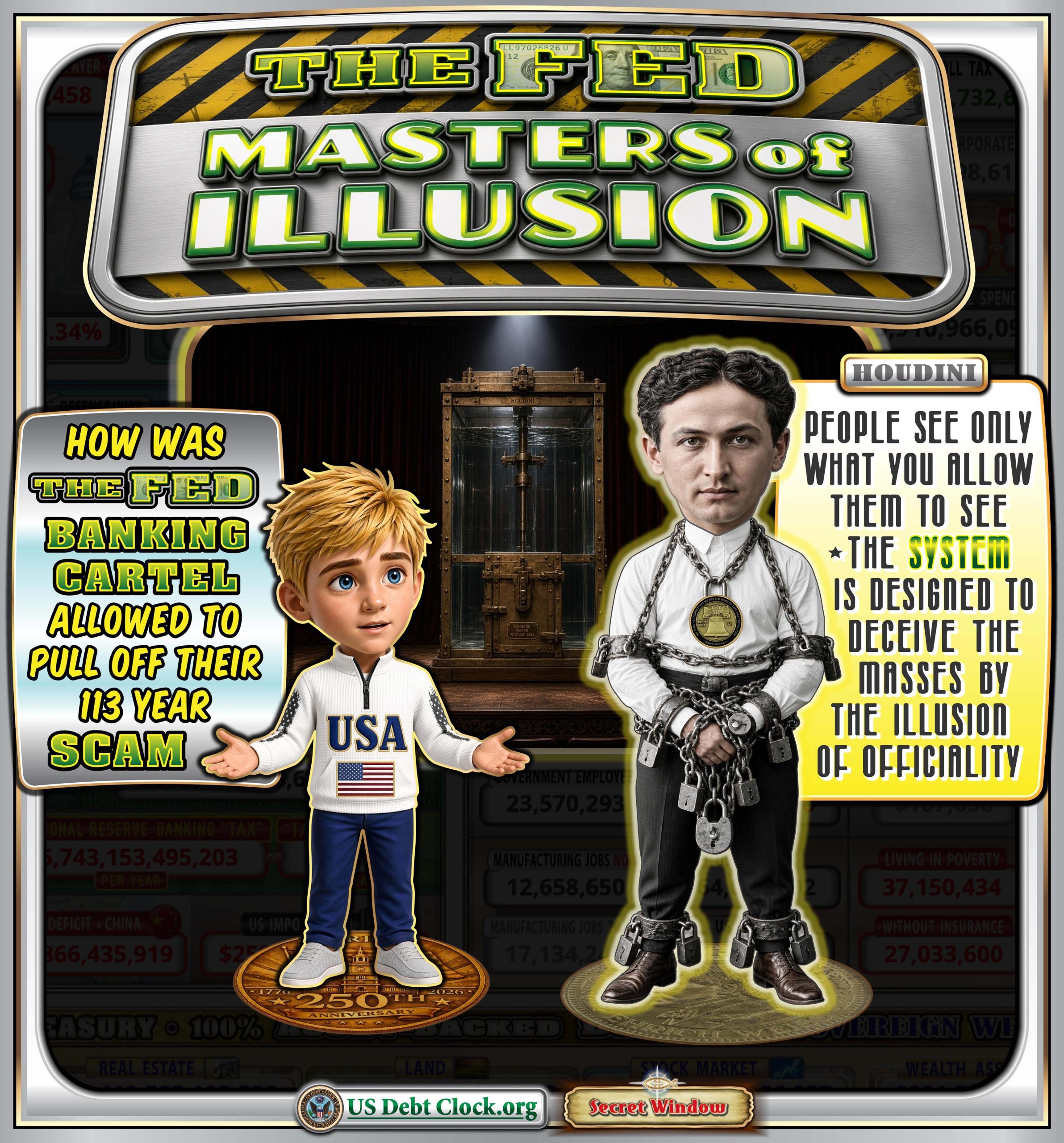
The US Debt Clock has released another provocative Secret Window poster, and this time the New Money Revolution brings one of history’s greatest illusionists onto the stage.
The headline declares:
THE FED — MASTERS OF ILLUSION
Standing on a commemorative American coin, a young boy asks:
“How was the Fed banking cartel allowed to pull off their 113-year scam?”
Across from him stands the legendary escape artist Harry Houdini, wrapped in chains and padlocks, delivering the poster’s central message:
“People see only what you allow them to see. The system is designed to deceive the masses by the illusion of officiality.”
That is the message attributed to Houdini within the cartoon, not an independently authenticated historical quotation.
Behind him sits one of his famous escape contraptions.
The symbolism is brilliant.
The US Debt Clock is suggesting that the greatest monetary illusion of modern history was not performed on a stage.
It was performed inside the financial system.
The Art of Monetary Illusion
Harry Houdini understood something fundamental about illusion.
The audience watches what the performer wants it to watch.
The chains appear impossible to escape. The locks seem secure. The apparatus looks impenetrable.
Yet the audience rarely understands the mechanism.
That is precisely the analogy the Debt Clock is drawing with the Federal Reserve.
Americans see interest rates, inflation reports, monetary policy announcements, bank reserves, Treasury auctions, and the national debt.
But how many understand the machinery connecting them?
Who creates money?
Who receives interest?
How does credit expansion affect asset prices?
Why does the national debt continue to grow?
And why do financial crises repeatedly leave households struggling while major financial institutions often receive extraordinary support?
These are the questions behind the poster.
The real illusion, according to the Debt Clock, is that the monetary system is too complicated for ordinary Americans to question.
The 1913 Connection: Nearly 113 Years of Central Banking
The poster’s reference to 113 years points directly to 1913.
On December 23 of that year, President Woodrow Wilson signed the Federal Reserve Act, establishing the modern American central banking system.
The institution was designed to address recurring banking instability, provide an elastic currency, and improve financial supervision.
But more than a century later, its structure and influence remain subjects of considerable debate.
The Federal Reserve manages monetary policy, influences borrowing conditions, provides liquidity, supervises certain financial institutions, and operates important payment infrastructure.
Its governance combines public authority with regional Reserve Banks that have distinctive institutional arrangements.
That structure is complicated, but complexity does not itself establish deception.
The Federal Reserve is subject to congressional oversight, financial reporting requirements, and multiple forms of auditing. Its 2025 audited financial statements were publicly released in March 2026.
Nevertheless, the Debt Clock’s criticism raises a meaningful issue:
Can a monetary institution remain genuinely accountable to the public if most citizens cannot understand how it operates?
That is where the Houdini comparison becomes particularly effective.
The Illusion of Officiality
The phrase “illusion of officiality” is perhaps the most important part of the entire poster.
The image challenges readers to distinguish between legitimate institutional authority and the assumption that every policy decision made under that authority must be correct.
Central banks possess lawful powers.
That does not make monetary policy infallible.
Interest-rate decisions can have unintended consequences. Quantitative easing can influence asset valuations. Inflation can erode purchasing power. Financial rescues can raise difficult questions about moral hazard and who ultimately bears economic risks.
These are legitimate subjects for public scrutiny.
But institutional criticism should be grounded in evidence.
For example, the Fed does not simply collect all interest charged on America’s money. Treasury securities have numerous holders, and the Federal Reserve has historically remitted excess earnings to the Treasury.
The financial system is more complicated than the cartoon’s accusation.
And that is precisely why its mechanisms deserve explanation.
Understanding the money is more powerful than merely distrusting the institution.
Why Houdini Is the Perfect Character
There is a fascinating historical detail behind this poster.
Harry Houdini died on October 31, 1926.
Tomorrow marks exactly 100 years since his death.
The US Debt Clock’s choice of Houdini therefore arrives at an extraordinary moment.
Houdini was not only a master escape artist. He also exposed fraudulent spiritualists and performers who used elaborate techniques to convince audiences they possessed supernatural powers.
He understood the difference between a convincing illusion and an independently demonstrated truth.
That gives this poster a second meaning.
Houdini’s greatest contribution was not merely fooling audiences.
It was understanding how people could be fooled.
A century after his death, his image is being used to ask whether Americans understand the financial machinery that influences their livelihoods.
The parallel is memorable:
Houdini escaped the chains. The Debt Clock is asking whether America can escape the debt.
From Money Logic to Masters of Illusion
This poster follows the previous Debt Clock declaration, Money Logic.
In that image, the same young boy questioned why Americans should pay interest within a monetary system intended to serve them.
The latest installment develops the child’s curiosity into a broader investigation.
Money Logic asked whether the system makes sense.
Masters of Illusion asks why the system has been so difficult to understand.
This continues a much larger narrative.
The American Jubilee imagined reducing America’s debt through asset revaluation.
Mega Restitution raised questions about potential financial recovery for taxpayers.
The Grand Infusion proposed a sovereign wealth reserve supporting a Treasury Dollar.
Economic Reinvention illustrated the possibility of lower taxes, cheaper credit, and greater household financial independence.
Now Masters of Illusion turns the spotlight back onto the existing system.
Before building a new monetary architecture, the Debt Clock appears to be arguing, Americans must understand the one they already have.
What the New Money Revolution Is Really Challenging
The US Debt Clock has repeatedly advanced the concept of a 100% asset-backed USA Treasury Dollar.
Its proposed foundation includes gold, silver, strategic resources, productive infrastructure, and sovereign wealth.
That represents a fundamentally different monetary philosophy from the current nonconvertible dollar system.
But an asset-backed monetary system would have its own complexities.
Who owns the backing assets? How are they valued? Can currency holders redeem their claims? Who controls issuance? What prevents overvaluation, political manipulation, or excessive monetary expansion?
Simply replacing the Federal Reserve with another institution would not eliminate the need for transparency.
The true objective should be a monetary structure whose rules, reserves, and obligations can be independently verified.
That is the enduring lesson of Houdini’s art.
The audience deserves to understand what is happening behind the curtain.
The Invest Offshore Perspective
For Invest Offshore readers, the poster reinforces a principle central to international asset protection:
Never confuse institutional reputation with financial due diligence.
Whether evaluating a bank, offshore trust, sovereign bond, gold custody arrangement, private placement, or asset-backed financial instrument, the same questions apply.
Who controls the asset?
Who owns the liability?
Where is the collateral?
What legal protections exist?
Can the transaction be independently verified?
And what happens if the institution fails?
Real wealth protection depends on understanding the mechanics rather than accepting impressive appearances.
The US Debt Clock’s monetary argument may be provocative, but its most useful investment lesson is straightforward.
Follow the balance sheet. Understand the obligations. Verify the assets.
Conclusion: The Greatest Escape Act of All?
The US Debt Clock’s Masters of Illusion poster is one of its most imaginative messages yet.
A child asks how the Federal Reserve banking system maintained its position for nearly 113 years.
Houdini, the master of impossible escapes, responds with a warning about deception and the appearance of authority.
The chains symbolize financial dependency.
The locks symbolize institutional complexity.
The escape apparatus represents the machinery hidden from public understanding.
And the child represents the next generation asking questions that deserve clear answers.
The poster does not prove a century-long financial conspiracy. Nor does it establish that the Federal Reserve is about to disappear.
But it presents a powerful challenge.
A financial system that serves the people should be understandable, transparent, and accountable to the people.
The American Jubilee imagined freedom from debt.
Mega Restitution imagined financial recovery.
The Grand Infusion imagined a new foundation for money.
Money Logic asked the obvious question.
And now Masters of Illusion asks us to look behind the curtain.
A century after Houdini’s death, perhaps the greatest financial escape act is not making the Federal Reserve disappear.
It is helping Americans understand the money system well enough to make informed choices about their own financial future.
Invest Offshore continues tracking the New Money Revolution, Treasury reform, sovereign wealth, precious metals, and the evolving architecture of global capital.
Invest Offshore — Global Capital. Clear Intelligence.
Leave a Reply