
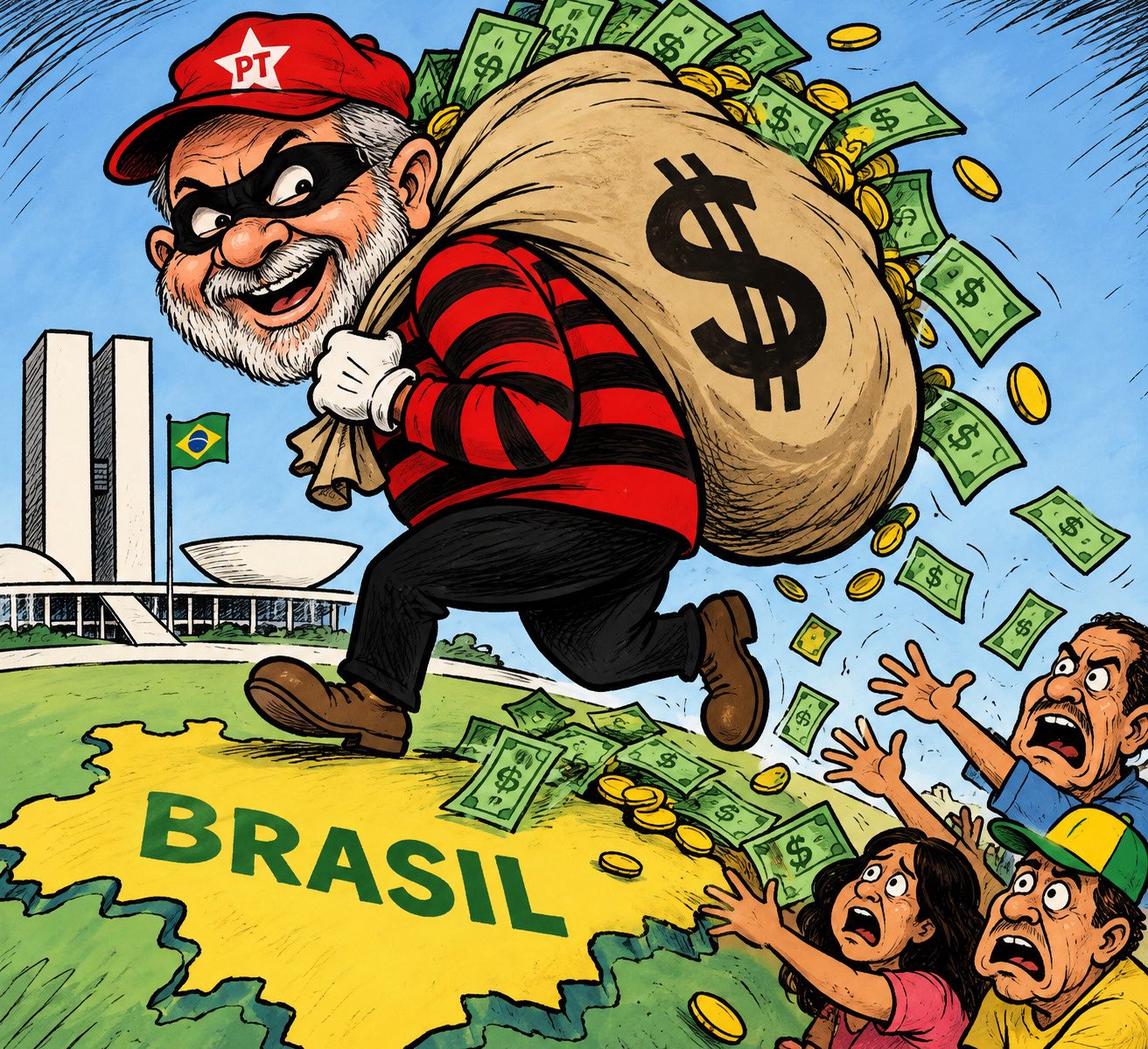
Brazil’s post-election financial carnage is exposing the dangers of crowded political trades, leveraged hedge funds, and misplaced confidence in emerging markets.
The financial earthquake shaking Brazil is more than another emerging-market correction. It is a dramatic demonstration of what happens when political expectations, institutional positioning, and trillions of dollars in investment assumptions collide with an unexpected election result.
We recommend an important article published by ZeroHedge:
The headline is provocative. The underlying market destruction is very real.
For international investors, offshore asset managers, family offices, and anyone managing exposure to Latin America, this is essential reading.
The Election Result That Broke the Trade
On October 25, 2026, Brazilian President Luiz Inácio Lula da Silva secured reelection with 51.79% of the valid vote, defeating Flávio Bolsonaro, who received 48.21%.
Institutional investors had positioned heavily for a Bolsonaro victory, anticipating tighter fiscal policies, lower government spending, and a more favorable environment for private capital.
The election delivered the opposite outcome.
On Monday, October 26, Brazil’s Ibovespa stock index plunged approximately 13.9%, triggering a temporary trading halt. The Brazilian real lost more than 8% against the U.S. dollar, while government debt came under pressure.
The liquidation continued through the week.
By Friday, October 30, Brazil’s benchmark stock index was approximately 18% below its pre-runoff closing level. The dollar had appreciated roughly 9% against the real over the same period.
This was not simply a stock market correction. It was a simultaneous repricing of equities, currencies, government bonds, and political risk.
Worse Than Lehman Brothers? The Numbers Tell a Remarkable Story
One of the most striking observations in ZeroHedge’s reporting concerns the iShares MSCI Brazil ETF (EWZ), a major investment vehicle for international exposure to Brazilian equities.
On October 26, EWZ declined 19.8% in a single session.
That exceeded its 19.6% loss on October 15, 2008, during the global financial crisis following the collapse of Lehman Brothers.
Only the extraordinary March 16, 2020 pandemic decline of 23.1% was worse in the fund’s history.
The comparison requires perspective: Brazil has not experienced a Lehman-style global banking failure. Rather, the one-day loss in a major Brazil ETF exceeded a particularly devastating session during the 2008 crisis.
Nevertheless, the magnitude is extraordinary.
And it becomes more revealing when we examine the investment capital that entered Brazil immediately before the election.
According to ETF.com and FactSet data cited in subsequent reporting, EWZ attracted approximately $4.09 billion in net inflows between October 1 and October 23.
Investors crowded into the same political outcome.
Then the outcome changed.
The Macro Hedge Funds Are the Real Story
The most consequential part of this episode may not be the index decline. It may be the damage inflicted on sophisticated institutional investors.
Bloomberg reported on October 30 that some Brazilian macro hedge funds suffered single-day losses reaching 24%, as positions established after the first election round were overwhelmed by the reversal.
These were not necessarily inexperienced speculators.
They included professional investment managers operating across equity markets, interest-rate derivatives, and foreign exchange.
Their investment thesis depended on the expectation of a particular political outcome and the economic reforms that might follow.
When that assumption failed, multiple positions became vulnerable simultaneously.
This is precisely the type of correlated liquidation that offshore investors must understand.
Diversification among financial instruments means remarkably little when those instruments are all exposed to the same underlying political assumption.
A fund may own government bonds, stocks, and currency derivatives, yet remain dangerously concentrated in one macroeconomic scenario.
The critical risk is not always what an investor owns. It is what every position assumes will happen next.
The Offshore Investment Implications
Brazil remains one of the world’s most important commodity-producing economies, with substantial exposure to iron ore, energy, agriculture, banking, infrastructure, and international trade.
The country’s economic significance has not disappeared because of an election.
But international capital demands confidence in fiscal management, monetary stability, contract enforcement, and the predictability of government policy.
The coming months will test whether Lula’s administration can restore that confidence.
For offshore investors, several priorities deserve immediate attention:
- Currency exposure: Brazilian assets must be evaluated in U.S. dollar terms, not simply by their local equity-market performance.
- Counterparty risk: Highly leveraged funds and financial intermediaries may face liquidity pressures following substantial drawdowns.
- Sovereign debt: Government borrowing costs and fiscal credibility require close monitoring.
- Commodity opportunities: Export-oriented Brazilian businesses may respond differently from domestically focused financial institutions, particularly when the real weakens.
- Jurisdictional diversification: Investors should assess whether their capital structure genuinely limits exposure to any single political or monetary regime.
These considerations do not mean that investors must abandon Brazil. Indeed, sharp repricing can eventually produce exceptional opportunities.
But opportunities are valuable only when investors have sufficient liquidity, reliable counterparties, and the patience to distinguish temporary distress from lasting deterioration.
The Bigger Warning: Political Risk Is Financial Risk
The broader lesson from Brazil reaches far beyond Latin America.
Global investors have become increasingly dependent on political forecasts, central-bank expectations, election probabilities, and assumptions about future fiscal policies.
When those forecasts become crowded investment positions, markets can grow remarkably fragile.
The Brazilian experience shows how rapidly confidence can evaporate when the consensus trade is wrong.
It also demonstrates why independently verified asset valuations, prudent leverage, currency diversification, and strong custody arrangements remain essential components of international wealth management.
No jurisdiction, exchange, or sophisticated hedge fund is immune to political uncertainty.
And no opinion poll should ever substitute for a comprehensive investment risk assessment.
Invest Offshore’s Recommendation: Read the ZeroHedge Report
We recommend ZeroHedge’s analysis because it draws attention to the extraordinary severity of the Brazilian selloff and the institutional casualties behind the headlines.
Readers should distinguish its dramatic market comparisons from evidence of an actual systemic banking crisis. Likewise, disputed political allegations should not be mistaken for established facts.
The verified financial developments are sufficiently serious without exaggeration.
For investors who follow global capital flows, sovereign credit, offshore banking, and emerging-market opportunities, Brazil has become one of the most important financial case studies of 2026.
The question is no longer simply who governs Brazil.
The question is how much capital was committed to a political outcome that never happened—and how much additional risk remains hidden in the portfolios of institutions that got it wrong.
That is why this story deserves attention well beyond São Paulo.
Recommended Reading
Additional reporting: Reuters — Brazil stocks and real tumble | ETF.com — Brazil ETF plunges nearly 20% | Bloomberg Línea — Hedge fund losses
Invest Offshore provides independent editorial coverage of international finance, offshore investment, capital markets, and global wealth preservation. This commentary is for informational purposes and does not constitute personalized investment advice.
Leave a Reply