
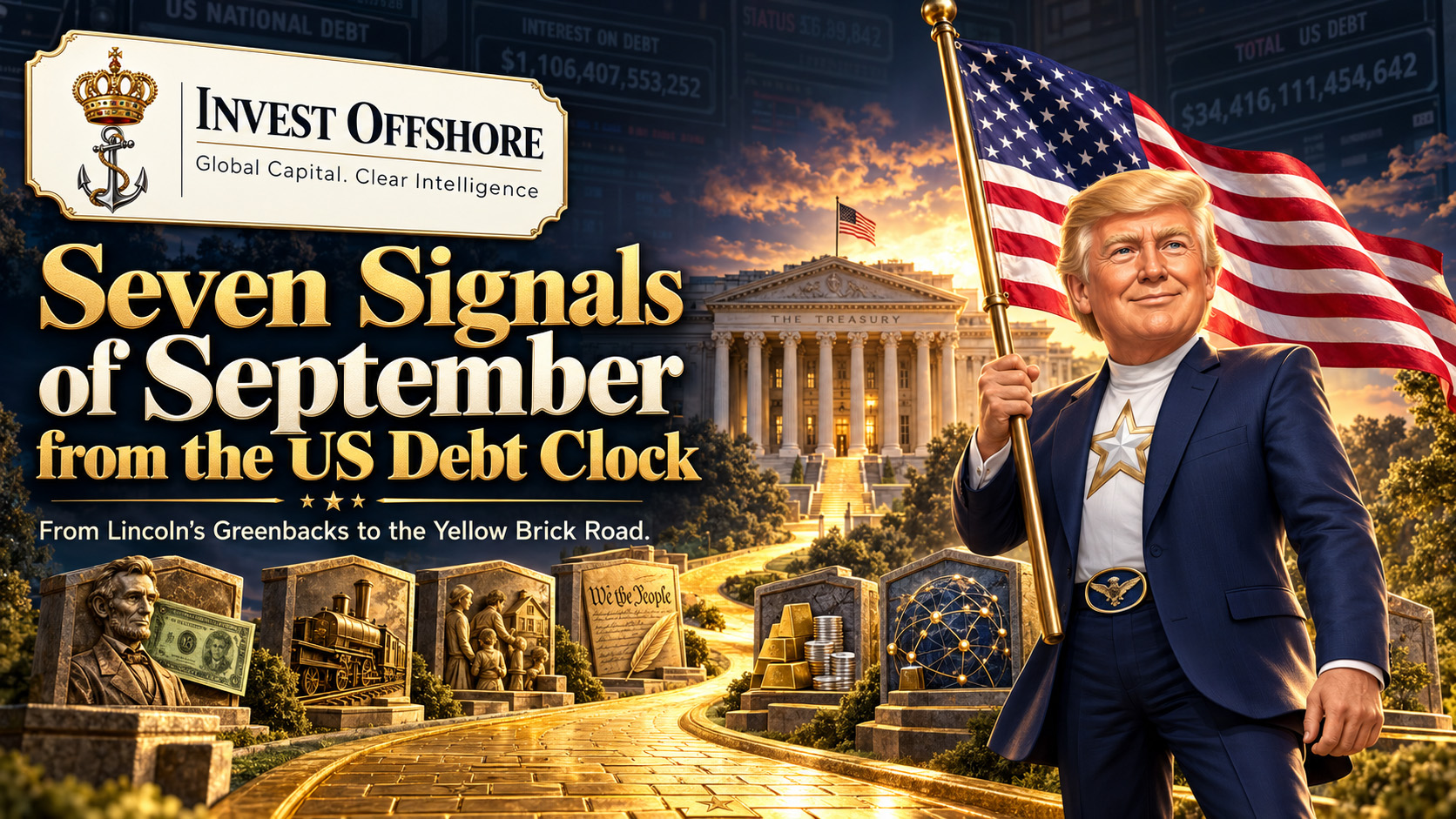
From Lincoln’s Greenbacks to the Yellow Brick Road
September’s US Debt Clock sequence tells a story about monetary transformation.
Across seven posters covered by Invest Offshore, the narrative moves through historical precedent, a proposed currency transition, household borrowing costs, constitutional authority, precious metals, alternative financial infrastructure and monetary sovereignty.
Together, the posts ask a question that reaches well beyond the imagery:
If America were to change its monetary architecture, how would that change actually happen—and what would it mean for global capital?
For internationally minded investors, the subject connects familiar concerns: purchasing power, reserves, banking relationships, custody, collateral and the movement of wealth across borders.
The distinction between a proposal and public policy remains essential. The Debt Clock’s imagery presents a speculative monetary thesis. The posters themselves do not establish that a Treasury Dollar has been enacted, that a nationwide 3% credit program exists, or that the government has adopted the proposed gold and silver valuations.
With that context, September’s seven signals offer a useful framework for examining the questions beneath the claims.
1. Transformational Action: History Opens the Door

The first signal places Abraham Lincoln beside a proposed “USA Treasury 100% Reserve” note, connecting a Treasury-centered monetary future with the history of Civil War-era greenbacks.
The historical reference gives the narrative its foundation. America’s monetary system has changed before, and government-issued money has been part of that history.
But precedent does not settle the design of a future system. Lincoln’s wartime financing circumstances cannot, by themselves, establish the legal authority, reserve structure or economic consequences of the Debt Clock’s contemporary proposal.
The useful question is what another transformation would require. Who would issue the currency? What assets would support it? How would issuance be governed? And how would the new money interact with existing obligations?
Read “Transformational Action”
2. A Seamless Transition: The Infrastructure Question

The second poster shifts attention from historical possibility to operational mechanics.
Its arrow from the poster’s “Fed Debt-Based Dollar” toward a proposed USA Treasury Dollar makes the transition appear straightforward. In practice, monetary change would involve a vast network of deposits, contracts, securities, payment systems and financial institutions.
A different currency design would need answers about existing mortgages, commercial loans, bank balances and international obligations. Businesses would need continuity in payments. Financial markets would need dependable settlement and liquidity.
For offshore investors, this is where the discussion becomes particularly relevant.
Custody, collateral, settlement and liquidity would determine how a transition affected capital in practice.
The credibility of any monetary proposal therefore depends heavily on the machinery that would make it usable.
3. It’s GO Time: Monetary Theory Meets Household Cash Flow

The third signal brings the argument into the household budget.
The poster compares conventional borrowing costs with a hypothetical 3% state-credit model and illustrates monthly savings of $1,082. Those figures belong to the poster’s scenario; they should not be treated as an available refinancing offer or guaranteed household benefit.
Still, the communication strategy is clear. Monetary architecture becomes easier to understand when expressed through mortgage payments, automobile financing and credit-card interest.
If borrowing costs fell meaningfully, households could have more capacity to save, invest or build businesses. Whether those benefits materialized would depend on funding, eligibility, credit risk and the broader economic effects of the program.
The investment question begins with those details. A rate printed on a poster is the beginning of an inquiry into credit economics.
4. Bring Down the Hammer: Authority Matters

Invoking Ronald Reagan, Donald Trump and the Constitution, the fourth poster places monetary authority at the center of the discussion.
Its imagery raises a serious institutional question: what legislation and organizational changes would be required to redesign the American monetary system?
Constitutional arguments can inform that debate. They do not demonstrate that a particular Treasury Dollar proposal has been authorized or implemented.
For investors, the legal structure deserves as much attention as the proposed backing. Contracts must be enforceable. Institutions must have defined responsibilities. Rules governing issuance, redemption and settlement must be credible.
A currency’s durability depends on confidence in that entire framework.
5. The Great Revaluation: Precious Metals Take Center Stage

The fifth signal puts gold and silver directly inside the Treasury Dollar thesis.
The poster proposes reference values of $10,000 for gold and $600 for silver. These are speculative Debt Clock figures, not official valuations for a new U.S. currency or price forecasts endorsed by Invest Offshore.
The broader question is how a monetary system placing greater weight on tangible reserves might operate.
Reserve quantities, currency supply, ownership, custody, auditing and redemption rules would all matter. A proposed valuation alone cannot explain whether a system would be credible or sustainable.
For global investors, such a framework would also raise questions about sovereign balance sheets, collateral practices, mining economics and international capital flows.
The numbers attract attention. The reserve structure deserves scrutiny.
6. Easy Out: Building Alternative Financial Rails

The sixth poster uses Theodore Roosevelt’s trust-busting image to suggest that established monetary institutions could be bypassed through an alternative structure.
That remains a thesis. The imagery does not supply evidence of an enacted plan to replace the Federal Reserve.
It does, however, invite a useful discussion about how financial infrastructure changes. New settlement networks, tokenized assets and payment systems can alter the way money moves, even while existing institutions continue to operate.
The practical questions concern adoption and authority. Who can use the system? Which assets settle through it? Who provides liquidity? What happens when a transaction fails?
For offshore capital, the answers would shape transferability, counterparty exposure and access to funds.
7. Follow the Yellow Brick Road: The Narrative Comes Full Circle

The final poster borrows from The Wizard of Oz, suggesting that the power to pursue monetary change was already present in America’s constitutional structure.
It completes September’s progression:
History → Transition → Savings → Authority → Revaluation → Alternative Rails → Monetary Sovereignty
The metaphor gives the series a memorable ending. Turning that narrative into policy would still require legal authority, institutional decisions and workable implementation.
For investors, the distinction is consequential. Symbolism can introduce an idea. Evidence establishes whether the idea is becoming an operational reality.
Read “Follow the Yellow Brick Road”
What September Means for Offshore Investors
September moves the Debt Clock narrative from “What if?” toward “How?”
That shift brings practical questions into view: what backs money, how credit is funded, who controls settlement and which institutions enforce the rules.
The relevant signals to watch would be official legislation, Treasury and Federal Reserve announcements, published program terms and observable changes in financial infrastructure.
For Invest Offshore readers, the enduring task is to understand their own position within that architecture.
What do you own? Where is it held? Which laws govern it? Who is the custodian? What claims exist against it? How readily can it be transferred?
Those questions remain useful regardless of whether the Debt Clock’s proposed monetary future takes shape.
September’s seven posters make the debate vivid. Clear intelligence comes from examining the history, mechanics and evidence behind the imagery.
Global Capital. Clear Intelligence.
Invest Offshore — following money, metals, markets and the changing architecture of global wealth.
Leave a Reply