
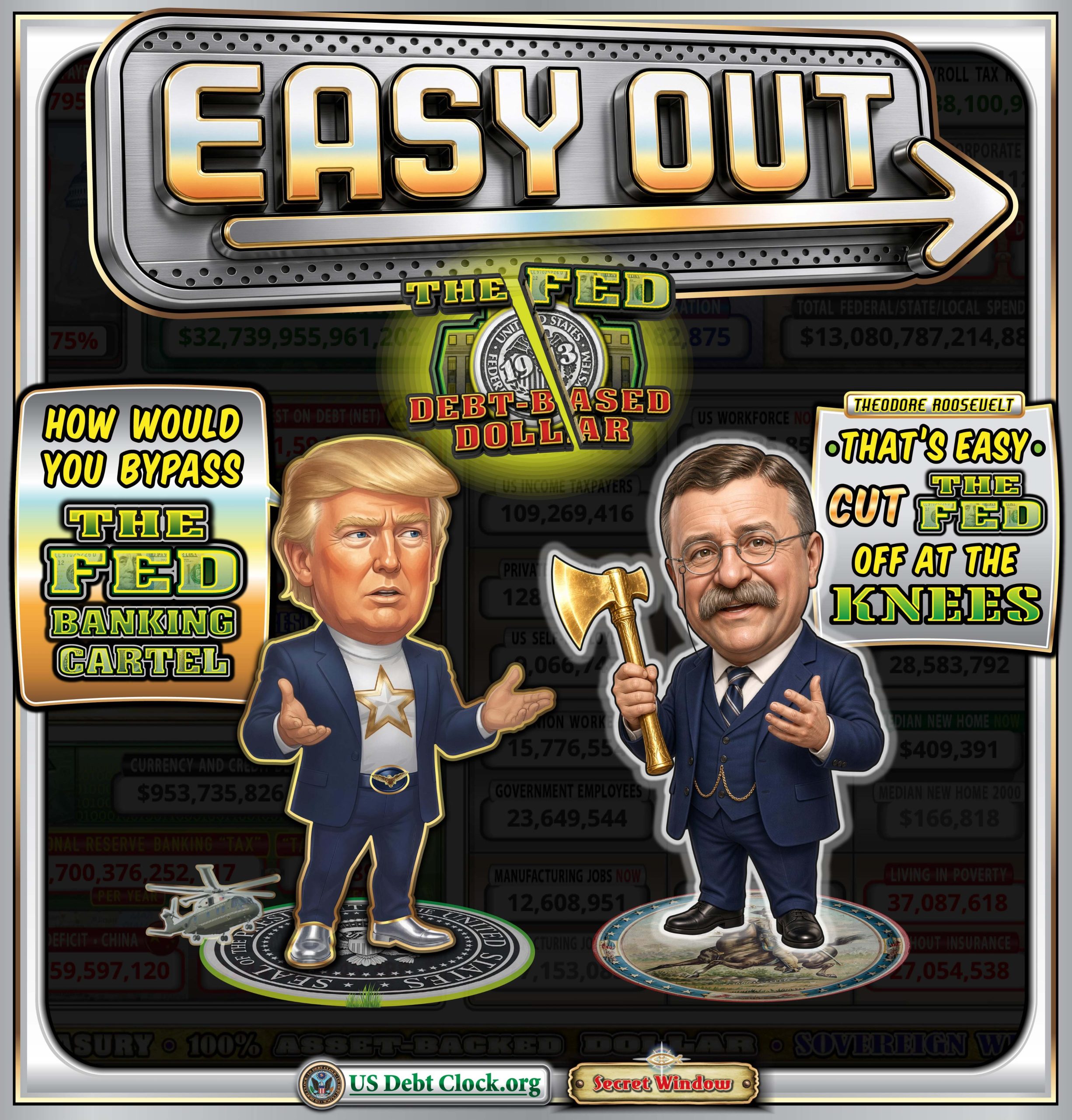
The US Debt Clock has released another “DJT” poster, and this one comes with a message as blunt as a battle axe:
Easy Out
At the center of the image is the familiar target:
The Fed Debt-Based Dollar — 1913
On the left, DJT asks:
“How would you bypass the Fed Banking Cartel?”
On the right, Theodore Roosevelt answers:
“That’s easy. Cut the Fed off at the knees.”
This is not a technical white paper. It is political cartoon theater. But like the best cartoons, it compresses a complicated monetary argument into one unforgettable image.
The poster is saying that the way out of the Federal Reserve debt-money system may not be to fight it head-on, but to bypass it.
Why Theodore Roosevelt Appears
Theodore Roosevelt is the perfect figure for this poster because he is remembered as the great trust-buster.
During his presidency, the federal government challenged powerful corporate combinations, most famously the Northern Securities Company. The Supreme Court upheld the government’s case in 1904, establishing Roosevelt’s reputation as a president willing to confront concentrated private power. Theodore Roosevelt Center
That historical symbolism matters.
The US Debt Clock is not randomly placing Roosevelt beside DJT. It is drawing a line between two eras of concentrated power:
Then: railroad trusts, industrial monopolies, and corporate combinations.
Now: central banking, debt-money, interest extraction, and financial concentration.
Roosevelt’s message in the poster is simple: when a protected system becomes too powerful, you do not merely complain about it. You remove its leverage.
The 1913 Target
The poster again highlights 1913, the year the Federal Reserve Act was signed into law. President Woodrow Wilson signed the Federal Reserve Act on December 23, 1913, creating the Federal Reserve System. Federal Reserve History
For the US Debt Clock, 1913 is not just a date. It is the origin point of the modern debt-dollar regime.
In the Debt Clock’s storyline, the Federal Reserve-era system created a dollar built on debt expansion, interest payments, banking leverage, monetary dilution, and public dependency on private credit structures.
The poster’s phrase “Fed debt-based dollar” is the accusation.
The proposed alternative, seen throughout the recent poster series, is the USA Treasury Dollar — an asset-backed, Treasury-centered monetary system designed to reduce reliance on the old debt machine.
What “Cut the Fed Off at the Knees” Means
The phrase is dramatic, but the financial meaning is strategic.
To “cut the Fed off at the knees” does not have to mean a reckless collapse of the monetary system. In the poster’s symbolic language, it means removing the Federal Reserve system’s practical monopoly over money creation, credit conditions, and the dollar’s operating architecture.
How?
By building alternative rails.
Treasury-issued instruments.
State credit-union lending channels.
Asset-backed currency models.
Gold and silver reserve logic.
Digital settlement tools.
Lower-interest credit structures.
Public ownership mechanisms.
A sovereign wealth reserve.
That is the “easy out” implied by the poster.
Not necessarily destroy the system overnight.
Bypass it until it becomes obsolete.
Bypass, Don’t Beg
This poster follows naturally from the prior A Seamless Transition and It’s GO Time messages.
First, the Debt Clock asked how America could switch from the Fed debt-based dollar to the USA Treasury Dollar.
Then it showed a smartphone-style household savings model based on lower-rate state credit union loans.
Now it asks the bigger strategic question:
How do you bypass the Fed Banking Cartel?
The answer: create a competing system that serves households, states, and productive capital better than the old one.
That is the Debt Clock’s argument.
If people can refinance cheaper, borrow cheaper, save more, own more, and transact through Treasury-aligned rails, then the old banking structure loses its grip.
The power of the old system is dependency.
The way out is optionality.
Roosevelt’s Trust-Busting Lesson
Roosevelt’s trust-busting was not anti-business. It was anti-control.
That distinction is crucial.
The US Debt Clock is making the same claim about banking. It is not arguing that credit, banking, settlement, or financial infrastructure are unnecessary. It is arguing that when the system becomes too concentrated, too protected, and too expensive, it stops serving the public and starts serving itself.
That is the trust-busting analogy.
In Roosevelt’s era, the question was whether massive industrial combinations could dominate commerce.
In this poster’s monetary version, the question is whether a debt-based banking system can dominate credit, currency, rates, and public finance.
The solution is not envy.
The solution is competition, transparency, and public authority.
The Axe Symbol
The axe in Roosevelt’s hand is not subtle.
It is the trust-buster’s tool.
The poster could have shown a pen, a speech, or a committee hearing. Instead, it shows an axe.
That means decisive action.
The Debt Clock is telling readers that the old system will not voluntarily surrender its privileges. If America wants a Treasury Dollar, lower interest, lower taxes, and asset-backed money, then the old debt-based structure must be structurally weakened.
That is what “Easy Out” means.
The exit may be simple in concept, but it still requires courage.
The Invest Offshore Decode
For Invest Offshore readers, this poster matters because it shifts the New Money Revolution from theory into strategy.
Earlier posters asked:
What backs the new dollar?
How do we revalue gold and silver?
How do we delete income tax?
How do we cap loans at 3%?
How do we create a seamless transition?
This poster asks:
How do we bypass the institution that benefits from the old model?
That question sits at the heart of every monetary reset.
If the old system controls the rails, then the new system needs new rails.
If the old system controls credit, then the new system needs new credit channels.
If the old system controls liquidity, then the new system needs new liquidity sources.
If the old system controls settlement, then the new system needs new settlement architecture.
That is why this poster is important.
It is not just anti-Fed rhetoric. It is a roadmap: build the Treasury Dollar path around the old system until the old system loses relevance.
What Offshore Investors Should Watch
The poster should not be mistaken for official policy. The Federal Reserve remains the U.S. central bank, Federal Reserve notes remain legal tender, and no official public replacement Treasury Dollar has been launched.
But the direction of the Debt Clock narrative is unmistakable.
For offshore investors, the watchlist is clear:
Treasury-centered instruments.
State credit-union models.
Gold and silver revaluation signals.
Digital settlement rails.
Lower-interest credit programs.
Asset-backed finance structures.
Sovereign wealth reserve concepts.
Legal and constitutional arguments around money issuance.
If any of those move from symbolism into implementation, the capital markets will notice.
Conclusion: The Easy Out Is Competition
The US Debt Clock’s Easy Out poster delivers a simple message:
The Fed debt-based dollar does not need to be debated forever.
It can be bypassed.
Roosevelt brings the trust-busting symbolism.
DJT brings the present-tense political figure.
The axe brings decisive action.
The USA Treasury Dollar brings the alternative.
The poster’s meaning is clear:
The old system survives because people believe there is no exit.
The Debt Clock says there is.
Build the new rails.
Back the money with assets.
Lower the cost of credit.
Restore Treasury authority.
Give households a better deal.
And let the old debt-dollar system lose power by comparison.
That is the easy out.
And according to the US Debt Clock, the axe is already on the table.
Leave a Reply