
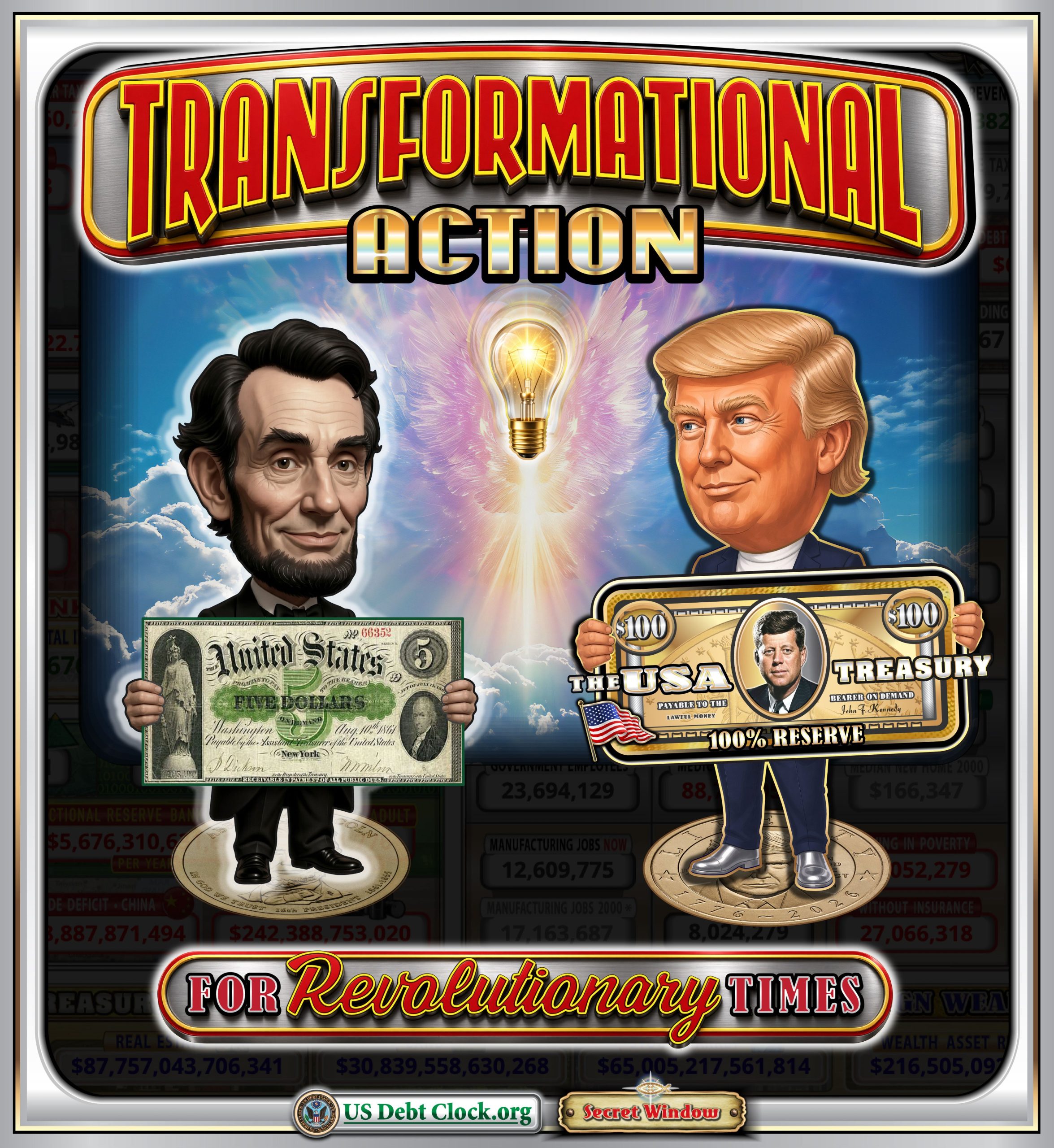
The US Debt Clock has released another “DJT” poster, and this one may be among the most symbolic of the entire New Money Revolution series.
The headline reads:
Transformational Action
For Revolutionary Times
At the center of the image are two figures separated by history but joined by monetary meaning.
On the left stands Abraham Lincoln, holding what appears to be an old United States Note — a reminder of sovereign money issued in a time of national crisis.
On the right stands DJT, holding a USA Treasury 100% Reserve note bearing the image of John F. Kennedy.
Between them floats a glowing lightbulb with wings — a visual cue that this is not just another poster about debt or taxes. It is about an idea. An illumination. A transfer of knowledge across time.
The message is clear:
The US Debt Clock is presenting America’s monetary future as a continuation of unfinished sovereign-money history.
The Core Decode: Lincoln, Kennedy, and the Treasury Dollar
This poster is not subtle.
Lincoln represents one of the most famous historical examples of direct sovereign issuance. During the Civil War period, the U.S. government issued United States Notes, often remembered as “Greenbacks,” rather than relying entirely on traditional debt finance.
In Debt Clock symbolism, Lincoln stands for a simple but powerful principle:
A nation can issue money in its own authority.
Kennedy, whose image appears on the “100% Reserve” Treasury note in DJT’s hands, is used here as a second symbolic link in the chain. Whether one accepts all the legends surrounding JFK and monetary reform or not, the Debt Clock clearly uses Kennedy as a symbol of interrupted Treasury-centered reform and unfinished monetary sovereignty.
So the image creates a timeline:
Lincoln — sovereign money in crisis.
Kennedy — unfinished monetary reform.
DJT — transformational action in the present.
That is the decode.
Why “Transformational Action” Matters
The phrase Transformational Action suggests movement beyond commentary.
Earlier Debt Clock posters were often about exposure:
- the Fed banking cartel
- asset-backed Treasury money
- repo operations
- tax deletion
- silver revaluation
- racketeer justice
- presidential disclosure
Those posters identified the problem.
This poster is about the solution phase.
Not just theory.
Not just outrage.
Not just diagnosis.
Action.
The Debt Clock is saying America has entered a moment where monetary history must be turned into policy.
The Meaning of the 100% Reserve Treasury Note
The most important object in the poster may be the note DJT is holding.
It reads as a USA Treasury note and emphasizes 100% Reserve. That concept is enormous.
A 100% reserve system implies a form of money fully backed by real value rather than sustained by layered leverage, partial reserves, or endless debt multiplication.
In the Debt Clock’s symbolic language, this note stands for a monetary reset based on:
Gold
Silver
Treasury authority
Sovereign wealth
Real assets
Full-value backing
That is why the poster matters.
It is not just celebrating old money.
It is imagining new money built on old principles.
Lincoln’s Role: Sovereignty Over Scarcity
Lincoln’s presence is especially powerful because he governed in revolutionary times of his own.
He faced war, fragmentation, emergency finance, and existential national stress.
The Greenback tradition — whether one treats it as financial necessity, political innovation, or patriotic legend — represents a moment when the nation chose direct monetary action over passive dependence.
That is exactly why the Debt Clock places Lincoln here.
He is the model for what sovereign action looks like when the existing system is no longer enough.
The poster is effectively asking:
If Lincoln could break convention to save the Union, what kind of monetary convention must be broken now to save the Republic?
Why the JFK Image Appears on the New Note
The JFK image on the Treasury note is equally symbolic.
In the Debt Clock universe, JFK represents unfinished business.
He represents the road not taken.
He represents the monetary reform that was interrupted.
He represents the idea that America once approached a different financial path but did not complete it.
By placing JFK on a “100% Reserve” Treasury note, the poster is making a bold statement:
The future Treasury dollar is not only new.
It is also a restoration of an older American intention.
Not a foreign system.
Not a technocratic abstraction.
Not merely a digital token.
A specifically American monetary idea, revived.
The Lightbulb With Wings
The glowing winged lightbulb between Lincoln and DJT is easy to overlook, but it may be the emotional center of the image.
It symbolizes revelation.
The lightbulb means invention, insight, realization, problem-solving, and breakthrough.
The wings mean elevation, transmission, inspiration, and movement between eras.
Together, the symbol suggests that the answer to America’s monetary crisis is not being invented out of nowhere. It is being remembered.
The idea already existed.
Lincoln carried one version of it.
Kennedy hinted at another.
The present moment is being asked to act on it.
That is why the lightbulb floats like a messenger.
“For Revolutionary Times”
The bottom banner reads:
For Revolutionary Times
That phrase widens the poster from monetary policy to civilizational mood.
The Debt Clock is saying that today’s moment is not normal.
Debt is extreme.
Interest burdens are historic.
Public trust is fractured.
Fiat credibility is questioned.
Tax fatigue is rising.
The middle class is squeezed.
The asset economy is separating from the wage economy.
These are revolutionary conditions.
Not necessarily revolution in the violent sense.
But revolution in structure.
Revolution in incentives.
Revolution in ownership.
Revolution in money.
And for revolutionary times, the Debt Clock argues, incremental tweaks are not enough.
Only transformational action will do.
The Invest Offshore View
For Invest Offshore readers, this poster is one of the clearest articulations yet of the New Money Revolution’s deeper thesis:
America’s monetary future will not be built by simply adjusting rates, printing more debt, or layering more complexity onto a failing system.
It must be rebuilt around:
Treasury authority
Asset backing
Lower leverage
Public ownership logic
Productive credit
Sovereign confidence
Historical continuity
In other words, the poster is not calling for novelty for novelty’s sake.
It is calling for a return to first principles.
And that matters to offshore investors because first-principle monetary change affects everything:
Gold and silver pricing
Treasury markets
Private banking
Tax policy
Real estate
Offshore asset protection
Dollar confidence
Cross-border settlement
Sovereign reserves
If the world’s reserve currency begins to shift from debt-backed psychology to reserve-backed credibility, global capital must reprice accordingly.
From Critique to Blueprint
This is why Transformational Action feels different from some of the earlier posters.
Earlier posters attacked the old system.
This one reaches for a blueprint.
Lincoln gives it historical legitimacy.
Kennedy gives it symbolic continuity.
DJT gives it present-tense agency.
The Treasury note gives it form.
The lightbulb gives it revelation.
The poster is saying the New Money Revolution is no longer only about what must be torn down.
It is about what must be built.
Conclusion: A Treasury Future Hidden in American Memory
The US Debt Clock’s Transformational Action poster may be one of its most important messages yet.
It suggests that America’s next monetary chapter is not merely a break with the past.
It is a selective recovery of the past.
Lincoln’s sovereign-money legacy.
Kennedy’s unfinished reform symbolism.
A 100% reserve Treasury vision.
A present moment demanding bold action.
That is the meaning of the poster.
It tells readers that in revolutionary times, the answer may not be to trust the same debt machine harder.
It may be to remember that America once believed money could serve the nation — not the other way around.
And if the Debt Clock is right, transformational action means finally putting that belief back into circulation.
Invest Offshore will continue tracking the New Money Revolution, Treasury reform, sovereign money, gold, silver, asset-backed finance, and the global capital shifts that follow when monetary history stops being a memory and starts becoming a plan.
Leave a Reply