
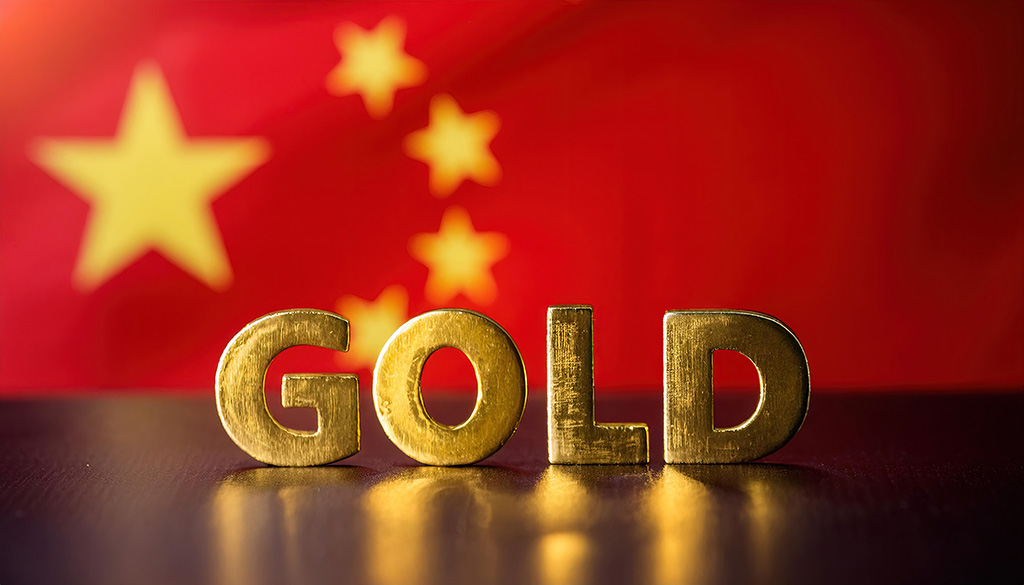
China’s push to internationalize the yuan is taking a distinctly old-world turn: gold. Rather than simply asking foreign governments and companies to trust another fiat currency, Beijing is building infrastructure that could give yuan-denominated trade a physical exit door into bullion.
China is developing a network of offshore gold vaults while expanding the trading, clearing and delivery infrastructure connecting physical bullion with the renminbi, according to an August 24 report from S&P Global Ratings highlighted by the South China Morning Post. The implications reach well beyond the gold market. Beijing appears to be constructing something potentially more consequential: a commodity-backed settlement ecosystem capable of making the yuan more useful outside China. S&P Global
The Problem Beijing Is Trying to Solve

China has wanted a larger international role for the renminbi for years. But there is an obvious obstacle.
A foreign exporter willing to accept yuan still has to answer a fundamental question: what do I do with the yuan afterward?
The U.S. dollar dominates international commerce not simply because Washington declares it the world’s reserve currency. It sits at the center of an enormous ecosystem of Treasury securities, dollar deposits, correspondent banks, derivatives, trade finance and globally liquid capital markets.
The yuan does not yet have an equivalent network.
SWIFT data for July 2026 showed the renminbi accounting for roughly 3.1% of international payments, ranking fifth, while the dollar remained overwhelmingly dominant. Swift
Gold potentially changes the equation.
Charles Chang, S&P Global Ratings’ Greater China corporate ratings lead, explained the underlying logic succinctly: if renminbi received through trade can ultimately be converted into gold, the currency becomes more practically useful because bullion itself is globally tradable. South China Morning Post
That is an important distinction.
China does not need to formally announce a gold-backed yuan to make gold strategically useful to the yuan.
It only needs to make the pathway from trade → yuan → gold → physical delivery increasingly convenient.
Hong Kong Was the First Big Step

The blueprint is already operational.
In June 2025, the Shanghai Gold Exchange opened its first offshore certified bullion vault in Hong Kong, operated by Bank of China (Hong Kong). At the same time, the exchange introduced two renminbi-denominated gold contracts—iPAu99.99HK and iPAu99.5HK—that permit settlement in cash or through physical delivery in Hong Kong.
Think about what that accomplishes.
An international participant can gain exposure to physical gold through a Chinese exchange, price the transaction in renminbi and obtain delivery outside mainland China.
Hong Kong therefore becomes more than an offshore financial center. It becomes a physical bridge between China’s currency and the world’s oldest monetary reserve asset.
Beijing and Hong Kong have continued expanding that architecture. In July 2026, officials announced plans for a central gold clearing system, yuan-denominated gold futures and a cross-border “Delivery Connect” mechanism linking Hong Kong more closely with the Shanghai Gold Exchange. Hong Kong also intends to expand gold storage capacity to more than 2,000 metric tonnes by 2030, compared with less than 200 tonnes currently cited by Reuters Breakingviews. Reuters
This is not merely another vault.
It is financial plumbing.
Next Stop: A Global Gold Corridor

According to the S&P report, China is considering extending this model into major gold and trading centers including Singapore, Kuala Lumpur, Dubai, Riyadh and Moscow. South China Morning Post
That geography is fascinating.
Singapore is one of Asia’s premier wealth-management and bullion centers. Dubai is an increasingly important physical gold hub linking Asia, Africa and the Middle East. Riyadh sits at the center of a capital-rich Gulf economy. Kuala Lumpur adds another Southeast Asian node. Moscow represents a major gold-producing nation largely separated from Western financial infrastructure.
Put those locations together with Shanghai and Hong Kong and an alternative architecture begins to emerge.
Not a new Bretton Woods.
Not necessarily a BRICS gold currency.
And certainly not yet a replacement for the dollar.
Instead, China may be building a distributed physical settlement network through which renminbi transactions can interact with gold at multiple points outside mainland China.
This is de-dollarization through infrastructure rather than proclamation.
Gold Becomes a Strategic Mineral

China’s policy toward gold itself is also changing.
S&P noted that Beijing reclassified gold from a financial asset to a “strategic mineral” in 2025, while Chinese producers including Zijin Mining and Shandong Gold Mining are expected to expand faster than many international peers. Beijing has also outlined plans to strengthen domestic gold-resource security, mining capacity, technology and industry scale. South China Morning Post
China therefore appears to be working on several layers simultaneously:
- Acquire more official gold.
- Increase domestic mining and processing capacity.
- Expand yuan-priced gold trading.
- Build offshore physical vaults and delivery points.
- Connect those vaults with international trade and financial centers.
- Make physical bullion an increasingly accessible destination for renminbi liquidity.
Viewed separately, each initiative looks incremental.
Viewed together, they resemble monetary strategy.
The PBOC Keeps Buying

The People’s Bank of China is reinforcing that strategy with its own balance sheet.
The World Gold Council reported that the PBOC added another 20 tonnes of gold in July 2026, its largest monthly addition since late 2023 and its 21st consecutive month of reported purchases. Official Chinese holdings reached approximately 2,366 tonnes, representing about 8% of the country’s foreign-exchange reserves. World Gold Council
China is not alone.
Central banks globally have accumulated an average of roughly 1,000 tonnes annually during the past four years, approximately twice the average pace of the preceding decade, according to the World Gold Council. Its 2026 survey found 89% of participating reserve managers expected global official gold holdings to increase over the following 12 months. World Gold Council
That backdrop matters enormously.
China is constructing its bullion infrastructure precisely when central banks around the world are rediscovering gold as a politically neutral reserve asset without counterparty credit risk.
Why Gold Solves Part of the Yuan Problem

Imagine an energy producer, mining company or trading nation doing more business with China.
It may be willing to invoice part of that commerce in yuan but unwilling to accumulate unlimited Chinese currency reserves.
A functioning yuan-gold ecosystem provides another possibility.
The exporter can receive renminbi, retain some for purchasing Chinese goods, invest some in Chinese assets—and potentially convert another portion into physical bullion stored in Hong Kong, Dubai, Singapore or another participating hub.
That does not make the yuan legally redeemable for gold in the classical monetary sense.
The distinction is critical.
China is not publicly recreating the pre-1971 dollar-gold system.
Instead, it is potentially making gold a highly liquid secondary destination for yuan earned through international commerce.
Economically, that can still be powerful.
The attraction becomes even greater for governments and institutions concerned about sanctions, reserve freezes or excessive dependence on Western financial infrastructure. S&P specifically noted that an international vault network could appeal to countries seeking to diversify where their bullion is stored and retain greater control over it. South China Morning Post
Gold Versus Treasuries

For decades, the standard recycling mechanism of global trade surpluses was straightforward.
Export goods.
Receive dollars.
Invest those dollars in U.S. government securities.
That circular structure helped finance American deficits while reinforcing demand for the dollar itself.
China’s emerging model raises the possibility of another loop:
Export commodities or goods → receive yuan → recycle yuan into Chinese commerce and assets → convert surplus liquidity into gold.
If that system becomes sufficiently liquid, geographically distributed and trusted, Beijing does not have to overthrow the dollar to accomplish something important.
It merely has to give trading partners another credible choice.
And monetary systems often change at the margin long before they change at the center.
The Offshore Investor Should Pay Attention

For Invest Offshore readers, the most important development may not be the gold price itself.
It is the creation of new jurisdictional infrastructure around physical gold.
Historically, serious international bullion custody has concentrated around London, Zurich, New York, Singapore and a handful of other centers. China’s strategy could gradually produce another interconnected custody network centered on Shanghai and Hong Kong but reaching into the Gulf, Southeast Asia and other emerging-market corridors.
That could ultimately create competition over storage fees, bullion financing, collateralization, refining standards, delivery rules, price benchmarks and settlement currencies.
It could also make the location of the gold increasingly important.
An allocated bar sitting in London is legally and geopolitically different from an allocated bar sitting in Hong Kong, Singapore or Dubai—even if every bar contains exactly the same number of ounces.
For sophisticated offshore investors, sovereigns and family offices, jurisdiction has become part of the asset.
This Is Bigger Than a Gold Vault

It would be premature to declare the arrival of a gold-backed yuan.
China still maintains capital controls. The renminbi remains far behind the dollar in international payments. London’s bullion market remains extraordinarily deep, while New York continues to dominate financial derivatives and dollar funding. Building vaults alone cannot replicate generations of Western market liquidity, legal precedent and investor confidence.
But dismissing China’s strategy because it does not immediately replace the dollar would miss the larger story.
Beijing is methodically assembling the pieces required for a parallel financial ecosystem: domestic gold production, sovereign accumulation, yuan benchmarks, international exchange access, offshore custody, physical delivery, cross-border clearing and eventually a network of global vaults.
The remarkable part is that the architecture connects 21st-century cross-border finance with a monetary asset that has survived for thousands of years.
China may not need to promise that every yuan is backed by gold.
It may simply need to demonstrate that, somewhere along the new Silk Road of finance, a yuan can reliably find its way into a vault—and emerge as bullion.
And that could make the renminbi far more interesting to the rest of the world.
For offshore investors, the signal is becoming difficult to ignore: the next phase of monetary competition may not be fought solely between currencies. It may be fought over the exchanges, clearing systems, vaults and physical assets standing behind them.
Leave a Reply