
The SEC’s August 18, 2026 proposal could mark one of the most consequential changes yet in America’s treatment of crypto capital formation — and its message to offshore token issuers is unmistakable.
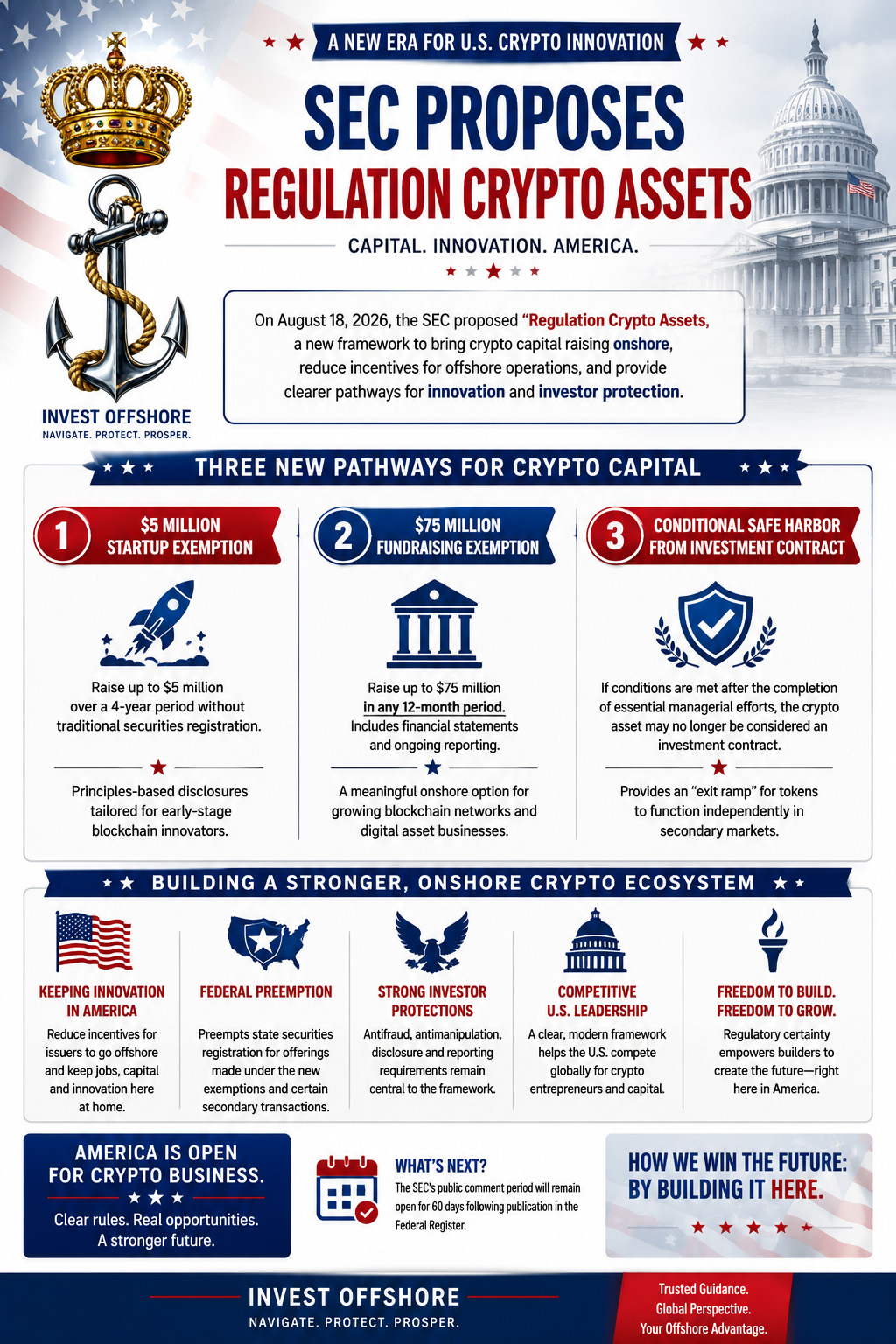
The U.S. Securities and Exchange Commission today proposed “Regulation Crypto Assets,” a new framework designed specifically for certain investment contracts involving crypto assets. Rather than attempting to squeeze token projects into securities rules written for conventional stocks and bonds, the SEC is proposing dedicated pathways through which crypto entrepreneurs could raise capital while remaining inside the American regulatory perimeter.
For Invest Offshore, the most interesting part may be the SEC’s stated objective: the Commission says the proposal is intended, in part, to reduce incentives for crypto issuers to create and operate offshore.
That represents a significant change in regulatory philosophy.
For much of crypto’s history, regulatory uncertainty encouraged entrepreneurs to look toward Switzerland, Singapore, the Cayman Islands, the British Virgin Islands, the UAE and other jurisdictions offering clearer frameworks for token issuance and digital-asset businesses. Regulation Crypto Assets is effectively Washington saying: America wants some of that business back.
Three New Doors for Crypto Capital
The proposed regulation revolves around three important mechanisms.
1. The $5 Million Startup Exemption
The first would create a one-time exemption allowing qualifying projects to raise up to $5 million during a four-year period without completing a conventional Securities Act registration.
This is essentially a regulatory runway for early-stage blockchain developers.
Both this exemption and the larger fundraising exemption would require issuers to provide investors with principles-based narrative disclosures. SEC Commissioner Hester Peirce described the concept as a capital-raising pathway better tailored to the unique characteristics of crypto projects.
Instead of forcing a startup blockchain network into disclosure architecture designed decades before Bitcoin existed, the SEC appears willing to recognize that crypto projects require their own framework.
2. The $75 Million Fundraising Exemption
The second proposed exemption is considerably larger.
A qualifying issuer could raise up to $75 million during each 12-month period. Issuers using this pathway would face additional requirements, including financial statements and ongoing reporting obligations.
That $75 million threshold is important.
This is no longer merely a sandbox for tiny experimental token projects. It potentially creates a meaningful American fundraising channel for blockchain infrastructure companies, decentralized networks and other digital-asset ventures that previously might have structured their capital raises offshore.
The tradeoff is straightforward: greater fundraising capacity in exchange for greater disclosure.
The Bigger Breakthrough: When Does the Investment Contract End?
The third element may ultimately prove the most important.
Regulation Crypto Assets proposes a conditional safe harbor from the term “investment contract.” If an issuer satisfies the prescribed conditions after completing or permanently ceasing the essential managerial efforts it promised investors, the underlying crypto asset could be deemed no longer subject to an investment contract for purposes of the federal securities laws.
That addresses one of crypto regulation’s most persistent questions.
A token and the transaction used to sell that token are not necessarily the same legal thing.
The SEC and CFTC moved toward formally recognizing that distinction in March 2026. The SEC’s interpretation identified digital commodities, digital collectibles, digital tools and qualifying payment stablecoins as categories that are not themselves securities, while recognizing that even a non-security crypto asset can become involved in an investment contract depending upon how it is offered and the promises made by its promoters.
Regulation Crypto Assets attempts to answer the next question:
How does that investment contract eventually end?
That matters enormously to secondary markets.
If a blockchain network matures, the development commitments underlying the original capital raise are completed and the token becomes independently functional, market participants need to know whether that token can circulate without carrying its original securities-law baggage forever.
The proposed safe harbor attempts to establish that exit ramp.
Washington Is Trying to Reverse Crypto Offshoring
Perhaps the most revealing sentence in the SEC announcement has little to do with Howey tests or registration thresholds.
The Commission explicitly says the proposed rules are designed to “reduce incentives for issuers to create and operate offshore.”
That is an extraordinary acknowledgment of what regulatory competition looks like in a digital economy.
Capital is mobile.
Software is mobile.
Developers are mobile.
Tokens are extraordinarily mobile.
When one jurisdiction makes a legitimate financial activity excessively difficult to conduct, that activity does not necessarily disappear. Frequently, it moves.
SEC Chairman Paul Atkins has been signaling this shift for months. In March, he described Regulation Crypto Assets as a way to create bespoke capital-raising pathways while Congress continued work on broader digital-asset market-structure legislation. He specifically framed the initiative as a means of giving American entrepreneurs greater regulatory certainty.
Now the concept has moved from speech to formal rule proposal.
State-Level Barriers Could Also Fall
There is another provision that deserves attention.
The proposed regulation would preempt state securities registration and qualification requirements for securities issued under its exemptions, along with certain qualifying secondary-market transactions.
That could be nearly as important as the federal exemptions themselves.
Digital assets operate nationally and globally, while American securities regulation can involve overlapping federal and state requirements. A uniform federal pathway could substantially improve the economics of compliant token issuance if the final regulation preserves this provision.
For entrepreneurs, lawyers, exchanges and institutional investors, regulatory certainty has an economic value of its own.
Offshore Finance Is Not Going Away
None of this means legitimate offshore financial centers suddenly become irrelevant.
There will continue to be valid reasons for international companies, funds, family offices and digital-asset businesses to operate through Switzerland, Luxembourg, Singapore, Dubai, Hong Kong and other financial centers.
Cross-border structuring is about far more than avoiding U.S. securities registration. It encompasses taxation, custody, banking, investor geography, fund domiciliation, asset protection, regulatory specialization and access to international capital.
What Regulation Crypto Assets could reduce is regulatory offshoring for its own sake — the decision to locate a crypto enterprise outside the United States primarily because nobody could determine with confidence what American securities regulators would do to it.
That distinction matters.
The Invest Offshore View
The significance of Regulation Crypto Assets is not that Washington has abandoned regulation.
It is that Washington may finally be recognizing regulatory competition.
The SEC is proposing to compete for entrepreneurs and capital by offering clearer rules: a $5 million startup pathway, a $75 million annual fundraising pathway and a mechanism through which a crypto asset can potentially separate from the investment contract under which it was originally distributed. Investor disclosure, financial reporting, antifraud and antimanipulation protections remain part of the structure.
That is a very different proposition from simply declaring everything a security and telling innovators to find a way through rules designed for another era.
But Regulation Crypto Assets is not law yet. It is a proposed rule and could change substantially before adoption. The SEC says the public-comment period will remain open for 60 days following publication of the proposing release in the Federal Register.
For investors watching the continuing convergence of traditional securities, tokenized assets and global offshore finance, August 18, 2026 may therefore become an important date.
America is no longer merely asking how to regulate crypto.
It is beginning to ask a much more competitive question:
How do we persuade the crypto economy to come home?
Leave a Reply