
Fidelity Investments manages approximately $7.1 trillion and administers roughly $18 trillion in total assets. When an institution of that scale starts describing finance in terms of programmable settlement, round-the-clock liquidity and tokenized assets, the digital-asset market should pay attention.
But the headline requires an important distinction.
The “$7+ trillion” figure refers to Fidelity’s managed assets—not a Fidelity prediction that XRP, blockchain infrastructure or tokenized finance will reach a $7 trillion valuation. Fidelity Digital Assets’ published base-case projection is that tokenized assets, excluding stablecoins, could reach approximately $1.4 trillion by 2030.
That clarification does not make the underlying thesis less important. It makes it more credible.
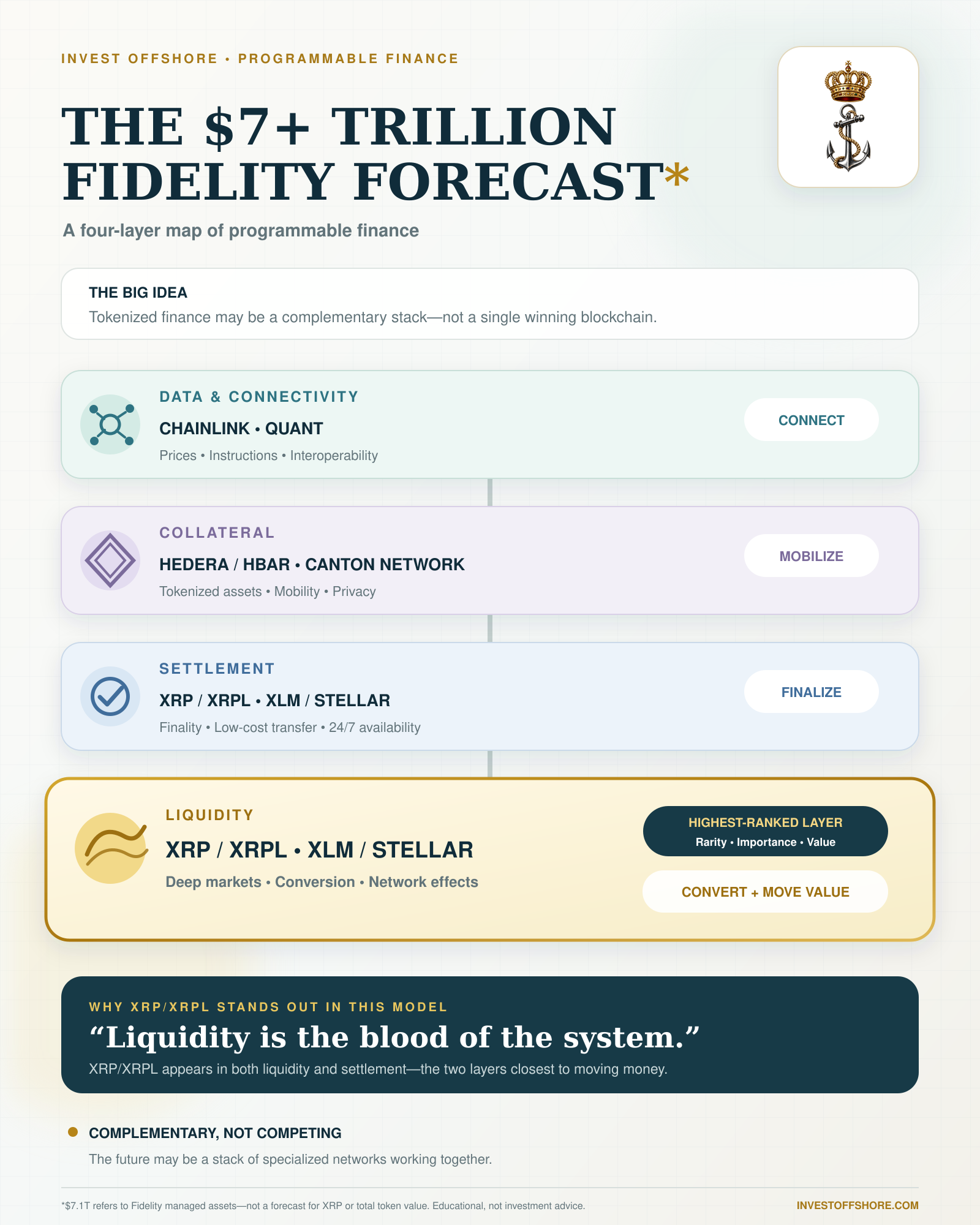
An infographic circulating alongside Fidelity’s research presents programmable finance as a four-part infrastructure stack:
| Function | Networks highlighted | Primary role |
|---|---|---|
| Liquidity | XRP/XRPL and XLM/Stellar | Converting value between assets, currencies and markets |
| Collateral | HBAR/Hedera and Canton Network | Mobilizing tokenized securities and other assets |
| Settlement | XRP/XRPL and XLM/Stellar | Completing transfers and establishing final ownership |
| Data and connectivity | Chainlink and Quant | Connecting blockchains, institutions and external information |
The important idea is not that one blockchain must defeat every other blockchain. It is that tokenized finance will probably require several specialized networks working together.
A Financial Stack, Not a Blockchain Horse Race
Traditional finance already operates through specialized layers. Exchanges provide markets. Banks supply liquidity. Clearinghouses manage counterparty obligations. Custodians hold assets. Settlement systems finalize transfers. Data providers distribute prices, interest rates and corporate information.
Programmable finance does not eliminate these functions. It attempts to make them faster, continuously available and interoperable.
Fidelity’s 2026 outlook describes the convergence of digital assets and capital markets as being driven by “programmable settlement, 24/7 liquidity, and borderless infrastructure.” Its tokenization research also identifies liquidity, interoperability and privacy as central conditions for broader institutional adoption.
The infographic translates those requirements into a possible blockchain architecture.
Liquidity: XRP Ledger and Stellar
Liquidity is the ability to exchange an asset quickly, in sufficient size and without causing an unacceptable change in price.
That makes liquidity more than a technical feature. It is an economic network.
The XRP Ledger was designed for payments, currency exchange and rapid settlement. XRP can function as a bridge asset between currencies or tokenized instruments, while XRPL’s native exchange infrastructure can connect issuers, market makers and payment providers. Ripple describes XRP as providing predictable liquidity for cross-border transfers that can settle within seconds.
Stellar approaches a similar problem through payments, tokenized assets and cross-asset transactions. Its network supports issued assets, a native decentralized exchange and path payments capable of converting between different assets during a transfer. Stellar now promotes its infrastructure for 24/7 settlement and liquidity, including tokenized securities and payment assets.
These networks overlap, but they are not identical. XRPL has concentrated heavily on institutional payments, exchange and liquidity. Stellar has emphasized accessible financial infrastructure, asset issuance and the connection between digital assets and local payment systems.
Collateral: Hedera and Canton Network
Tokenization becomes economically important when a digital asset can do more than sit in a wallet.
A tokenized Treasury, money-market fund or commodity could potentially be pledged as collateral, transferred between counterparties or used to secure financing without waiting for traditional markets and settlement windows to reopen.
Hedera provides native tokenization infrastructure with predictable fees, rapid finality and compliance-oriented controls. A notable institutional example involved Lloyds Banking Group, Aberdeen Investments and Archax using tokenized money-market fund units and UK government bonds as collateral for foreign-exchange transactions on infrastructure hosted on Hedera.
The Canton Network addresses the same opportunity from an institutionally focused direction. Canton combines interoperability with transaction privacy, allowing regulated organizations to coordinate transactions without revealing every position and counterparty to the entire network.
In one Canton collateral-mobility pilot, 27 market participants executed more than 500 transactions across six workflows. The stated objective was to demonstrate how tokenized assets could improve collateral mobility, liquidity and transactional efficiency.
Hedera can therefore be viewed as an efficient public tokenization and asset-control layer, while Canton is positioned as privacy-enabled infrastructure connecting institutional applications and pools of regulated collateral.
Settlement: XRP Ledger and Stellar Return
Settlement is where a transaction becomes final: the buyer receives the asset, the seller receives payment and the corresponding ownership records are updated.
This is why XRP Ledger and Stellar appear twice in the framework.
Both networks were designed around the movement and exchange of value rather than treating payments as an application added later. XRPL offers rapid finality, low transaction costs and native payment capabilities. Stellar similarly combines issued assets, exchange functionality and fast settlement.
Their dual role in liquidity and settlement is strategically significant. A network that can both locate or facilitate conversion liquidity and complete the resulting transfer may reduce the number of intermediaries required in a transaction.
Within the infographic’s framework, this places XRP/XRPL in the most prominent position. It is not merely described as a ledger recording the final transaction. It is positioned as part of the mechanism that helps value move from one asset, currency or market into another.
That is a much larger ambition.
Data and Connectivity: Chainlink and Quant
Blockchains cannot independently know the price of a bond, whether a payment has cleared through a banking system, whether a borrower remains compliant or what interest rate should be applied to a financial contract.
They need trusted data and connections to other systems.
Chainlink supplies decentralized data, computation and cross-chain connectivity. Its infrastructure is designed to move information and instructions among public blockchains, private networks and established financial systems. Chainlink describes institutional interoperability as the ability to connect digital assets, payment rails and legacy systems within a common programmable environment.
Quant addresses connectivity from an enterprise and banking perspective. Its Overledger technology is designed to connect multiple distributed ledgers and traditional financial infrastructure without requiring an institution to rebuild its systems around a single blockchain. Quant describes its role as connecting banking systems and blockchain networks to support programmable payments, tokenized settlement and cross-chain liquidity.
Chainlink may become the data and orchestration layer, while Quant may provide institutions with an abstraction layer for operating across different networks. Both functions become more valuable as the number of tokenized assets and specialized ledgers increases.
Why Liquidity Ranks Highest
According to the infographic, liquidity ranks highest in rarity, importance and potential economic value.
That argument makes sense because assets can be created more easily than liquid markets.
A company can issue a tokenized bond. A bank can develop a permissioned ledger. A fund can publish its ownership register on-chain. But none of those actions guarantees that buyers and sellers will be available at the same time, at competitive prices and in sufficient size.
Liquidity develops through network effects:
- More participants create deeper markets.
- Deeper markets reduce spreads and slippage.
- Lower trading costs attract more transactions.
- Greater transaction volume attracts additional market makers.
- More market makers deepen liquidity again.
Once this cycle becomes established, it can be difficult for a competing network to reproduce.
That is why liquidity can be described as the blood of programmable finance. Collateral may provide the assets. Settlement may complete the transfer. Data may tell the system what should happen. Connectivity may carry the instructions.
But liquidity allows value to move between them.
Every tokenized exchange ultimately depends on someone—or some automated market—to accept one asset and provide another.
Why XRP Occupies the Centre of the Thesis
The strongest interpretation of the infographic is not simply that XRP transactions are fast. Many blockchains can process transactions quickly.
The more important proposition is that XRP could operate as a neutral bridge asset across fragmented pools of tokenized value.
Imagine a future containing bank-issued deposit tokens, regulated stablecoins, tokenized government bonds, gold tokens, private-credit instruments and central-bank digital currencies. These assets may exist on different public and permissioned networks under different regulatory regimes.
A bridge asset would not need to replace them. It would need to provide temporary liquidity between them.
That is the role the infographic assigns to XRP: not necessarily the asset everyone holds permanently, but the asset that may be used when value must cross from one financial pool into another.
XRPL’s native exchange, payment pathways and rapid settlement support that theory. Ripple is also developing institutional DeFi capabilities, including compliance tools and permissioned exchange infrastructure.
However, infrastructure potential should not be confused with guaranteed adoption or token appreciation. Institutions may choose stablecoins, tokenized commercial-bank deposits, central-bank money or closed liquidity arrangements instead. Regulatory treatment, custody, market depth and counterparty standards will determine which solutions are used.
Complementary Networks Could Be the Real Forecast
The most interesting message in the framework may be that programmable finance is not a winner-takes-all market.
A transaction could use:
- Chainlink to deliver prices, reference data and cross-chain instructions;
- Quant to connect a bank’s existing systems with several distributed ledgers;
- Hedera or Canton to tokenize and mobilize institutional collateral; and
- XRPL or Stellar to provide conversion liquidity and settle the payment.
Each network would solve a different problem inside the same transaction.
This modular architecture resembles the internet, where specialized protocols perform different jobs while still contributing to a unified experience. Users do not need to understand every protocol. They simply expect the system to work.
Financial institutions will expect even more: legal certainty, privacy, predictable costs, regulatory compliance, qualified custody, deep liquidity and operational resilience.
The Invest Offshore Perspective
The $7.1 trillion attached to Fidelity gives the discussion scale, but it should not be mistaken for a crypto valuation forecast.
The real signal is that one of the world’s largest financial institutions now treats tokenization, programmable settlement and continuous liquidity as serious components of future market infrastructure.
Fidelity’s own research warns that tokenized markets remain fragmented and that many tokenized assets trade with less liquidity than their underlying traditional markets. That weakness may be precisely why the liquidity layer has the greatest potential value.
Within the infographic’s architecture, XRP/XRPL holds the strongest position because it appears in both liquidity and settlement—the two functions closest to the actual movement of money. Stellar shares those functional categories, while Hedera, Canton, Chainlink and Quant provide complementary collateral, data and connectivity capabilities.
The future of tokenized finance may not be controlled by the blockchain that creates the most assets.
It may be controlled by the networks capable of connecting those assets, supplying reliable liquidity and completing regulated transactions at institutional scale.
If liquidity is the blood of programmable finance, the decisive competition is only beginning.
This article is for informational purposes only and does not constitute investment, legal or financial advice. Digital assets are volatile, and infrastructure adoption does not guarantee an increase in the value of any associated token.
Leave a Reply