
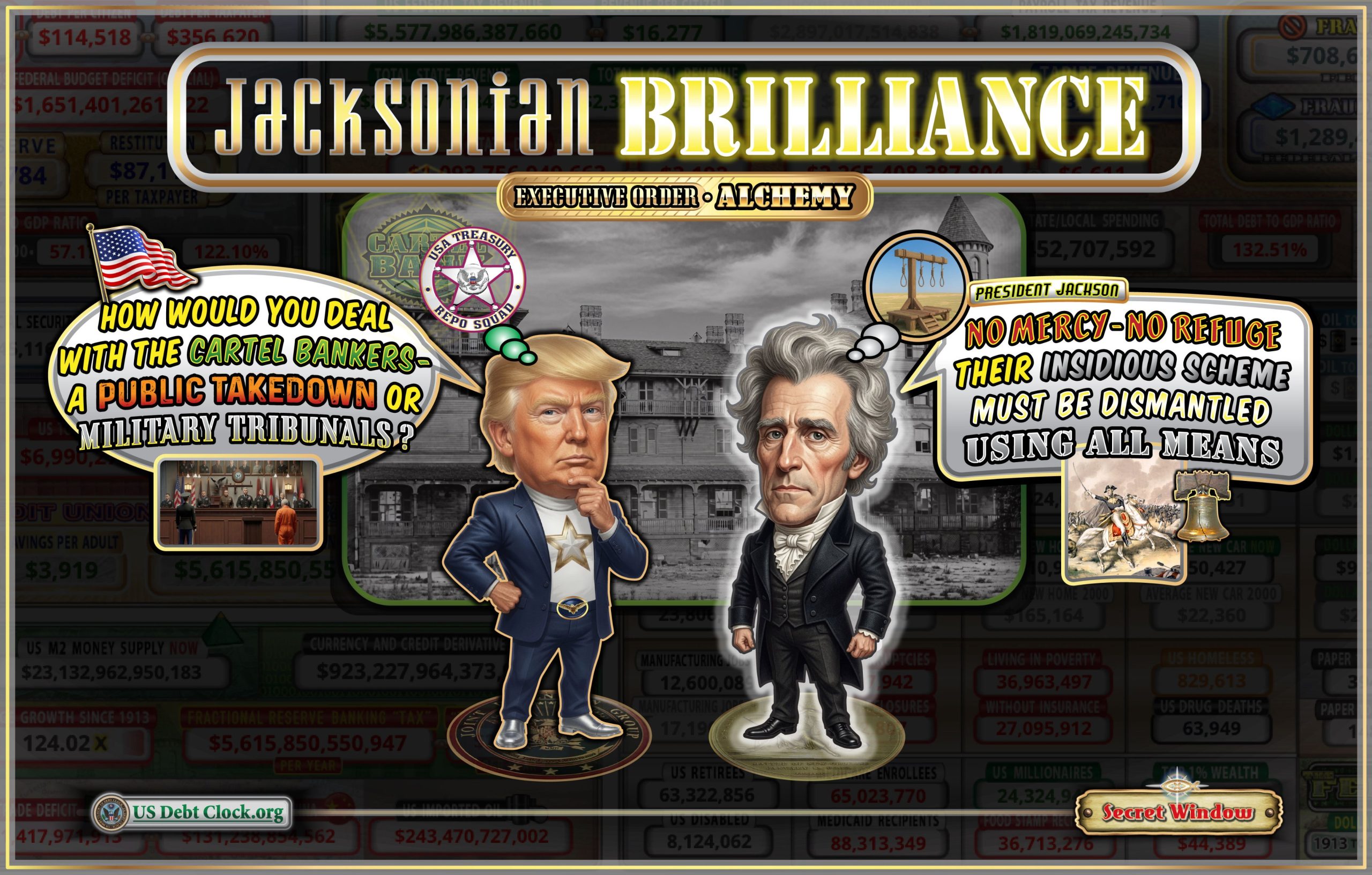
The US Debt Clock has released another “Secret Window” poster, and this one brings DJT back for the third time in the unfolding New Money Revolution storyline.
The title says it all:
Jacksonian Brilliance
Executive Order • Alchemy
This time, the setting is darker, sharper, and more historical. DJT stands beside President Andrew Jackson, the original American bank fighter, while the poster asks:
“How would you deal with the cartel bankers — a public takedown or military tribunals?”
Jackson’s answer is written like a frontier judgment:
“No mercy — no refuge. Their insidious scheme must be dismantled using all means.”
This is not subtle monetary commentary. This is a full dramatic escalation.
Why Andrew Jackson Matters
Andrew Jackson is not included by accident.
Jackson’s fight against the Second Bank of the United States became one of the most famous bank wars in American history. Federal Reserve History describes Jackson as a determined opponent of the Second Bank, and notes that his 1832 veto helped foreshadow the Bank’s eventual demise. (Federal Reserve History)
That is the historical key to this poster.
The Debt Clock is comparing today’s battle against the Federal Reserve-era banking structure with Jackson’s old battle against the Second Bank.
In other words:
Jackson killed the bank.
The Debt Clock is asking whether DJT is being positioned to kill the modern banking cartel.
That is the meaning of “Jacksonian Brilliance.”
The Third DJT Poster: From Question to Operation to Judgment
This new poster follows two earlier Debt Clock messages.
First came “The Battle Is On,” where DJT asked for the new 100% asset-backed Treasury Dollar.
Then came “REPO Wonderland,” where the focus shifted to a possible cartel asset seizure operation and the search for hidden collateral.
Now comes “Jacksonian Brilliance.”
This third poster moves the narrative into historical confrontation. It is no longer only about designing new money. It is about dismantling the old money power.
The sequence is clear:
Poster one: Where is the new Treasury dollar?
Poster two: How is the asset recovery operation going?
Poster three: How do you deal with the cartel bankers?
That is a storyline.
Executive Order • Alchemy
The recurring phrase “Executive Order • Alchemy” appears again.
Alchemy is the symbolic transformation of base metal into gold. In the Debt Clock’s language, it means transforming a debt-backed financial system into an asset-backed monetary system.
The old model is debt, interest, taxation, inflation, and banking control.
The new model being hinted at is Treasury issuance, asset backing, gold, silver, sovereign reserves, lower interest, and restored public ownership of national wealth.
That is the “alchemy.”
It is not magic. It is balance-sheet transformation.
The “Cartel Bank” Target
The poster again shows the Cartel Bank symbol in the background.
That has become one of the Debt Clock’s central villains. It represents the old monetary order: private banking privilege, central-bank power, fractional-reserve leverage, debt creation, and interest extraction.
Historically, the modern Federal Reserve System was created in 1913 when President Woodrow Wilson signed the Federal Reserve Act into law. (Federal Reserve History) The Debt Clock’s posters repeatedly point back to 1913 as the birth year of the current debt-money regime.
The message is simple: the old system was built by statute, and the new system may require executive and Treasury-level action to unwind it.
Public Takedown or Military Tribunals?
This line is intentionally dramatic. It should be read as political theater and monetary symbolism, not as an official legal announcement or a call for public action.
The Debt Clock is using courtroom and battlefield imagery to say that the old banking order is being placed on trial in the court of public opinion.
The real question is not about spectacle.
The real question is accountability.
Who created the debt?
Who collected the interest?
Who benefited from inflation?
Who controlled the rails?
Who held the collateral?
Who knew the system was unsustainable?
Who pays when it breaks?
That is the trial the poster is staging.
The Jacksonian Meaning
Jacksonian politics was rough, direct, populist, and deeply suspicious of concentrated financial power.
In this poster, Jackson represents the old American instinct that money should not be controlled by a protected financial elite. He represents the idea that public credit must serve the people, not a banking class.
The Debt Clock is borrowing that symbolism and applying it to the modern moment.
Its message is:
The Second Bank had its Jackson.
The Federal Reserve system may now have its challenger.
The battle is not only political.
It is monetary.
Why Offshore Investors Should Pay Attention
For Invest Offshore readers, this matters because the U.S. dollar is not just America’s currency. It is the foundation of global settlement, offshore banking, commodity pricing, sovereign reserves, and cross-border capital flows.
If the United States moves toward any serious debate about asset-backed money, Treasury-led issuance, gold revaluation, state credit systems, banking reform, or debt restructuring, the offshore world changes.
Gold changes.
Silver changes.
Treasury markets change.
Private banking changes.
Cash redemption rumors change.
Collateral strategy changes.
Offshore asset protection changes.
Even if the posters are symbolic, the symbolism is becoming more specific.
Conclusion: The Bank War Returns
The US Debt Clock’s “Jacksonian Brilliance” poster is the third act in a growing monetary drama.
The first poster asked for the new money.
The second poster searched the vault.
The third poster brings in Andrew Jackson and asks how to dismantle the cartel.
That is the decode.
This is not just about DJT. It is about the return of the Bank War — updated for Treasury dollars, digital rails, gold reserves, sovereign assets, and a public waking up to the cost of debt.
The Debt Clock is saying the old system is no longer merely being criticized.
It is being challenged.
And with Jackson now standing beside DJT, the message is unmistakable:
The New Money Revolution has found its historical precedent — and the battle over who controls money is back on the table.
Leave a Reply