
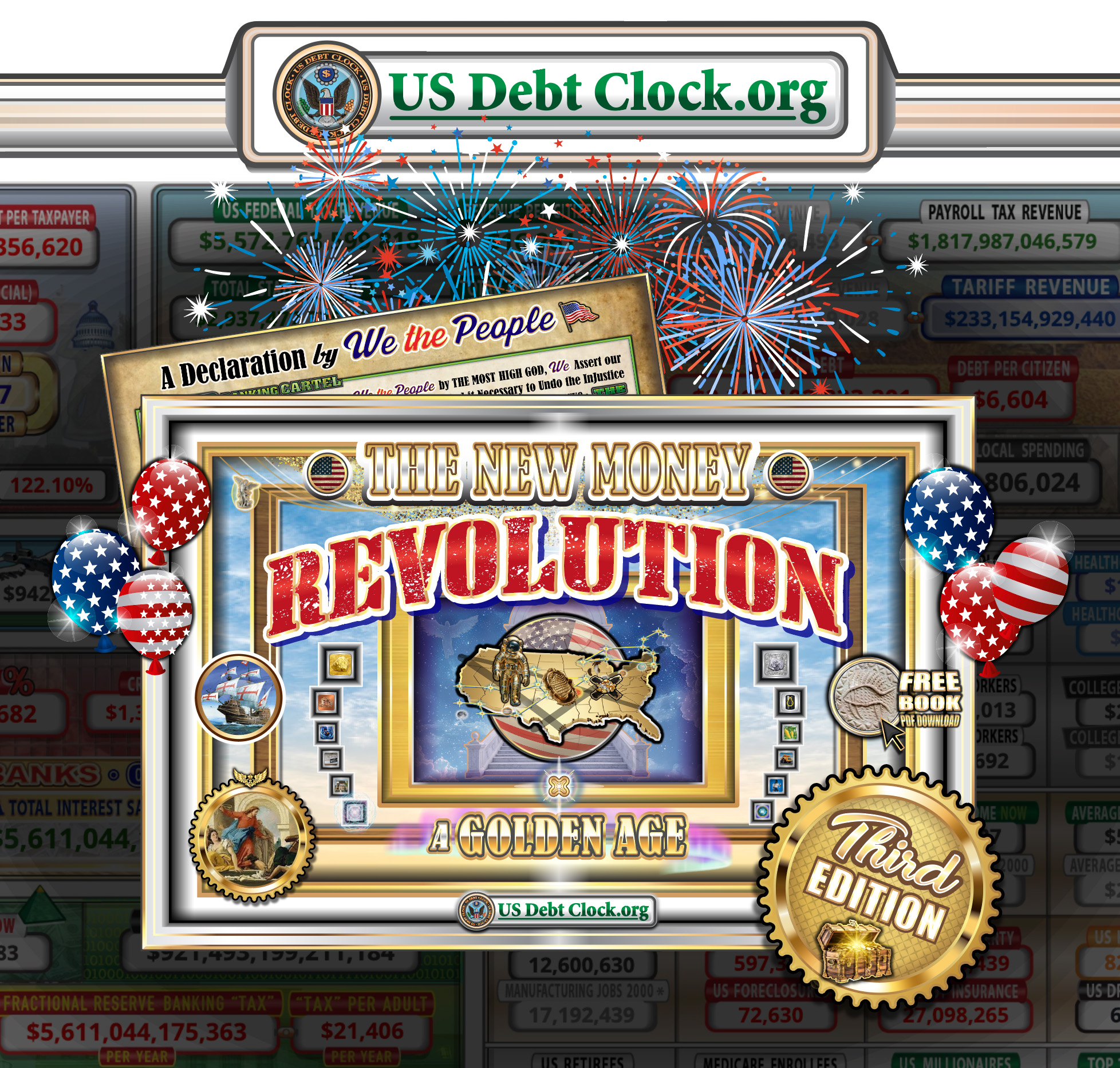
The US Debt Clock’s Fourth of July post arrives like a financial fireworks display.
Behind the familiar national debt dashboard, the image explodes with red, white, and blue celebration. In the foreground sits the headline:
The New Money Revolution
A Golden Age
Third Edition
There is also a document tucked behind the poster titled “A Declaration by We the People.” That detail matters. This is not merely a patriotic graphic. It is designed to look like a monetary declaration of independence.
The message is clear: the next American revolution may not be fought with muskets, tea crates, or colonial pamphlets. It may be fought through money, debt, taxation, banking, sovereign credit, gold, silver, and public ownership of the national balance sheet.
The Fourth of July Signal
The timing is everything.
July 4 is the day America celebrates political independence. The Debt Clock’s poster points toward something different: financial independence.
In its attached New Money Revolution: Third Edition, the Debt Clock frames the entire story as a battle between a Federal Reserve debt-money dollar and a proposed USA Treasury Dividend Dollar. The PDF repeatedly contrasts debt-based money, interest, banking control, and taxation against asset-backed public wealth, sovereign reserves, state credit unions, and what it calls a new ownership society.
That is why the image includes fireworks. It is not just decoration. It is a visual announcement: the monetary conversation has entered revolutionary language.
From Debt to Wealth
For decades, Americans have watched the Debt Clock climb higher.
National debt.
Consumer debt.
Mortgage debt.
Student debt.
Credit card debt.
Interest on debt.
Tax revenue.
Unfunded liabilities.
But this poster flips the script. It does not focus on fear. It focuses on restoration.
The New Money Revolution is the idea that America’s future should not be built on endless borrowing from the future, but on unlocking national wealth already present in the system: gold, silver, land, energy, infrastructure, technology, productive labor, and sovereign credit.
That is the “Golden Age” message.
It suggests a transition from a debt-based society to an asset-based society.
The Declaration Behind the Poster
The most important clue is the parchment behind the main graphic.
The phrase “A Declaration by We the People” borrows the emotional weight of 1776. It positions monetary reform as the unfinished business of American independence.
The original Revolution asked: who has the right to govern?
The new revolution asks: who has the right to issue money, collect interest, tax production, and control national credit?
That is a much bigger question than politics. It goes straight to the operating system of the economy.
The Debt Clock’s Core Argument
The Debt Clock’s thesis appears to be this:
The old system turned money into debt.
Debt created interest.
Interest required taxes.
Taxes weakened citizens.
Banks controlled credit.
The public carried the obligation.
Private institutions captured the benefit.
The proposed new system reverses that logic:
Money becomes sovereign credit.
Credit is tied to national assets.
Interest falls.
Taxes can be reduced.
States gain stronger financial independence.
Citizens become stakeholders.
The national balance sheet is restored.
That is the meaning of the phrase New Money Revolution.
Why Offshore Investors Should Care
For Invest Offshore readers, this is not just a domestic American story.
The U.S. dollar is the world’s reserve currency. If America changes the way it thinks about money, debt, gold, Treasury issuance, digital settlement, or public credit, the entire offshore world must adjust.
Gold changes.
Silver changes.
Bitcoin changes.
Treasury markets change.
Private banking changes.
Tax planning changes.
Sovereign wealth structures change.
Offshore asset protection changes.
The offshore investor should not read this poster as official law. It is not. It should be read as a signal of the growing narrative around monetary reset, sovereign wealth, and asset-backed finance.
Narratives matter because capital moves before policy is fully visible.
The Fourth of July Meaning
The visual message is brilliant because it connects three American ideas:
Independence — freedom from outside control.
Restoration — returning stolen or lost value.
Revolution — replacing a failing system with a new one.
That is why the poster feels larger than a financial meme. It is telling Americans to stop seeing themselves as debtors and start seeing themselves as owners.
Owners of land.
Owners of production.
Owners of national credit.
Owners of the future.
That is a powerful psychological shift.
Conclusion: A Declaration of Monetary Independence
The US Debt Clock’s Fourth of July post should be understood as a declaration of monetary independence.
It says the old revolution freed the nation politically. The new revolution must free the nation financially.
Whether this becomes policy, campaign language, Treasury reform, or simply another chapter in the Debt Clock’s growing mythology, the message is unmistakable:
America is no longer only counting debt.
America is beginning to count wealth.
And if the Debt Clock is right, the next great American chapter will not be called collapse.
It will be called restoration.
The New Money Revolution has entered the Fourth of July stage — and the fireworks may only be beginning.
Leave a Reply