
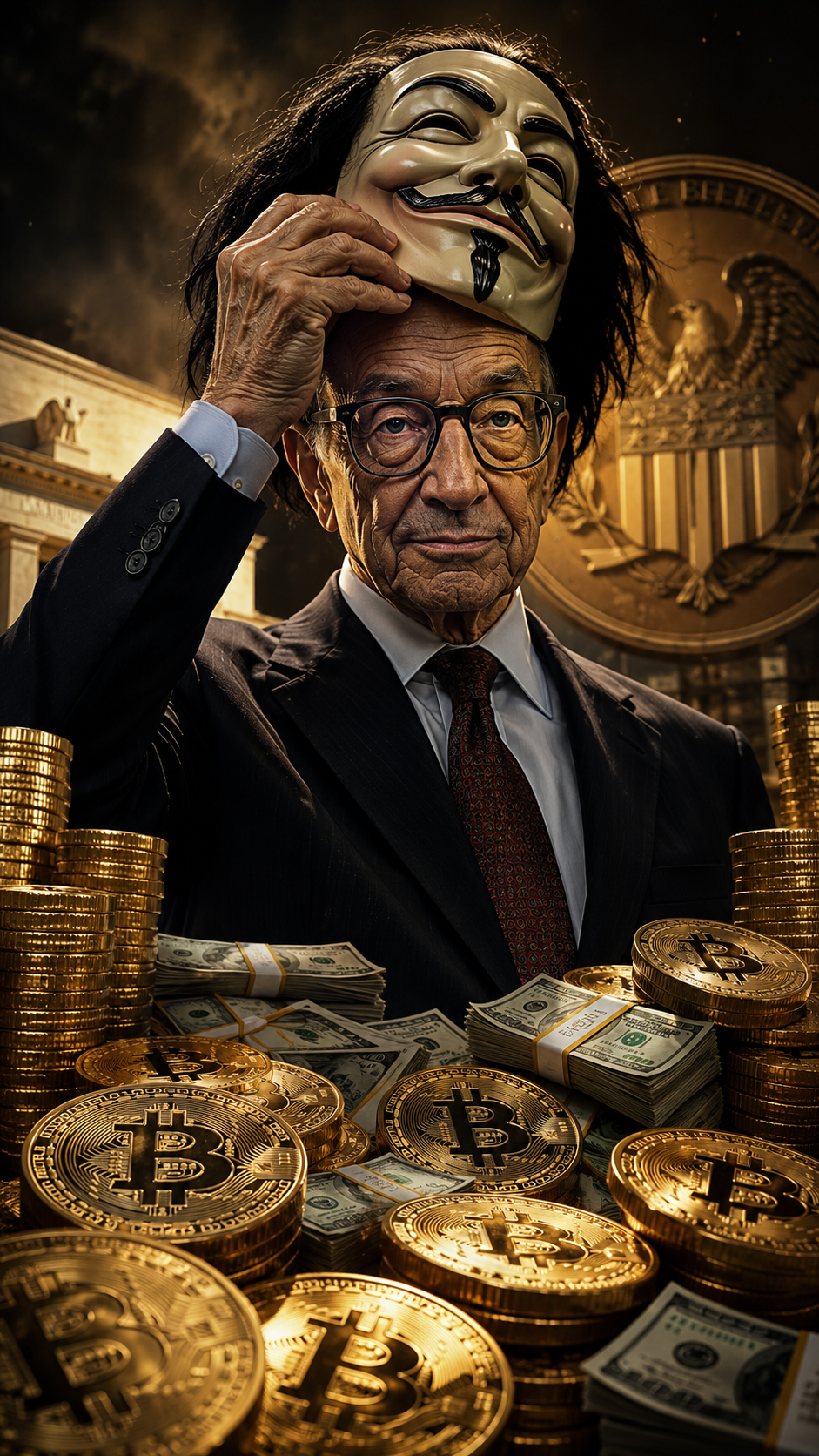
Alan Greenspan, the former Chairman of the Federal Reserve and one of the most consequential financial figures of the modern era, has passed away at the age of 100. For nearly two decades, Greenspan sat at the center of American monetary power. He was the face of the Federal Reserve through market crashes, bubbles, booms, geopolitical shocks, and the long march toward the financial system we live inside today.
To most of the world, Greenspan will be remembered as “The Maestro” — the central banker whose language moved markets, whose rate decisions shaped global capital flows, and whose legacy remains fiercely debated after the 2008 financial crisis.

But in the darker corners of the internet, another question has never quite died:
Was Alan Greenspan somehow connected to the birth of Bitcoin?
To be clear, there is no public proof that Greenspan was Satoshi Nakamoto. There is no signed message, no leaked memo, no credible witness, and no forensic smoking gun tying him directly to the original Bitcoin code. The official mystery remains intact.
And yet, the theory has persisted for years because it touches three nerves at once: Greenspan’s early gold-standard philosophy, the strange timing of Bitcoin’s emergence after the financial crisis, and the enduring belief that a monetary invention of Bitcoin’s sophistication may not have been the work of one lone coder.
The Satoshi Name Game
The lightest version of the theory begins as an internet word game.
Some observers noticed years ago that the name “Satoshi Nakamoto” could be broken into pieces that appear to echo major Japanese technology brands:
SA from Samsung.
TOSHI from Toshiba.
NAKA from Nakamichi.
MOTO from Motorola.
Is this proof? Of course not. It is the kind of pattern recognition the internet loves — half joke, half cipher, half financial folklore.
But the reason the game endured is that Satoshi Nakamoto always sounded more like a carefully chosen mask than a normal attribution. Bitcoin was not launched by a celebrity founder. It was launched by a ghost. And when the ghost vanished, the world began searching for fingerprints.
That search eventually widened beyond cryptographers and software engineers. It moved into central banking, monetary history, intelligence theory, and the ideological war between hard money and fiat money.
That is where Alan Greenspan enters the myth.
Greenspan the Gold Bug
Long before Greenspan became the most powerful central banker in the world, he was an intellectual ally of Ayn Rand and a defender of the gold standard. In 1966, he wrote “Gold and Economic Freedom,” one of the most famous hard-money essays ever written by a future Federal Reserve chairman.
In that essay, Greenspan argued that gold and economic freedom were inseparable. He warned that deficit spending and paper money gave governments the power to quietly confiscate wealth through inflation. In other words, before Greenspan became the public guardian of fiat money, he understood the philosophical case against it.
This is the core of the Bitcoin-Greenspan theory.
Bitcoin is digital hard money. It has a fixed issuance schedule. It does not require a central bank. It does not need a trusted financial intermediary. It is not controlled by a government. Its monetary policy is enforced by code, not committees.
That sounds far closer to the young Greenspan’s gold-standard worldview than to the public role he later occupied as Chairman of the Federal Reserve.
The theory, therefore, is not that Greenspan coded Bitcoin alone in his bathtub. The more interesting version is that he may have been part of a small intellectual circle that understood the coming failure of fiat credibility and helped shape, inspire, or protect a digital alternative.
A founder does not always have to be the programmer. Sometimes the founder is the architect of the idea.
The 2008 Timing Problem
Bitcoin arrived in 2008, just as the global financial system was breaking.
Banks failed. Central banks intervened. Governments printed, guaranteed, bailed out, and backstopped the old order. Trust collapsed across the financial world.
Then, almost perfectly on cue, Bitcoin appeared.
The Bitcoin white paper proposed a peer-to-peer electronic cash system that allowed payments to move without going through a financial institution. It solved the double-spending problem through proof-of-work and a distributed network rather than a trusted third party.
For those who believe history is not random, the timing was too perfect.
This is where the “inside job” theory begins. Some people argue that Bitcoin was too elegant, too disruptive, and too strategically timed to have been released by a lone anonymous coder. They see it instead as a controlled monetary experiment — a test of digital scarcity, decentralized settlement, and post-crisis trust.
If Bitcoin was an inside job, Greenspan becomes an obvious suspect in the internet imagination. He had the economic mind. He had the institutional knowledge. He had the motive, at least ideologically, from his earlier gold-standard years. He also had decades of access to elite financial, academic, and government circles.
The theory does not require him to be Satoshi. It only requires him to have been close enough to the intellectual origin of Bitcoin to understand what it was before the public did.
The “No Intrinsic Value” Denial
One of the strangest pieces of the Greenspan-Bitcoin puzzle is his public dismissal of Bitcoin.
In 2013, Greenspan called Bitcoin a bubble and questioned where its intrinsic value came from. On the surface, that sounds like a clean rejection. But to conspiracy theorists, it sounded almost too clean.
Why would a lifelong monetary thinker who once defended gold so forcefully fail to recognize the gold-like properties of Bitcoin? Why would a man who understood the dangers of paper money dismiss the first successful non-sovereign digital monetary system?
The skeptical answer is simple: Greenspan did not believe Bitcoin was money. He believed it lacked backing. He believed it had no issuer, no claim, and no fundamental redemption value.
The conspiratorial answer is more theatrical: he had to deny it.
If Greenspan had been involved in Bitcoin’s intellectual birth, public dismissal would have been the perfect cover. The central banker could not openly bless the anti-central-bank asset. The Maestro had to play his public part.
Again, this is not proof. But it is exactly the kind of contradiction that keeps a theory alive.
Hidden in Plain Sight
Alan Greenspan was often portrayed as an old-world economist, but that image may have been incomplete. He was highly quantitative, deeply analytical, and operated for decades inside institutions with access to advanced computing, financial modeling, and mainframe infrastructure.
Bitcoin required cryptography, distributed systems, game theory, monetary theory, and a deep understanding of trust. Greenspan was not known publicly as a cryptographer, but he certainly understood money, incentives, inflation, banking, and systemic confidence.
That distinction matters.
The creation of Bitcoin was not merely a technical event. It was a monetary event. It was a direct challenge to the central banking model. Whoever created it understood that money is not only software, and not only economics, but belief.
Greenspan understood belief. He built a career on it.
The Verdict: Not Proven, But Not Forgotten
So was Alan Greenspan a founder of Bitcoin?
The honest answer is that we do not know.
The public record does not prove it. The code does not identify him. The Satoshi trail still points more naturally toward cypherpunks, cryptographers, privacy advocates, and open-source developers than toward a retired Federal Reserve chairman.
But the circumstantial fascination remains powerful.
Greenspan began as a hard-money intellectual, became the world’s most famous fiat central banker, presided over the era that helped produce the conditions for the financial crisis, and lived long enough to watch Bitcoin rise from an obscure white paper into a trillion-dollar monetary asset.
That arc is almost too perfect.
Perhaps Greenspan had nothing to do with Bitcoin. Perhaps he was simply one of history’s great monetary paradoxes: a gold bug who became the king of fiat, and then lived to see digital gold challenge the empire he once managed.
Or perhaps the internet’s favorite conspiracy theory contains a sliver of truth — not that Alan Greenspan was Satoshi Nakamoto, but that Bitcoin was born from the very monetary contradictions Greenspan embodied.
In that sense, whether he founded Bitcoin or not, Alan Greenspan helped create the world that needed it.
And that may be the most important clue of all.
Source notes: Greenspan’s death at 100 was reported today, with his Fed tenure from 1987 to 2006 and the later controversy over deregulation and the financial crisis noted in major coverage. (theguardian.com) Reuters also notes his Ayn Rand connection and his private, intellectual persona. (Reuters) The Bitcoin white paper itself was published under the name Satoshi Nakamoto and described peer-to-peer electronic cash without a financial institution. Greenspan’s 1966 “Gold and Economic Freedom” essay is the key text behind the “secret gold bug” angle. (Constitution Society) His 2013 public dismissal of Bitcoin as a bubble is part of what keeps the contradiction alive. (Business Insider)
Leave a Reply