
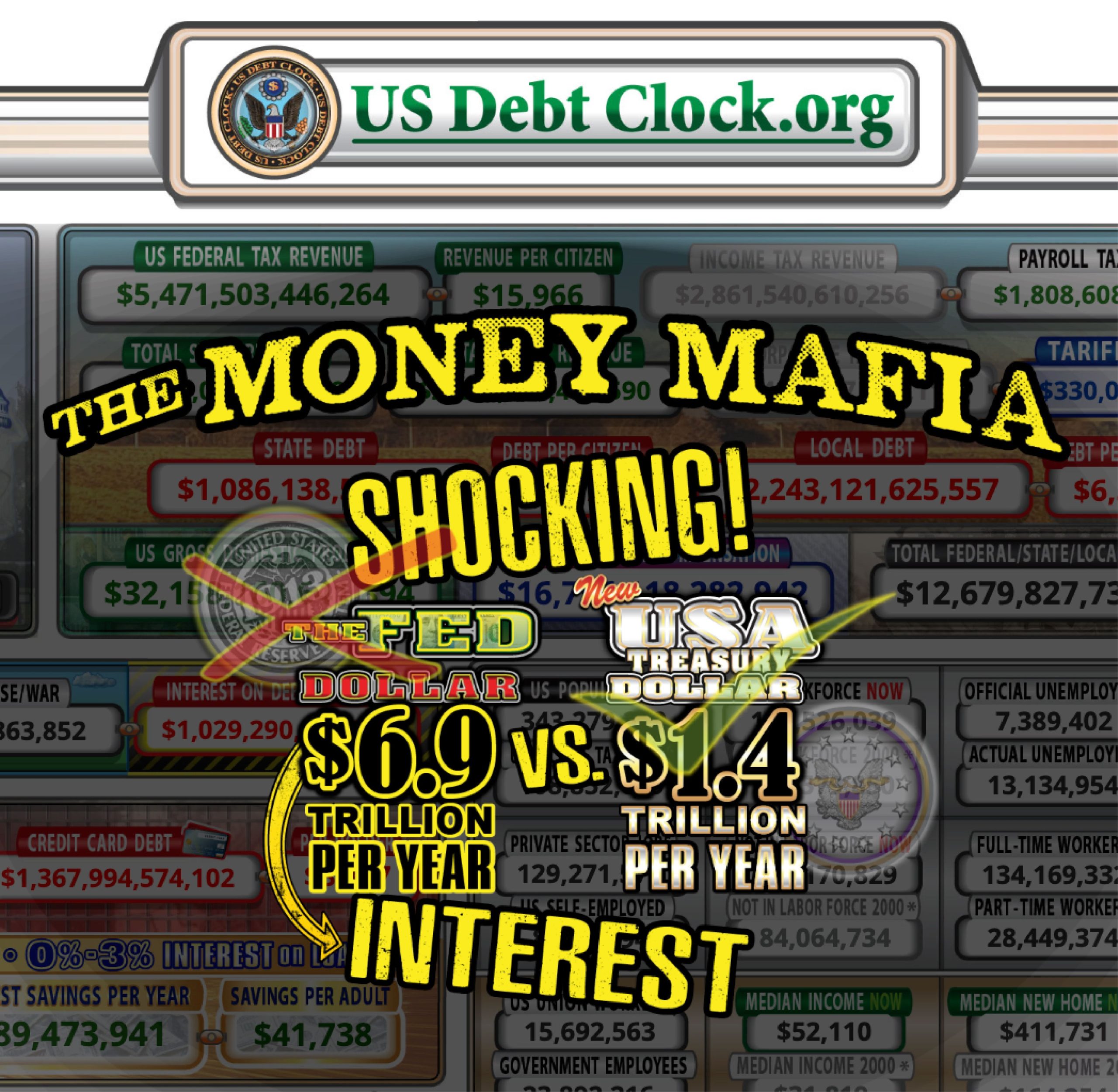
The latest US Debt Clock poster lands like a warning shot:
“The Money Mafia — Shocking!”
Behind the headline is the familiar Debt Clock dashboard: federal tax revenue, state debt, local debt, credit card debt, interest on debt, and the machinery of a nation drowning in numbers. In the foreground, the poster contrasts two currencies:
The Fed Dollar
$6.9 trillion per year interest
versus
The New USA Treasury Dollar
$1.4 trillion per year interest
The message is not subtle. It is accusing the existing dollar system of operating like a protection racket: debt is created, interest is charged, taxpayers carry the burden, and the productive economy pays tribute forever.
That is the core meaning of the phrase “Money Mafia.”
It is not necessarily a legal accusation. It is a metaphor for a system where money creation, debt issuance, central banking, commercial banking, taxation, and interest expense have become so intertwined that the average citizen no longer knows who is really in charge.
The Poster’s Central Question: Who Owns the Interest?
The Debt Clock is not just pointing at the national debt. It is pointing at the cost of carrying the debt.
As of May 26, 2026, TreasuryDirect listed total U.S. public debt at about $39.17 trillion. That includes roughly $31.45 trillion in debt held by the public and $7.72 trillion in government holdings. (TreasuryDirect)
That is the mountain.
Interest is the avalanche.
The Congressional Budget Office projects a $1.9 trillion federal deficit in fiscal year 2026, with rising net interest costs driving much of the long-term deterioration. CBO also projects debt held by the public rising from 101% of GDP in 2026 to 120% of GDP by 2036. (Congressional Budget Office)
So when the poster compares $6.9 trillion against $1.4 trillion, it is not giving a normal budget-office line item. It is dramatizing the difference between a high-interest debt machine and a lower-interest sovereign money model.
In other words:
The Fed Dollar means debt plus interest.
The Treasury Dollar means sovereign issuance with controlled interest.
That is the decode.
The Fed Dollar vs. The Treasury Dollar
Current U.S. paper currency is the Federal Reserve Note. The Federal Reserve itself states that Federal Reserve notes are obligations of the United States and receivable for taxes, customs, and public dues; courts have also held that Federal Reserve notes are lawful money. (Federal Reserve)
So legally, the existing dollar works.
But politically and financially, the Debt Clock poster is asking whether it works for the people.
The “Fed Dollar” represents the post-1913 central-bank model: Treasury borrows, the market buys, the Fed manages liquidity and interest rates, banks expand credit, and the taxpayer pays the bill.
The “New USA Treasury Dollar” represents the dream of a different system: money issued closer to the sovereign balance sheet, possibly linked to assets, productive credit, gold, energy, infrastructure, or national wealth rather than endless rollover debt.
That is why the poster uses the phrase “Shocking!”
It is trying to shock readers into realizing that the greatest budget line item may not be defense, welfare, or foreign aid.
It may be interest.
Why the Interest Number Matters
The U.S. government does not simply owe money. It must constantly refinance money.
Treasury bills mature. Notes mature. Bonds mature. New debt replaces old debt. When rates are higher, the rollover gets more expensive.
That is the trap.
Treasury’s own explanation is straightforward: interest expense depends on the total amount of federal debt and the interest rates investors charged when they loaned the money. (Fiscal Data)
The Debt Clock poster takes that dry accounting fact and turns it into a battle cry:
If the rate is the weapon, then interest is the tribute.
That is the “Money Mafia” concept.
Not men in dark suits in a smoky room. Something bigger. A structure. A machine. A system where every household, every business, every taxpayer, and every future generation is forced to service debt they did not personally negotiate.
The Federal Reserve’s Own Stress Signal
There is another clue.
The Federal Reserve’s H.4.1 report explains that when Federal Reserve Bank earnings are not enough to cover costs, dividends, and surplus requirements, a deferred asset is created. The Fed must earn enough in the future to eliminate that deferred asset before remittances to Treasury resume. (Federal Reserve)
Plain English: the central-bank machine that once sent profits back to Treasury has itself been caught in the interest-rate squeeze.
That does not mean the Fed is bankrupt in a normal corporate sense. It means the old model is no longer clean, simple, or politically easy to defend.
The public sees inflation.
The taxpayer sees debt.
The investor sees rollover risk.
The Treasury sees interest expense.
The Fed sees balance-sheet stress.
And the Debt Clock turns all of it into one phrase:
The Money Mafia.
What the Poster Is Really Predicting
The poster appears to predict a monetary pivot.
Not merely a tax cut.
Not merely a rate cut.
Not merely a new bill design.
A full change in the operating system of money.
The clues are all there: “Fed Dollar” fading, “New USA Treasury Dollar” emerging, interest falling, and the old debt dashboard pushed into the background.
The message is that America’s future may depend on moving from a debt-rent economy to a productive-credit economy.
A debt-rent economy taxes labor, inflates assets, rewards leverage, and transfers wealth through interest.
A productive-credit economy would reward manufacturing, energy, infrastructure, exports, savings, and real asset creation.
That is the philosophical heart of the Debt Clock poster.
The Invest Offshore View
For offshore investors, this poster should not be read as official policy. It should be read as a signal of narrative direction.
America is asking questions it avoided for decades:
Who benefits from the debt?
Who collects the interest?
Who controls the payment rails?
Who owns the collateral?
Who has the gold?
Who issues the money?
Who gets paid first?
Those are not fringe questions anymore. Those are balance-sheet questions.
And balance-sheet questions eventually become market questions.
If the United States moves toward a Treasury-centered, asset-backed, lower-interest monetary architecture, the implications would be enormous: gold, silver, Bitcoin, commodities, infrastructure finance, offshore structures, sovereign credit, and private capital would all be repriced.
Conclusion: Follow the Interest
The US Debt Clock’s “Money Mafia” poster is not about one villain. It is about one mechanism.
Interest.
Interest is the bloodstream of the old system.
Interest is the silent tax.
Interest is the chain around the sovereign balance sheet.
The poster’s decode is simple: America is being shown the difference between money issued as debt and money organized around national wealth.
The old dollar asks the citizen to pay tribute.
The new dollar, if it comes, must restore production, ownership, and sovereignty.
That is why this poster matters.
Because when the public finally understands the interest, the public finally understands the system.
And once the system is understood, the old magic stops working.
Invest Offshore continues to monitor the New Money Revolution, Treasury reform, gold, digital settlement, and sovereign infrastructure opportunities, including investment opportunities in West Africa and the Copperbelt Region.
Leave a Reply