
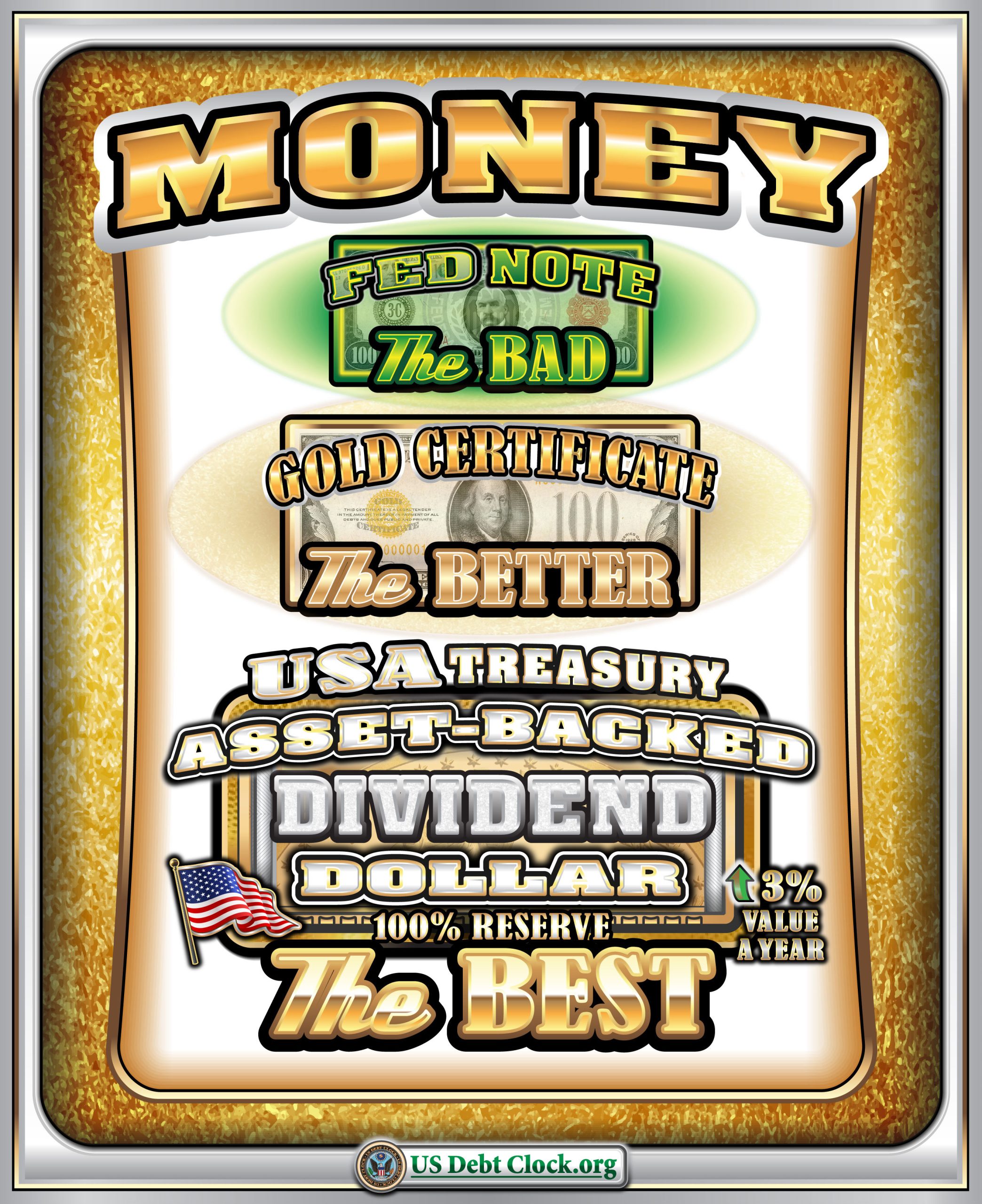
The April 29, 2026 US Debt Clock poster is framed like a simple ranking chart—almost a classroom diagram—but it’s really a manifesto for the New Money narrative.
Across the page it stacks three tiers:
- FED NOTE — “The Bad”
- GOLD CERTIFICATE — “The Better”
- USA TREASURY ASSET-BACKED DIVIDEND DOLLAR (100% reserve) — “The Best” (with a “+3% value a year” style claim)
In other words: the poster argues that money is evolving from debt-based paper, to asset-referenced paper, to a Treasury-led, asset-backed system designed to restore purchasing power and legitimacy.
Whether you read this as prophecy, persuasion, or just meme economics, the framing is crystal clear: the era of “trust me” money is being challenged by the idea of “show me” money.
The Bad: Fed Notes as a debt-based instrument
Calling the Federal Reserve Note “the bad” is the poster’s way of condemning a system where money is deeply intertwined with:
- credit expansion and contraction
- perpetual refinancing and debt rollovers
- an economy that must “grow” to service yesterday’s borrowing
- the steady, invisible transfer of purchasing power through dilution
In the New Money Revolution worldview, Fed notes represent a world where money is less like a receipt and more like a lever—pulled by policy, liquidity cycles, and bank balance sheets.
You can argue the Fed system has also stabilized crises and prevented deeper collapses—and that’s true. But the poster is focused on the cost: dependence on debt, and the long-term erosion of trust.
The Better: Gold certificates as “proof-of-value” language
The poster’s middle tier—Gold Certificates—isn’t just about nostalgia. It’s about architecture.
A gold certificate, historically, represented a claim on gold held somewhere else. The key concept is:
the money references a tangible asset.
That reference does two things psychologically:
- It forces the conversation back to scarcity and discipline.
- It reduces the sense that money is merely a political instrument.
Even if a future system isn’t literally redeemable in gold, the “gold certificate” idea signals a money regime that wants accountability—a chain of trust that can be checked.
The Best: “Asset-Backed Dividend Dollar” as a new operating system
The bottom tier—USA Treasury Asset-Backed Dividend Dollar, 100% reserve—is the poster’s “best” because it blends three themes that keep repeating across the US Debt Clock series:
1) Treasury-led legitimacy
This is a “sovereign issuance” story: money tied to a national balance sheet, not primarily to private credit creation.
2) Asset-backing as trust infrastructure
Not just one asset, but implied baskets of real value—commodities, productive capacity, strategic reserves—anything that can serve as collateral for credibility.
3) Dividend logic
This is the radical twist: rather than money being only a medium of exchange, it becomes part of a citizen-benefit system—an ownership-like concept where the public shares in national productivity.
That’s why the poster dares to suggest “+3% value a year.” It’s trying to flip the most emotional pain point in modern life—inflation—into its opposite: a currency that rewards holding and restores purchasing power.
Is that easy? No. But as a narrative, it’s powerful: money that doesn’t punish savers.
What this poster is really doing: simplifying the transition
The genius (and danger) of the graphic is that it makes a complex monetary debate feel like a simple upgrade path:
Bad → Better → Best.
And when you look at the broader series—“Gold Window,” “Payable to the Bearer on Demand,” “Sovereign Wealth Reserve,” “End the Fed,” “Wealth Tsunami”—you can see the storyline tightening:
- identify the problem (debt-based money)
- point to the historical anchor (gold, redemption)
- propose the new mechanism (asset-backed, reserve-driven, Treasury-led)
- add a political promise (dividend, citizen ownership, lower extraction)
It’s not presenting a policy memo. It’s presenting a belief system about where money is going next.
The 4th of July speculation: why that date keeps showing up
Now for the part everyone whispers about: July 4th.
In New Money Revolution circles, July 4th is a magnet for speculation because it’s the ultimate American symbolism date—independence, sovereignty, national reset energy. If you wanted to launch anything designed to be perceived as “restoring America’s financial independence,” the optics of that date are obvious.
But here’s the practical reality: the bigger the monetary shift, the less likely it is to be announced with a fireworks countdown.
If markets knew an exact “switch flip” date, you’d see front-running chaos:
- FX and rates volatility
- liquidity hoarding
- bank balance-sheet tightening
- speculative positioning and leveraged blowups
- a rush into hard assets and exit trades
So if July 4th ends up being relevant at all, the most plausible form is not a dramatic overnight replacement of everything. It would be something staged and operationally manageable, like:
- a symbolic announcement (language shift, framework reveal)
- a pilot program expansion
- a new class of Treasury instrument
- a settlement rail upgrade
- a “reserve” disclosure initiative
- or a legal/administrative milestone that signals direction without triggering a stampede
In other words: July 4th is perfect for messaging—while the real plumbing change happens quietly, in phases.
Bottom line
“Money, the Better, the Best” is the US Debt Clock’s clearest attempt yet to rank monetary regimes by trust:
- trust in policy (Fed notes)
- trust in tangible reference (gold certificates)
- trust in collateral + sovereignty + public benefit (asset-backed dividend money)
Whether July 4th becomes a headline moment or just another date in the rumor mill, the signal this poster is sending is consistent:
The next era of money is being marketed as more accountable, more asset-linked, and more citizen-facing than the debt-based model we’ve lived under.
Invest Offshore continues to track real-asset opportunities globally, including investment opportunities in West Africa seeking investors for the Copperbelt Region, plus verified gold for sale through our network and partners worldwide, and select mining concessions with documented title, geology, and clear pathways to production.
Leave a Reply