
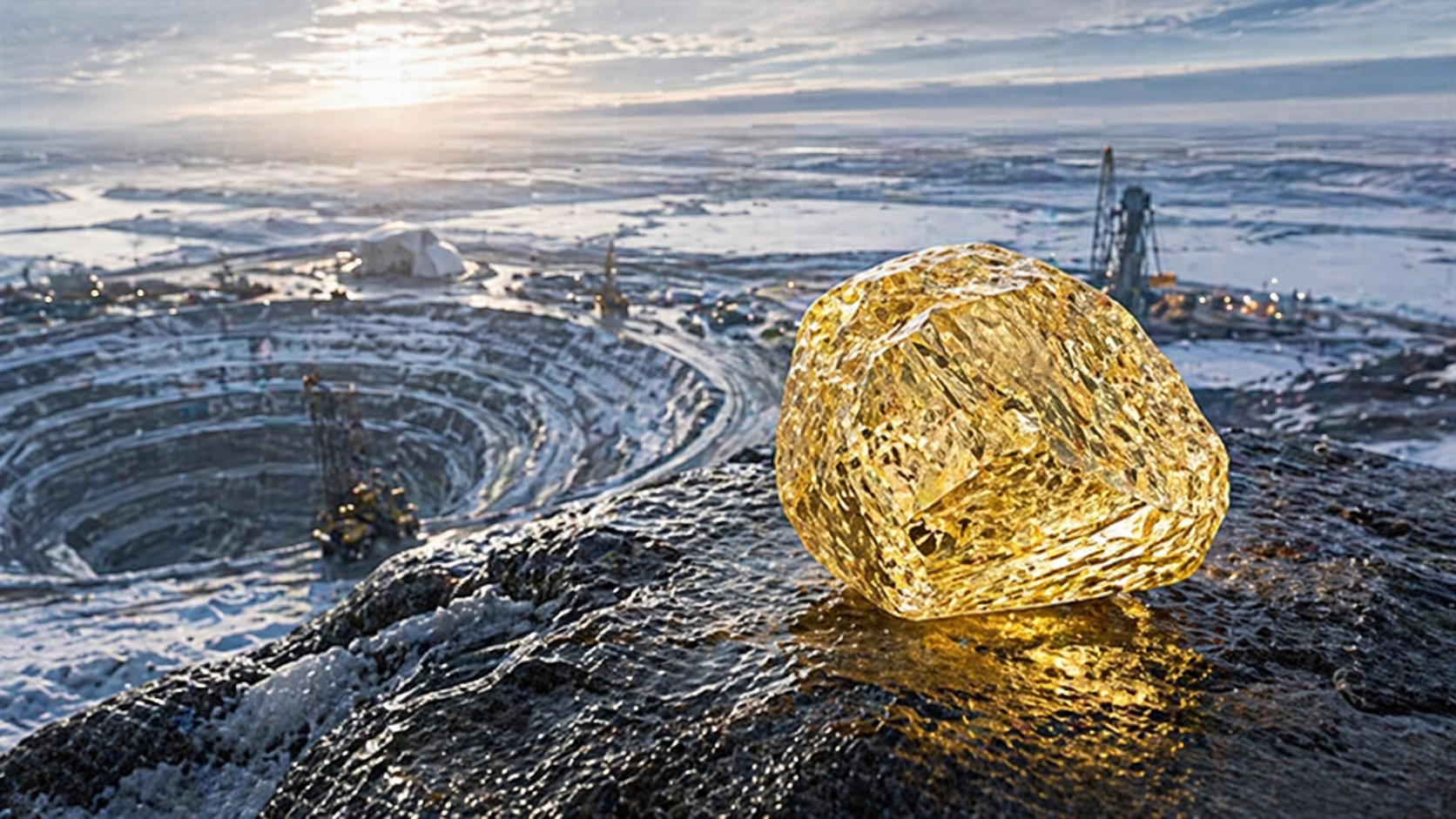
A 158.20-carat yellow diamond pulled from the Diavik Diamond Mine in Canada’s Northwest Territories is more than a rare geological event. It is a case study in how mineral wealth is discovered locally, financed globally, and ultimately transformed into national economic value.
Rio Tinto announced the discovery on April 1, 2025, describing the stone as one of the largest gem-quality yellow diamonds ever discovered in Canada. Diavik sits about 200 kilometers south of the Arctic Circle, in one of the most remote mining jurisdictions on earth. Yellow diamonds make up less than 1% of Diavik’s output, and this was only the fifth yellow diamond over 100 carats found there in the mine’s 22-year history. (Rio Tinto)
That is the headline. But the deeper story is capital.
A prospector may find the first clue. A geologist may follow the indicator minerals. A small syndicate of family, friends, and early believers may keep the dream alive through the risky years. But once a discovery moves from a claim on a map to a mine in production, the money becomes international. Exploration is local. Mining is global.
Diavik is a perfect example. Aber Resources discovered diamonds in kimberlite pipes beneath Lac de Gras in the mid-1990s; later, Rio Tinto developed and operated the mine, with Dominion Diamond holding 40% until Rio Tinto acquired the remaining interest in 2021. (Rio Tinto)
That is how the modern resource economy works. Canada supplies the geology, the rule of law, the skilled workforce, and the mining culture. Offshore capital supplies the scale. U.S. investors, international institutions, family offices, and global mining houses bring the balance sheet required to build roads, airstrips, energy systems, camps, environmental programs, Indigenous partnerships, processing plants, and long-term closure plans.
Canada and the United States are already joined at the hip economically. Canada’s own government describes the U.S. as Canada’s largest investor, while Canada is the second-largest investor in the United States. Nearly C$3.6 billion in goods and services crossed the border each day in 2024. (Global Affairs Canada)
That relationship matters in mining. It matters in diamonds. It matters in gold. It matters in copper, lithium, uranium, rare earths, and every strategic mineral required for the next century of industrial growth.
The Diavik diamond should remind investors of a simple truth: wealth is not created at the moment of discovery. Wealth is created when discovery meets structure.
A rock in the ground is geology. A claim is paperwork. A feasibility study is promise. A mine is capital, engineering, logistics, permitting, risk tolerance, and time.
Diavik was not easy money. It was remote, cold, expensive, and technically demanding. The mine was built in a sub-Arctic environment, off-grid, with seasonal access challenges. Rio Tinto later added renewable power infrastructure, including a 3.5 MW solar plant completed in 2024, designed to reduce diesel consumption and support closure work through 2029. (Rio Tinto)
That is the offshore investment lesson. Real assets require patient capital. The investor who waits until the diamond is already polished pays retail. The investor who enters when the prospector is still proving the ground takes the risk — and may own the upside.
Now Diavik has reached the end of production, with closure work beginning after its final operating phase. Cabin Radio reported in March 2026 that production had ended and closure work was moving forward, while noting Diavik’s legacy of major stones, including the 158.20-carat yellow diamond and the 552-carat yellow diamond found in 2018. (Cabin Radio)
The timing is almost poetic. One of Canada’s great diamond mines, nearing the end of its life, delivers a final yellow miracle from the frozen North. But for investors, the message is not nostalgia. It is strategy.
The next Diavik will not finance itself.
It may be a gold mine in Tanzania. A copper project in the DRC or Zambia. A lithium field in North America. A renewable-energy-backed mining corridor in West Africa. The pattern will be the same: local discovery, international capital, disciplined structure, compliant execution, and patient ownership.
For Invest Offshore readers, this is the opportunity zone. Offshore capital is not an escape hatch. Properly structured, it is a development engine. It connects private wealth with frontier geology. It moves projects from discovery to production. It turns family-backed exploration stories into national assets.
The diamond came from Canada. The lesson belongs to the world.
Invest Offshore continues to identify and present select investment opportunities in West Africa, including opportunities seeking investors for the Copperbelt Region.
Leave a Reply