
Something extraordinary is happening to the U.S. monetary system, and most people are still looking at the pieces instead of the whole picture.
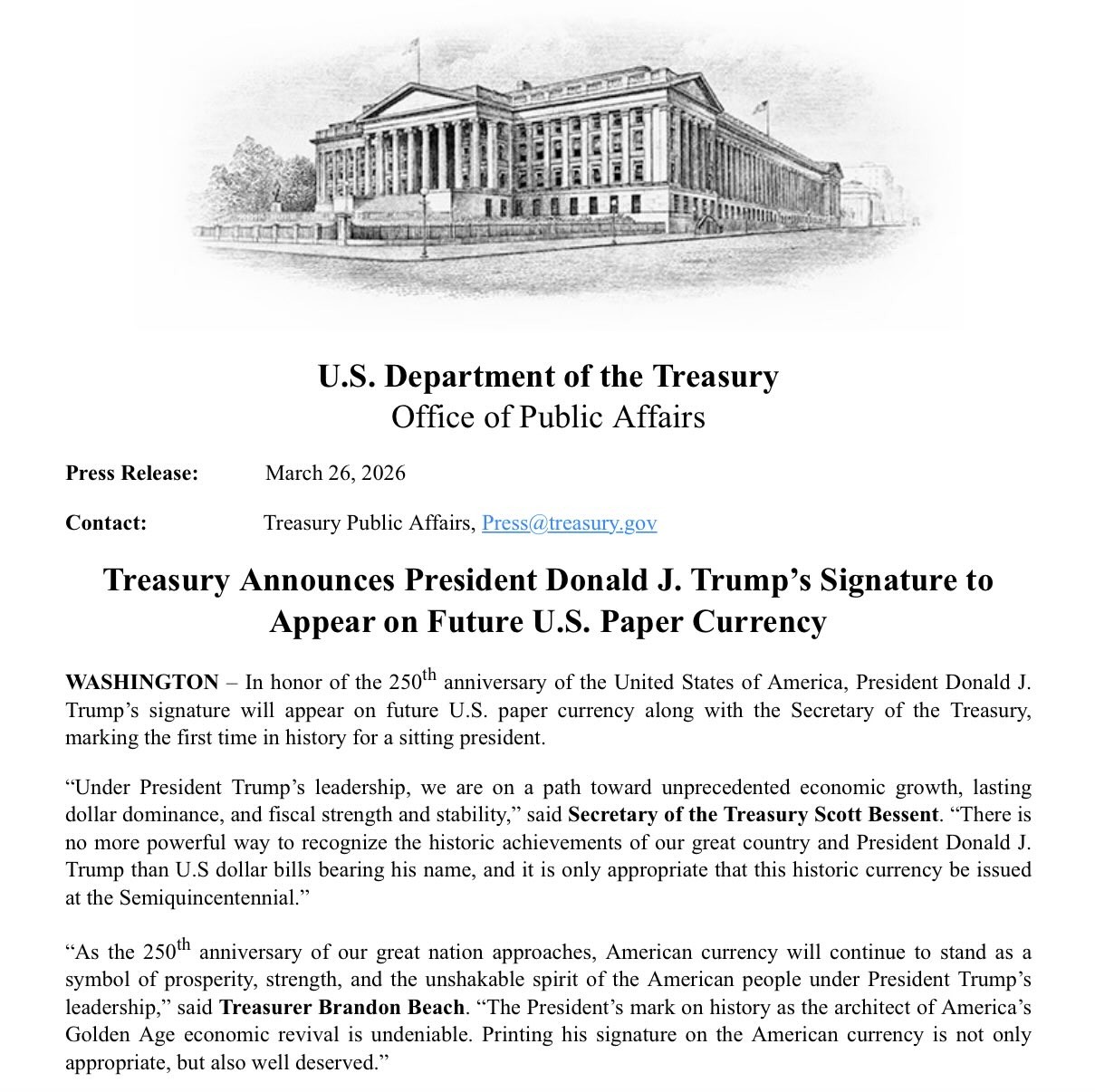
On March 26, 2026, the U.S. Treasury announced that newly printed American paper currency will carry President Donald J. Trump’s signature alongside Treasury Secretary Scott Bessent’s signature, marking the first time in history that a sitting president’s signature will appear on U.S. paper money.
Treasury framed the move as part of the country’s 250th anniversary celebration and tied it to what Bessent called “lasting dollar dominance.” (U.S. Department of the Treasury)
By itself, that would already be a historic headline.
But on its own, it does not explain what appears to be the deeper shift now underway: a new monetary architecture built around three pillars at once—hard reserve assets, digital-dollar rails, and symbolic rebranding of sovereign money.
That matters for investors, offshore thinkers, and anyone who still believes the dollar system of the last 50 years will simply continue unchanged.
The first pillar is already unmistakable: Bitcoin has entered the reserve conversation. In March 2025, the White House formally established a Strategic Bitcoin Reserve and a U.S. Digital Asset Stockpile. The executive order states that government bitcoin transferred into the reserve “shall not be sold” and will be maintained as a reserve asset of the United States. The same order describes Bitcoin as “digital gold,” cites its fixed 21 million supply, and directs Treasury and Commerce to explore budget-neutral strategies for acquiring more. (The White House)
That is not rumor. That is not market chatter. That is federal policy.
The second pillar is the digital dollar. The GENIUS Act created the legal framework for payment stablecoins in the United States, and regulators are now racing to finish the rulebook. The OCC’s February 2026 notice says the law’s effective date is the earlier of January 18, 2027, or 120 days after final regulations are issued, while the implementing regulations themselves are due by July 18, 2026. (Swift)
That distinction matters. July 18 is not the full activation date of the entire system, but it is a critical regulatory milestone. It means Washington is putting legal plumbing in place for dollar-linked digital instruments that can circulate far beyond the legacy bank wire model. At the same time, Swift says it is working with more than 40 financial institutions to add a blockchain-based ledger to its infrastructure, with the first use case focused on 24/7 cross-border payments. (Swift)
Read that again slowly.
The United States is building the legal foundation for regulated digital dollars while the world’s dominant financial messaging network is building infrastructure for always-on cross-border value transfer. That does not prove some master plan. But it does show that the old monetary rails are being upgraded in real time.
Then there is the gold question.
This is where confirmed fact ends and informed speculation begins.
The U.S. Mint states that Fort Knox holds 147.3 million ounces of gold and that this gold remains carried on the books at $42.22 per ounce, a statutory valuation unchanged since 1973, even though market gold is now above $4,000 per ounce. (United States Mint)
That accounting mismatch is enormous. It is one reason gold keeps returning to the center of monetary debate. Around the world, central banks have continued buying bullion at historically elevated levels, with the World Gold Council reporting durable official-sector demand through 2025 even after multiple record years, and Reuters noting that central-bank buying remains a major structural force in the market. (World Gold Council)
No official U.S. announcement has confirmed a gold revaluation. No public evidence proves a gold-linked Treasury instrument is imminent. But the gap between book value and market value is real, and so is the incentive for analysts to keep watching.
The symbolism has also become impossible to ignore.
On March 19, 2026, a federal arts panel unanimously approved a 24-carat commemorative gold coin featuring Trump’s image as part of the semiquincentennial coin program. Reuters reported that the U.S. Mint will finalize the coin’s dimensions, with discussion reaching as large as three inches in diameter, and noted that critics raised legal and democratic concerns even as supporters defended the design as appropriate for the 250th anniversary. (Reuters)
A week later came the paper-currency announcement.
Put those events together and the message becomes clearer: the administration is not only changing policy, it is also changing the visual language of money. Bitcoin is being treated as a sovereign reserve asset. Stablecoin law is being finalized. Cross-border payment infrastructure is being digitized. Gold is being reintroduced into the public imagination. And newly printed U.S. bills will now bear the signature of the president himself. (The White House)
For offshore investors, this is the real takeaway: monetary transitions do not happen in a single speech. They happen through legislation, executive orders, regulatory deadlines, reserve policy, settlement infrastructure, and symbols. One layer at a time.
July 4, 2026 now looks less like a mere anniversary and more like a stage point in that transition. America250 says July 4 will mark the nation’s 250th birthday, while official Sail4th planning describes the New York celebration as the defining event of the semiquincentennial, including the largest peacetime maritime gathering in American history. (America250)
Whether Washington uses that window for a bigger monetary announcement remains unknown.
But investors should not miss what is already visible in public documents: America is reinforcing dollar power not by returning to the old system unchanged, but by layering new reserve logic, new digital rails, and new monetary symbolism on top of it. (U.S. Department of the Treasury)
The money is changing.
The question is not whether change is underway.
The question is how far it goes.
Leave a Reply