
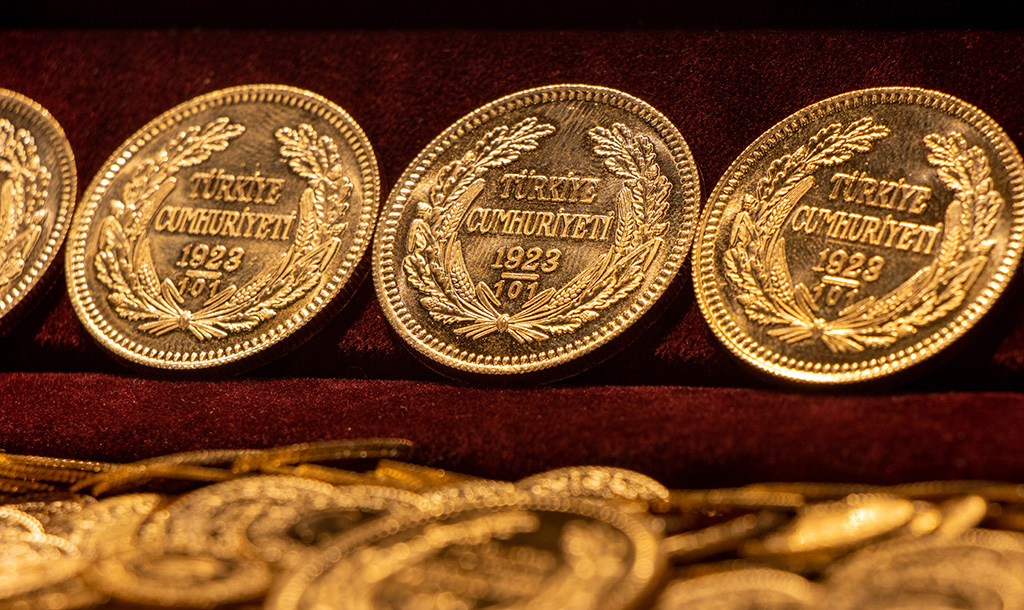
Turkey’s central bank has turned its gold reserves into a front-line currency defense tool, and the scale of the move is hard to ignore. In the week reported on March 26, the Central Bank of the Republic of Türkiye’s gold reserves fell by almost 50 tonnes to 772 tonnes, the biggest weekly drop since August 2018. Reuters reported that bankers estimated roughly 22 tonnes were sold outright and about 31 tonnes were used in gold-backed lira and foreign-exchange swaps, as Ankara fought to stabilize markets after the Iran war sent shockwaves through energy prices, inflation expectations, and demand for dollars. (Reuters)

What looked dramatic a week ago now looks like only the opening act. On April 2, Reuters reported that Turkey’s gold reserves dropped another 69.1 tonnes to 702.5 tonnes in the latest week, bringing the two-week decline to more than 118 tonnes. Bankers estimated that about 26 tonnes were sold and another 42 tonnes were used in swap transactions. That makes the reserve drawdown not just a mid-March event, but a rolling intervention that has rapidly become the largest weekly fall in Turkey’s international-standard gold reserves since at least 2013, when the central bank began publishing the data series. (MINING.COM)
Why would a country dump or encumber so much gold so quickly? Because the lira is under pressure, energy is more expensive, and Turkey is especially exposed to imported inflation. Reuters reported on March 30 that Turkey’s total reserves had fallen by roughly $55 billion since the war began a month earlier. Authorities have responded by halting the easing cycle, raising overnight rates to 40%, tightening liquidity, and leaning on both foreign-currency sales and gold operations to keep the financial system from buckling under the strain. Inflation was reported at 31.5% in February. (Reuters)
The surprise is not that Turkey sold gold. The surprise is that gold did not simply collapse in a straight line under the weight of official-sector selling. Yes, the metal has been hit hard. Reuters reported that spot gold was down more than 14% in March, putting it on track for its worst monthly performance since 2008, and another report said prices had fallen 17% since the Iran war began on February 28. But that is only half the story. On March 17, gold still held near $5,004 an ounce as traders balanced safe-haven buying against inflation and rate fears, and on April 1 it rebounded to about $4,784 as the dollar softened and markets reassessed the path of the war. (Reuters)
That matters because it tells us the gold market is doing two things at once. On one side, higher oil prices and war-driven inflation fears are pushing investors toward the dollar and forcing markets to price in tighter monetary conditions, which hurts non-yielding assets like gold. On the other side, the same geopolitical instability keeps safe-haven demand alive. Gold has not behaved like a simple fear trade. It has behaved like a battleground between liquidity stress and long-term mistrust of fiat vulnerability. (Reuters)
There is another structural force underneath the market: central banks still want gold. The World Gold Council said central banks bought a net 863 tonnes in 2025, well above the 2010–2021 annual average, and said persistent economic and geopolitical uncertainty is likely to keep demand going through 2026. Reuters also noted earlier this year that central banks remained strong buyers as they diversify reserves and reduce reliance on the U.S. dollar. In other words, Turkey may be a forced seller, but it is selling into a market where many official buyers still see bullion as strategic insurance. (World Gold Council)
That is the real Invest Offshore angle here. When a major emerging-market central bank starts unloading gold to defend a currency, it should have crushed confidence in bullion. Instead, the market absorbed it, wobbled, and kept trading. That suggests the buyer on the other side is not weak hands chasing a headline. It is deeper capital: reserve managers, sovereign allocators, long-horizon institutions, and private wealth that increasingly sees gold not as a relic, but as collateral for a more fractured world order. The chart may show Turkey’s reserves plunging, but the broader message is that somebody was ready to take that gold off the market. That is not bearish. That is redistribution. (MINING.COM)
Turkey’s gold drawdown is therefore more than a story about one central bank defending one currency. It is a stress test for the entire monetary system. If governments under pressure must mobilize bullion to buy time, and if the market still finds buyers for that bullion, then gold remains exactly what it has always been in moments of crisis: the asset nations reach for when confidence in paper starts to fray.
At Invest Offshore, we continue to track the intersection of sovereign stress, hard assets, and cross-border opportunity. We also have investment opportunities in West Africa seeking investors for the Copperbelt Region, where real assets and long-cycle resource exposure remain central to the next global capital rotation.
Leave a Reply