
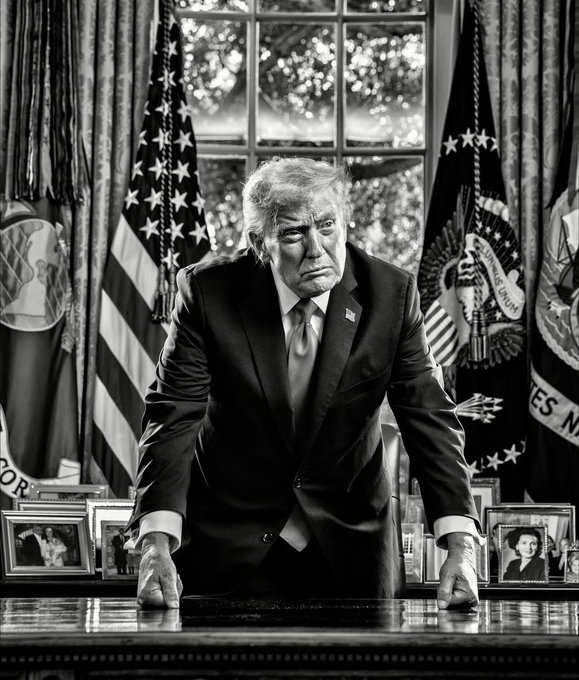
President Trump used a phrase this week that hit markets, diplomats, and political observers like a flare in the night: America’s military, he said, was “loading up and resting, looking forward … to its next conquest.” He made the remark while warning that U.S. ships, aircraft, and military personnel would remain in and around Iran until what he called the “REAL AGREEMENT” was fully complied with, and while insisting that the Strait of Hormuz must remain open and secure. (Reuters)
That matters because the line did not arrive at the end of a clean, settled victory lap. Reuters and AP both describe the ceasefire as fragile, with deep disagreement still hanging over uranium enrichment, freedom of navigation, and whether the Strait of Hormuz is truly reopening in any durable sense. AP reported that Iran had again closed the strait in response to Israeli attacks in Lebanon, while Reuters noted that Tehran emerged from the nearly six-week war damaged but still in control of key levers of regional pressure. (Reuters)
So no, the cleanest reading is not “Iran is done.” The regime did not collapse. Reuters reported that Iran’s leadership remains in control, its leverage over Hormuz has increased, and the broader settlement is still unresolved. That is exactly why Trump’s wording landed so heavily: not because it proved a hidden script, but because it suggested Washington may see the military phase as incomplete and the strategic phase as ongoing. (Reuters)
This is where the financial angle gets interesting.

The strongest part of the market case is not the internet-code language around “Phase 2.” It is gold. The European Central Bank said that, at market prices, gold became the world’s second-largest reserve asset in 2024, behind only the U.S. dollar. Reuters later reported that foreign central banks now hold about $4 trillion in gold, slightly more than the roughly $3.9 trillion they hold in U.S. Treasuries, the first time since 1996 that gold has overtaken Treasuries in that way. That is not the same as gold “dethroning the dollar,” but it is still a profound signal. (European Central Bank)
Why are central banks doing this? The answers are not mystical. They are geopolitical. Reuters reported this week that reserve managers now rank geopolitical tension as their top global risk, and nearly 40% of central banks surveyed are considering adding more gold. China, meanwhile, has continued buying gold for 17 straight months, even after the metal’s sharp price swings. Gold is being treated less as a trade and more as a strategic reserve in a world that increasingly distrusts seizure risk, sanction risk, debt expansion, and political volatility. (Reuters)
That does not prove an imminent gold-backed reset. It does, however, prove that the custodians of global reserves are repositioning for a more fragmented monetary order. Reuters has also reported that BRICS discussions continue to revolve around payment-system interoperability and reduced reliance on the dollar, including proposals to link digital-currency systems and expand local-currency settlement. Even so, the evidence points to gradual diversification, not an overnight replacement of the dollar and not a single unified BRICS currency suddenly taking over. (Reuters)
So what should investors hear when Trump says “next conquest”?
They should hear a political message first, not a prophecy. But they should also hear a deeper truth about the era we are entering. The contest now is not only over territory, missiles, and sea lanes. It is over reserves, payment rails, sanctions power, central bank credibility, and which assets cannot be diluted, frozen, or printed into oblivion. On that battlefield, gold is already moving. Central banks are already repositioning. The dollar is still on top, but its uncontested supremacy no longer looks as eternal as it once did. (European Central Bank)
That is why Trump’s phrase resonates beyond the war itself. The more grounded interpretation is not that the Federal Reserve has become a military target. There is no evidence of that in the reporting. The stronger interpretation is that the postwar struggle is increasingly financial: who controls the pipes, who sets the collateral, who holds the trust of reserve managers, and what asset sits at the center when faith in paper promises starts to thin. (Reuters)
Iran may have been one chapter. But the next great contest could indeed be monetary.
And in that contest, the smart money is already moving.
Leave a Reply